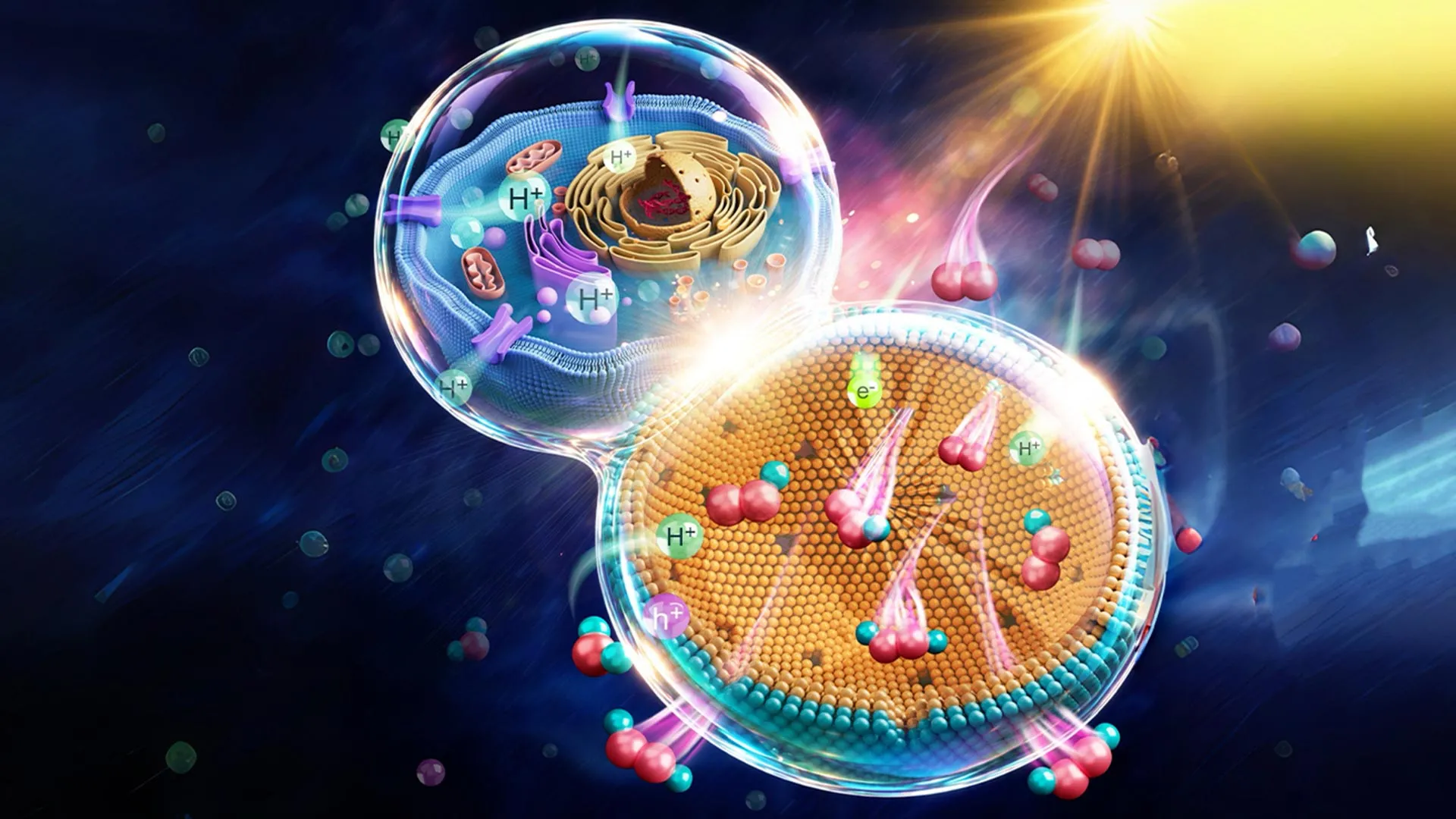
Researchers have created a hollow CdS@polydopamine nanoreactor that imitates two important features of living cells. The design offers a new way to reproduce some of the highly organized chemical functions of cells inside synthetic nanomaterials.
The findings were published in the Journal of the American Chemical Society. The research was led by Prof. LI Can at the Dalian Institute of Chemical Physics (DICP) of the Chinese Academy of Sciences (CAS), in collaboration with Prof. Jian Liu's team at Inner Mongolia University.
Recreating Cellular Chemistry at the Nanoscale
Living cells carry out complex biochemical reactions with exceptional efficiency and precision. They achieve this by arranging different components within tightly controlled spaces, where molecules can move, interact, and react under carefully regulated conditions.
Scientists are now attempting to apply these same principles to engineered nanomaterials. This field, known as nanocell engineering, seeks to create cell-like structures with specialized surfaces and internal pores or cavities. These synthetic systems, often called nanoreactors, bring together ideas from cell biology and nanotechnology.