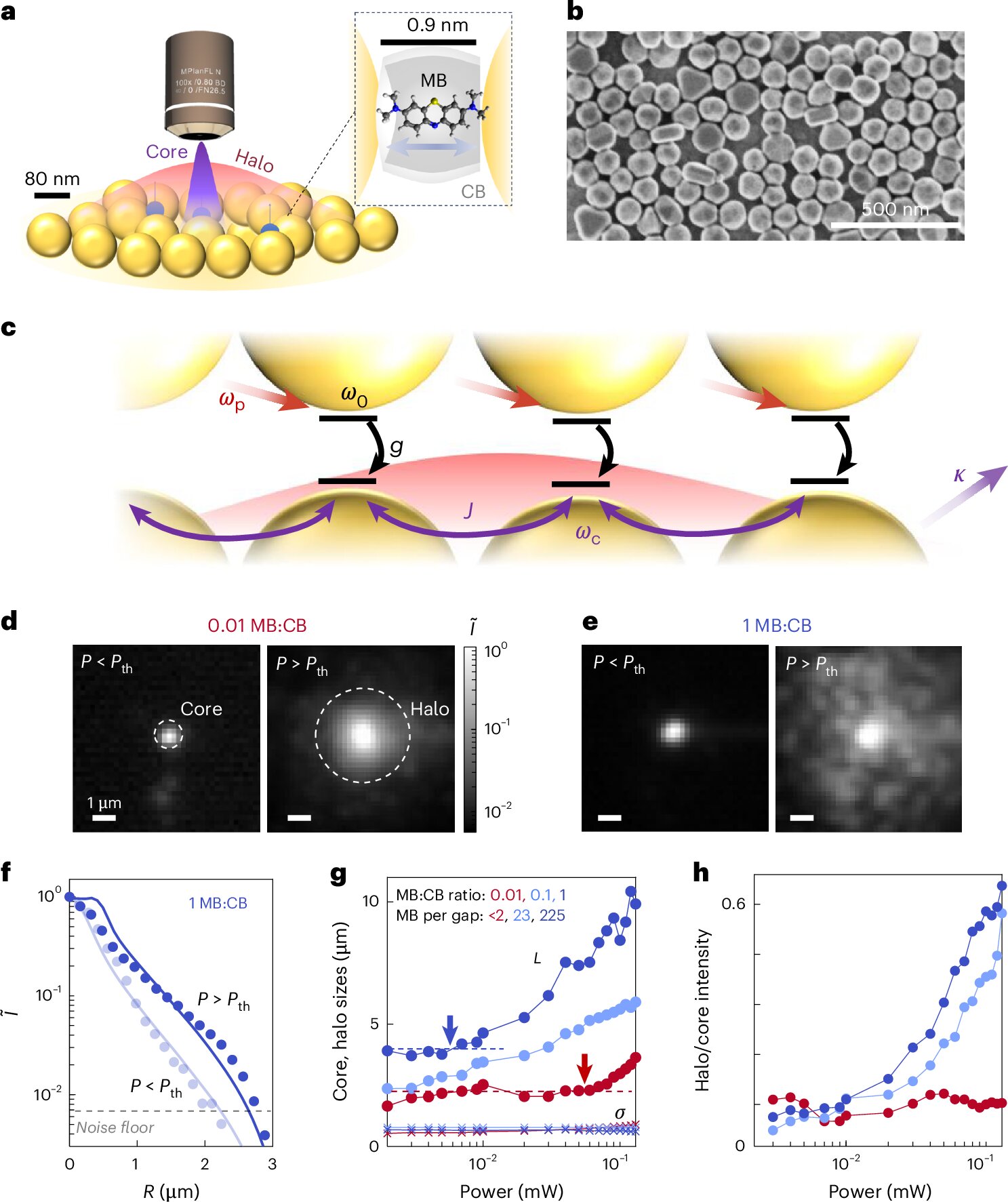
Synchronization of dipoles in plasmonic nanogaps. Credit: Nature Nanotechnology (2026). DOI: 10.1038/s41565-026-02242-w
What if glowing molecules could synchronize, much like fireflies flashing in unison? Researchers have discovered that molecules confined within tiny gold nanostructures can behave collectively, coordinating their interactions even under conditions where this was previously thought impossible. The finding challenges long standing assumptions about how optical coherence forms and opens new possibilities for highly sensitive sensors, molecular photonics, and future quantum technologies capable of operating at room temperature.
Optical coherence describes a state in which light—or the molecules producing it—behaves in a highly coordinated way. It is the principle behind technologies such as lasers, advanced imaging systems and quantum communication. Traditionally, scientists believed this kind of coordinated behavior required specially designed optical cavities that trap light for relatively long periods.
Collective behavior in leaky cavities
In the new study, published in Nature Nanotechnology, researchers showed that molecules confined inside tiny gaps (known as plasmonic cavities) between gold nanoparticles can synchronize their behavior even though light escapes from the system extremely quickly. This finding could contribute to a new way to build synchronized states of matter like superfluids at room temperature and could potentially be applied to advanced sensing, molecular photonics and quantum devices.