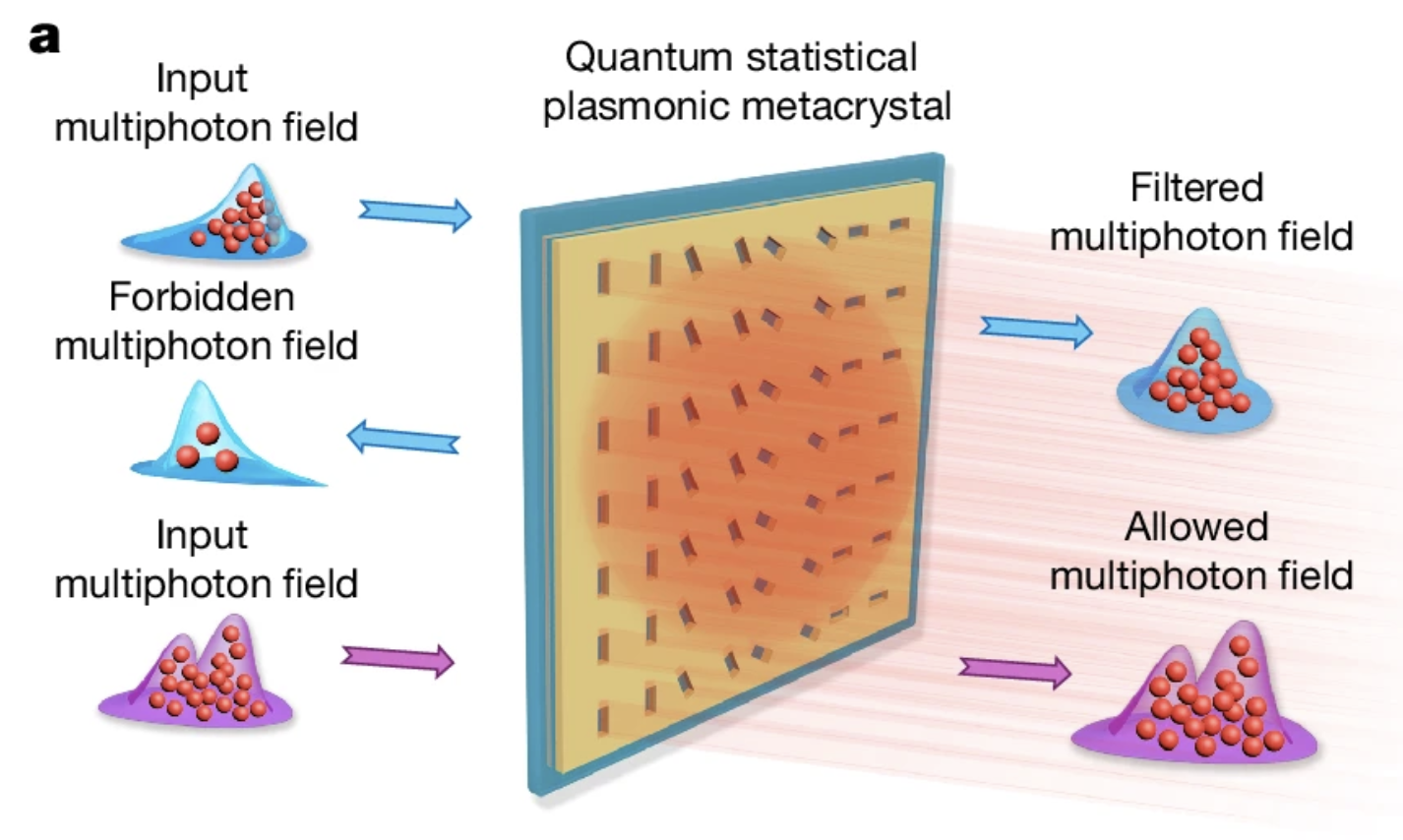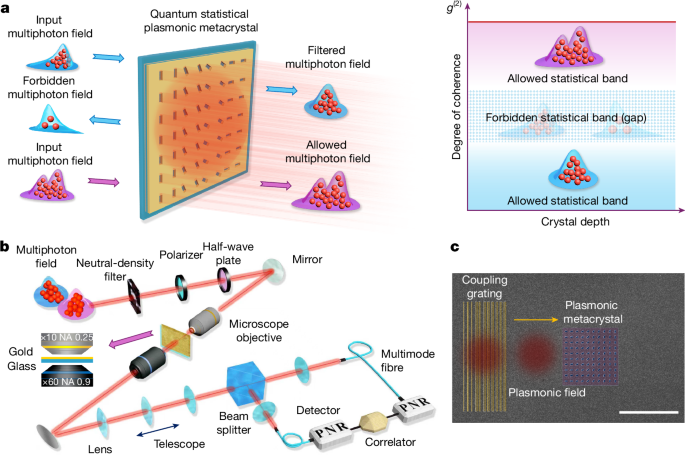
MainThe modern world has been shaped by semiconductor technologies, grounded in the intrinsic band structures of materials and in our ability to engineer those structures with precision6,7. Similarly, the emergence of photonic crystals four decades ago not only transformed the field of optics but also laid the groundwork for compact quantum technologies8,9. The possibility of replacing bulky optical set-ups with two-dimensional nanostructures, typically referred to as metasurfaces, has stimulated widespread interest in exploring their potential for the preparation, manipulation and detection of quantum light fields3,10. However, most implementations so far have focused on integrating single-photon emitters with metasurfaces and manipulating several degrees of freedom, such as frequency, polarization and orbital angular momentum2,11,12,13,14,15. Similar efforts have also been reported for entangled photon pairs14,16,17. Yet, given the enormous implications that controlling larger multiparticle systems on metasurfaces would have for scalable quantum technologies, numerous continuing efforts aim to demonstrate this capability2,3,18. Nevertheless, this goal has remained elusive so far.Interest in multiphoton quantum systems originates from the complex interference phenomena they can host19,20,21,22, which are particularly valuable for quantum information technologies14,23,24,25. The nature of these interference processes depends on the quantum coherence properties of the multiphoton system, which are, in turn, determined by the quantum statistical characteristics of the corresponding light fields19,21,26,27. These fundamental properties define different kinds of light, such as single photon sources, coherent light and thermal light21,28,29. Unlike other degrees of freedom, such as polarization or frequency, which can be investigated and filtered using photonic metasurfaces2,3, the statistical properties of multiphoton systems cannot be directly accessed. So far, their identification has required characterizing the collective behaviour of the entire multiphoton system21,25,29. Consequently, no material has yet been shown to exhibit sensitivity to the statistical fluctuations or coherence properties of multiphoton systems. As a result, the implementation of operations based on the quantum coherence of multiphoton systems has remained unattainable so far.Here we introduce, to our knowledge, the first class of room-temperature quantum materials that are intrinsically sensitive to the quantum statistical properties defining all forms of light. In close analogy with the emergence of allowed and forbidden bands in semiconductors and photonic crystals, the meta-atoms composing quantum statistical plasmonic metacrystals result in quantum statistical bands that enable selective transmission of light according to its quantum coherence28. We show that the response of these plasmonic metacrystals is governed by the geometry of the constituent meta-atoms and by their collective arrangement within the crystal lattice30. As a result, many-particle interactions mediated by the plasmonic metacrystal suppress forbidden quantum statistical fluctuations, which cannot propagate through the metasurface, whereas multiphoton fields supported by allowed statistical bands propagate robustly and without distortion. These statistical bands therefore enable the controlled transport of otherwise fragile multiphoton quantum states. The demonstration of the first room-temperature quantum material intrinsically sensitive to the quantum coherence of many-body systems has direct implications for improving the efficiency of energy-harvesting processes, which are fundamentally influenced by the coherence properties of light31,32,33,34. The ability to control these properties using a coherence-sensitive materials platform operating under ambient conditions opens transformative opportunities for solar energy conversion and the development of next-generation optoelectronic devices5,31,32. More broadly, our approach lays the groundwork for robust many-body quantum technologies operating beyond cryogenic environments1,3,5,18,22,23,30,35.Sharing similarities with the formation of allowed and forbidden bands in semiconductors and photonic crystals, the repeating arrangement of meta-atoms in our plasmonic metacrystal results in multiparticle interference processes that are sensitive to the statistical fluctuations defining different kinds of light22,26,27. As illustrated in Fig. 1a, these processes establish allowed and forbidden quantum statistical bands whose emergence depends on the geometry of the plasmonic metacrystal. This response enables the first kind of optical materials that are sensitive to the quantum statistical properties of light. We characterize the quantum statistical fluctuations of multiphoton fields using the degree of second-order coherence, \({g}^{(2)}(0)=1+(\langle {(\Delta \hat{n})}^{2}\rangle -\langle \hat{n}\rangle )/{\langle \hat{n}\rangle }^{2}\), in which \(\hat{n}\) is the photon-number operator and \(\Delta \hat{n}=\hat{n}-\langle \hat{n}\rangle \) denotes the photon-number fluctuation operator21,28,29. Notably, our plasmonic metacrystal transmits multiphoton fields whose degrees of coherence fall within the allowed statistical bands, whereas fields lying in forbidden bands are filtered and thermalized until their statistics converge to the nearest allowed band. In general, this transmitted multiphoton field can be described as an average over transverse spatial configurations Σ as $${\hat{\rho }}_{{\rm{out}}}=\int {\rm{d}}{\varSigma \bigotimes }_{i,j}|{\alpha }_{0}\rangle {\langle {\alpha }_{0}|}_{{\theta }_{{ij}},{\varSigma }_{{ij}}}.$$
Quantum statistical plasmonic metacrystals - Nature
A new class of materials, quantum statistical plasmonic metacrystals, is described, which can selectively transmit different types of light based only on their quantum coherence, showing bands of allowed and forbidden photon statistics.
6,204 words~28 min read