Researchers at the City College of New York are charting a fast-growing area of quantum science centered on materials only a few atoms thick. In these systems, light, electric charge, and magnetism are closely connected rather than behaving independently.
The work comes from physicist Vinod M. Menon's Laboratory for Nano and Micro Photonics (LaNMP). Researchers believe these unusual interactions could eventually support advanced optoelectronic devices and quantum technologies that manipulate light, charge, and electron spin together.
When Light and Magnetism Interact
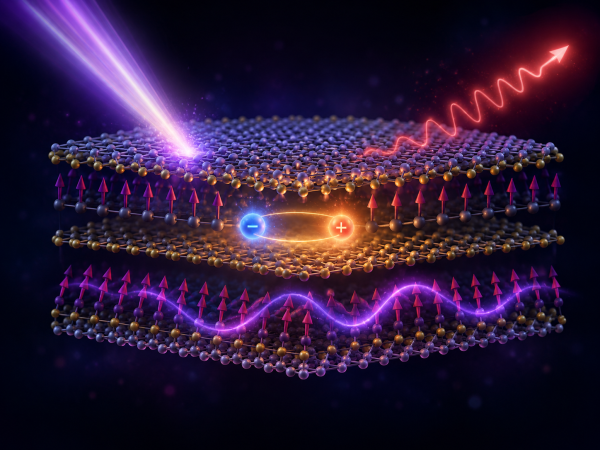
In a review published in Nature Materials, titled "Excitons in van der Waals magnetic materials," the researchers examine recent progress involving layered magnetic semiconductors. These materials allow light-generated excitations called excitons to interact with magnetic order and with magnetic waves known as magnons.
An exciton forms when incoming light energizes an electron and causes it to move, leaving behind a positively charged "hole." The electron and hole remain linked, forming an electrically neutral particle that can still interact strongly with light. Magnons are different. They are collective waves that travel through the organized magnetic structure of a material.