view more
In this study, researchers investigated the photocurrent response of a bilayer atomically thin antiferromagnet. In this material, spins are aligned within each atomic layer, while the spin orientations of the top and bottom layers are opposite. Depending on the relative spin configuration between the two layers, the system exhibits two distinct antiferromagnetic (AFM) states (Fig. 1a).
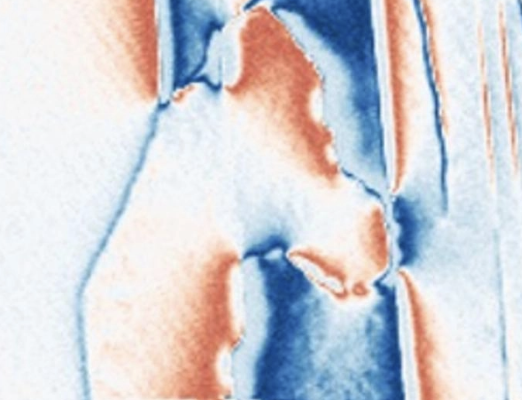
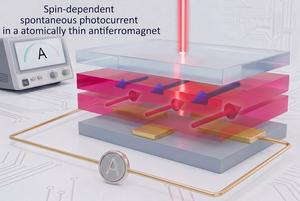
To explore how these magnetic states interact with light, the researchers fabricated devices by attaching electrodes to bilayer samples and illuminated the center of the material, away from the electrodes. They measured both the zero-bias photocurrent and current–voltage characteristics under illumination. The experiments revealed that no electrical current flows in the absence of AFM order. In contrast, when the system is in an AFM state, illumination alone generates a finite current even without any applied voltage. Moreover, the direction of the photocurrent reverses between the two AFM states (Fig. 1b), directly reflecting the magnetic configuration of the material.
The researchers further showed, using a theoretical model, that the observed photocurrent behavior—including its dependence on photon energy—can be explained by the quantum geometric properties of the electronic wavefunctions. This identifies a previously unexplored mechanism for photocurrent generation in magnetic materials.