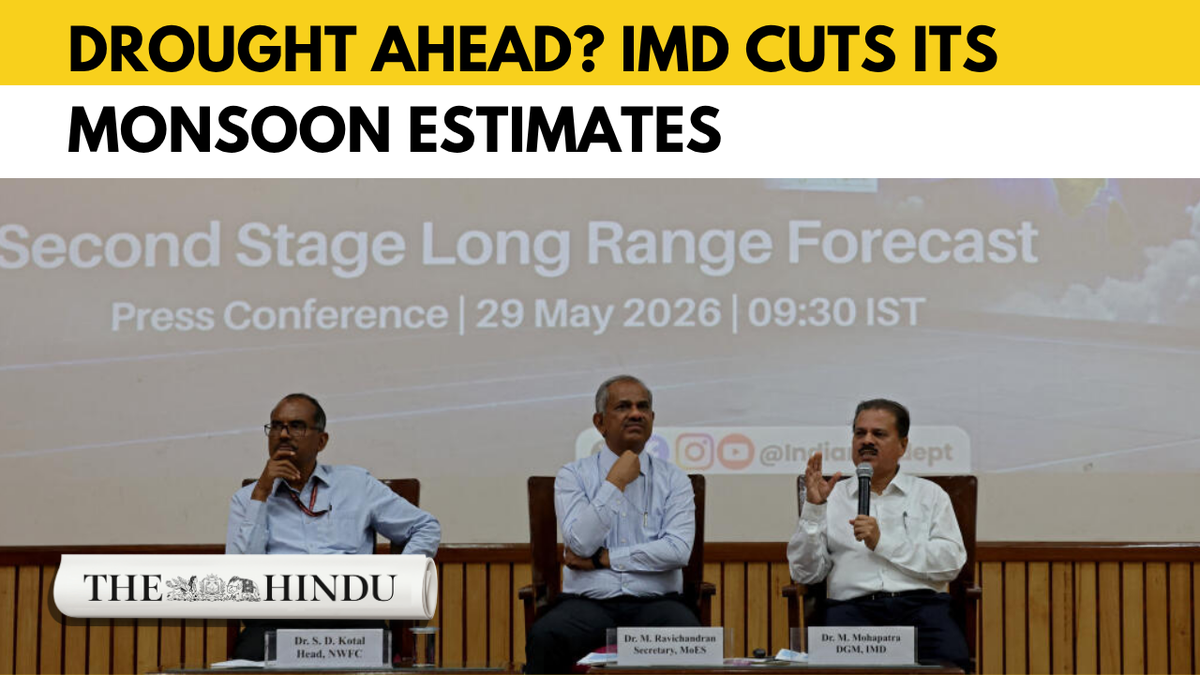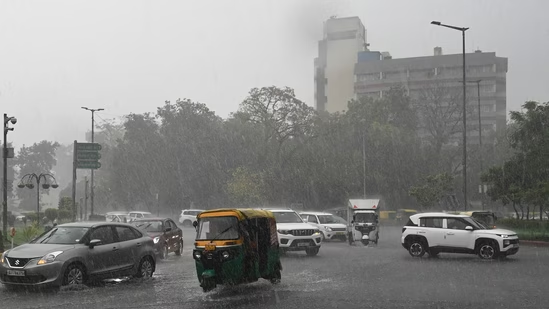
The prospect of an El Nino developing this year was already evident before IMD issued its April 13 forecast. The India Meteorological Department (IMD) said on May 29 that the June-September monsoon season will see “below normal” rainfall this year, a category defined as rainfall below 96% of the Long Period Average (LPA), or the average rainfall recorded during 1971-2020. The direction of the May 29 forecast – the second and final pre-season forecast – was the same as the first pre-season forecast issued on April 13. However, expected rainfall was revised down from 92% of LPA to 90%. How accurate are IMD’s pre-season forecasts, and why did it lower its rainfall estimate? Here are three charts that answer these questions.Sudden downpour over the weekend significantly brought down the mercury in New Delhi. (Arvind Yadav/ HT Photo)How to read IMD's 2026 monsoon forecastIMD’s El Nino forecasts have historically had the lowest accuracy, but there appears to be some improvement recently As HT explained in a two-part series last week, one factor with a strong influence on the monsoon is conditions in the Pacific Ocean. Warmer-than-normal temperatures in the central-eastern equatorial Pacific Ocean (called El Nino) suppress monsoon rains, while cooler-than-normal temperatures (called La Nina) enhance monsoon rains. A developing El Nino is a big reason the IMD has predicted below-normal rainfall this monsoon. However, this must be read with the fact that the quantitative error in IMD’s forecast almost doubles in an El Nino year: from around 4-5% of LPA in La Nina or neutral conditions to around 9-10% in an El Nino year. There appears to be some improvement in the five-six (whether one counts a monsoon as an El Nino monsoon depends somewhat on how one defines it) El Nino-affected monsoon seasons since 2009. However, given this is a recent change, one will have to wait to see if the recent improvement means that IMD has overcome the challenges of predicting monsoon rains in an El Nino year.One error source could be forecasting Indian Ocean conditions… One possible reason IMD finds El Nino years harder to predict is that atmospheric conditions are significantly different during such years, since La Nina is just an enhanced version of neutral conditions. Another reason could be that factors besides El Nino affect the monsoon. One of these is the Indian Ocean Dipole (IOD), measured as the difference in sea surface temperatures in the western and eastern Indian Ocean. When IOD is positive with value of at least 0.4, there are tailwinds for the monsoon. When IOD is negative with value of at least 0.4, there are headwinds for the monsoon. Values between -0.4 or 0.4 are considered neutral and may not influence the monsoon. As this suggests, a positive IOD can counter some of the headwinds (proverbial and in some ways literal) generated by an El Nino. When the IOD was positive in both June-August and July-September periods, the three-month periods that cover the monsoon season, monsoon has been near-normal or above normal in the El Nino affected monsoon years since 1988, the period analysed above.…which is also the reason for the update in 2026 monsoon’s forecast The prospect of an El Nino developing this year was already evident before IMD issued its April 13 forecast. The main change since then is increased certainty that El Nino conditions will emerge as early as the May-July period. Even an El Nino that develops later, during November-January, can suppress monsoon rainfall. At the same time, the forecast for a positive IOD during the 2026 monsoon has been changing almost every week, with some forecasts suggesting a marginally positive IOD during the monsoon and some not. It is possible that IMD updated its forecast when a positive IOD had a low probability during the monsoon. The changing IOD forecasts also suggest that the monsoon can possibly spring a positive surprise on IMD’s gloomy forecast. Whether or not that happens, however, remains uncertain. Number TheoryUnlock a world of Benefits with HT! From insightful newsletters to real-time news alerts and a personalized news feed – it's all here, just a click away! -Login Now!See Less
How to read IMD's 2026 monsoon forecast | Number Theory
The prospect of an El Nino developing this year was already evident before IMD issued its April 13 forecast.
TL;DRAI
IMD cut its 2026 monsoon forecast to 90% of LPA, signaling below-normal rainfall as El Niño arrives by May–July. Forecast error doubles in El Niño years (~9% vs ~5% of LPA), adding material risk for India-exposed supply chains and climate-sensitive planning.
688 words~3 min read