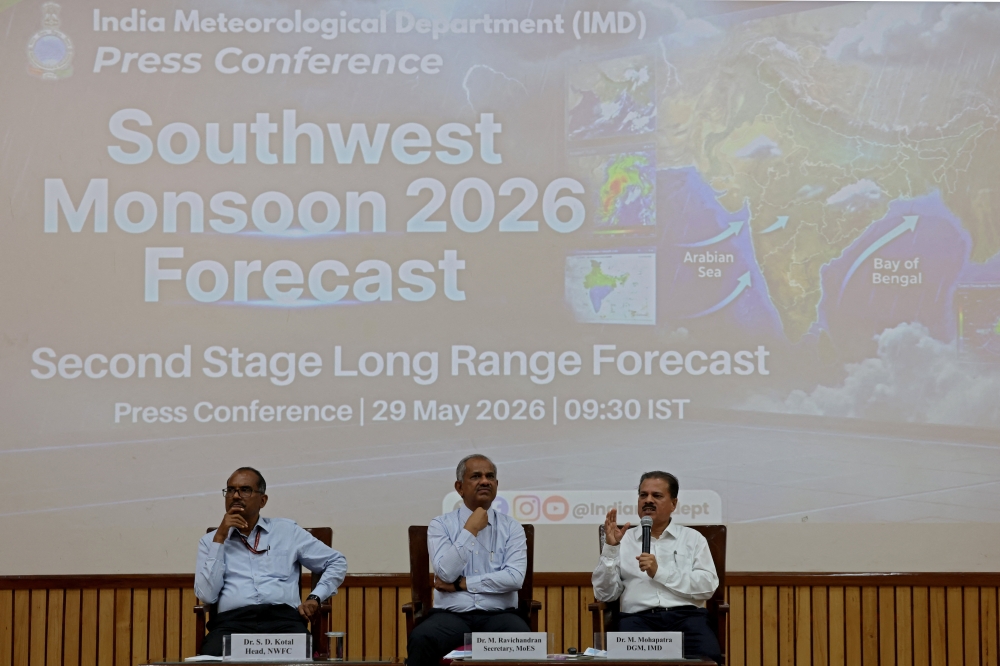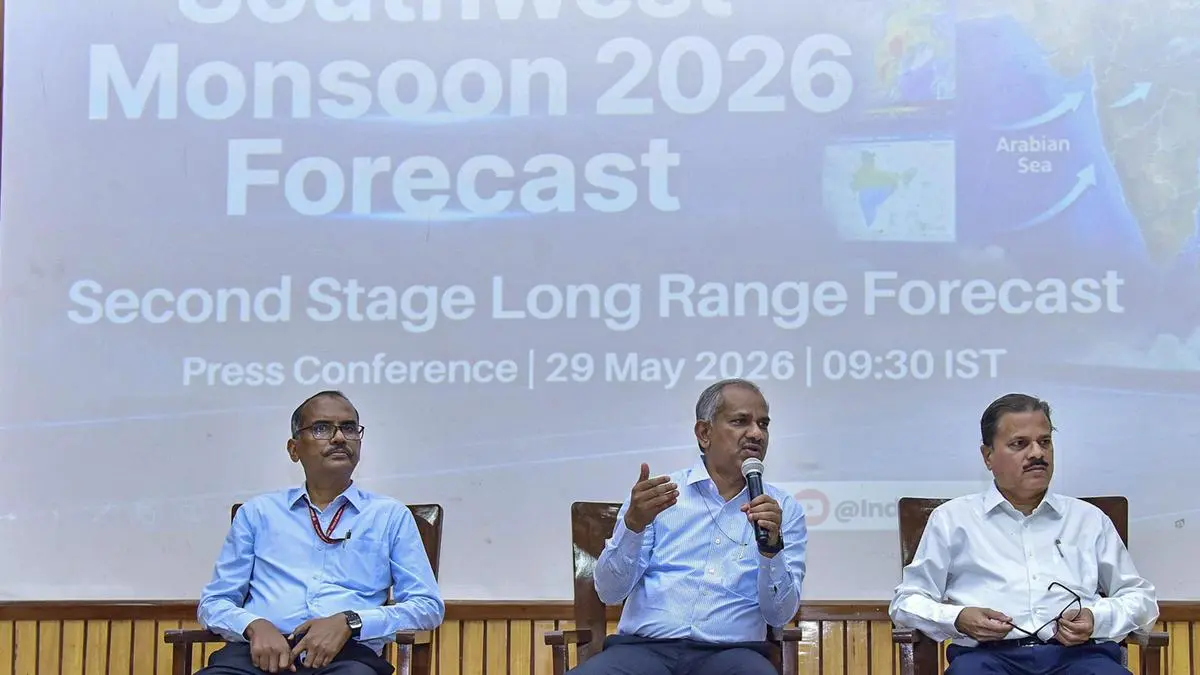
Ministry of Earth Sciences Secretary Dr M Ravichandran (centre) addressing a press conference on the Second Stage Long Range Forecast for Southwest Monsoon 2026, in New Delhi.
| Photo Credit:
The India Meteorological Department (IMD) on Friday scaled down its projection for the South-West Monsoon to 90 per cent of the long-period average (below-normal rainfall), leaving the country facing its driest weather in 11 years.The rainfall, taking into account the long-period average (LPA) or the average rain since 1971, will likely be the lowest since 2015. It could leave the country dry in most parts. In 2015, it was 86 per cent of the LPA, while in 2014, it was 88 per cent of the LPA. In 1991, IMD forecast the monsoon rain at 90 per cent of LPA. In 2023, the monsoon was 92 per cent LPA, which resulted in over a third of the country experiencing prolonged dry periods and drought. The lowering of the earlier forecast made in April, with IMD forecasting 92 per cent of LPA, comes even as the monsoon has run into an incoming western disturbance and lost its vigour.To set in next weekReleasing the second stage monsoon forecast for 2026, India Meteorological Department (IMD) Director General M Mohapatra said the monsoon, which accounts for over 75 per cent of the annual rainfall, is likely to emerge over the Kerala coast next week. Initially, the IMD had predicted the monsoon to set in on May 26 before it faced hurdles. The European Centre for Medium-Range Weather Forecasts (ECMWF) expects a trough developing from coastal Karnataka northwards to be sufficient to trigger moderate to heavy rainfall over central Kerala.The India Meteorological Department’s (IMD) numerical model guidance continues to indicate that monsoon onset may remain delayed until June 4–5. From June 8 to 15, the monsoon may lose some of its early momentum, with rainfall retreating largely to coastal Kerala and Coastal Karnataka. Below-normal in core areaThe IMD’s projection has an error margin of ±4 per cent. Mohapatra said the south, central, and northwest regions will have below normal rain, while the east and north-east meteorological sub-divisions may have normal precipitation (94-106 per cent of LPA) in the June-September monsoon season. Normal to above normal rainfall is likely to be seen in some areas of the north-west and eastern parts of the southern peninsula and adjoining areas of east-central India, he said.The IMD Director-General said that the monsoon core zone (MCZ), consisting of most of the rainfed agriculture areas in central India, is likely to be below normal, or less than 94 per cent of LPA.Heat for central, north-westOn the outlook for June, he said that the monsoon may be below normal, while the maximum temperature in most parts is likely to be above normal. “The average rainfall for the country as a whole during June 2026 is most likely to be less than 92 per cent of the LPA of 165.4 cm,” said Mohapatra.Also, normal to above-normal rainfall is likely over some parts of the north-west, south peninsula and isolated pockets of central India during June, he said. Quantitatively, the rainfall is likely to be less than 94 per cent in central and southern regions, while mostly irrigated north-west India may have below 92 per cent of LPA.During June 1-7, rain bands may spread into south Goa in the north and eastward along the Western Ghats into adjoining Tamil Nadu, including central parts and north coastal districts, while Rayalaseema and parts of Telangana could also receive helpful showers early into the season.Meanwhile, central and North-West India are likely to endure a renewed spell of heat and dryness. Southern Gujarat, western Madhya Pradesh and adjoining south Uttar Pradesh may face particularly harsh conditions.(With inputs from Vinson Kurian, Thiruvananthapuram)Published on May 29, 2026