OpenAI has disclosed that an internal model generated a proof disproving the Erdős unit-distance conjecture, a long-standing question in discrete geometry. The result, announced on May 20, 2026, was subsequently checked by external mathematicians and presented with accompanying mathematical commentary. It is a notable, but carefully bounded, example of AI-generated reasoning contributing to frontier mathematics.
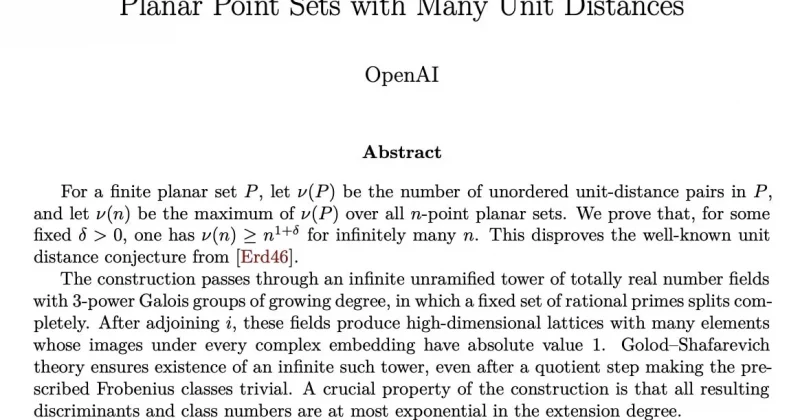
According to OpenAI's announcement on the discrete geometry result, the conjecture concerned the number of pairs of points at unit distance that can occur in point sets. The company says its internal model found a construction showing that, for infinitely many values of n, point sets can contain substantially more unit-distance pairs than constructions associated with the conjecture's previously believed upper-bound behavior.
The central significance is not simply that an AI system produced mathematical text. OpenAI says the output was turned into a proof whose key steps were examined by mathematicians outside the company. A companion remarks document, prepared by members of the mathematical community, supplies a human-oriented presentation of the argument, historical context, and discussion of the result's methods. That human verification is essential: a plausible-looking derivation is not a mathematical result until its reasoning can withstand expert scrutiny.