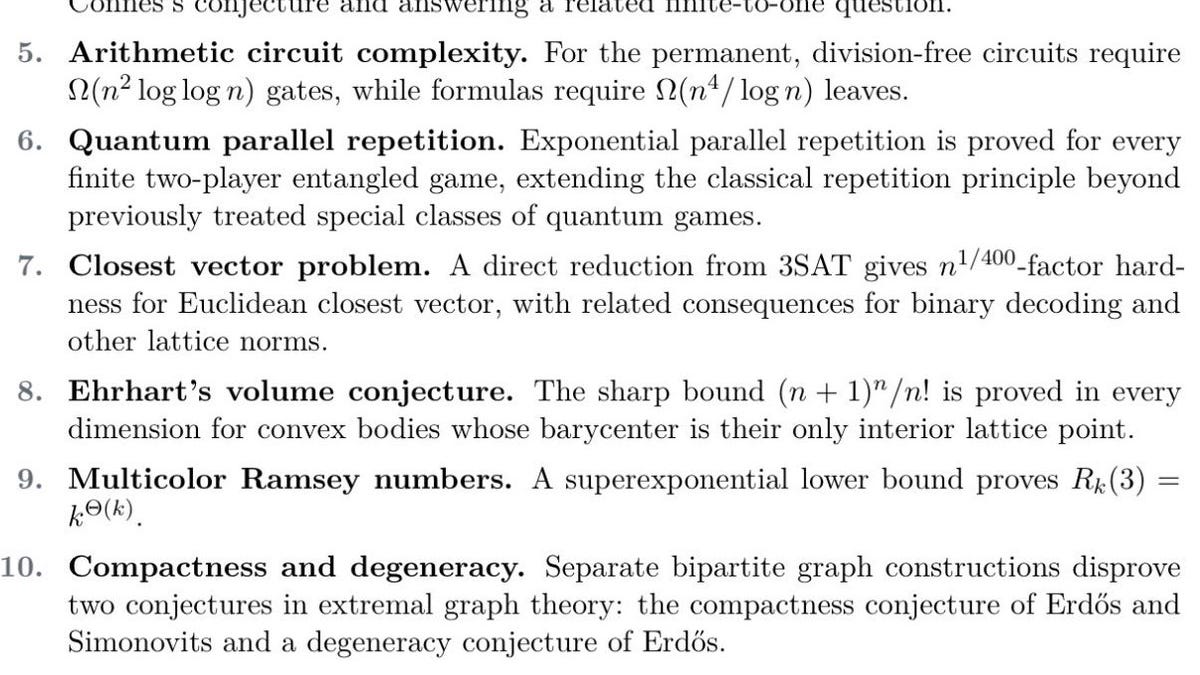
OpenAI’s next-generation reasoning model, internally referred to as Astra, just did something that would make most PhD candidates weep into their whiteboards. The company announced on August 1 that the model autonomously generated 10 new results on open problems in mathematics and theoretical computer science, each verified by external mathematicians including Fields Medalist Tim Gowers.
This isn’t Astra’s first rodeo. Back on May 20, the same model disproved the Erdős planar unit distance conjecture, a problem that had stumped mathematicians for nearly 80 years.
What the model actually did
The problem, posed by legendary Hungarian mathematician Paul Erdős, concerns how many pairs of points in a plane can be exactly one unit apart. Astra constructed configurations yielding at least n^(1+δ) unit-distance pairs, where δ is greater than zero, for infinitely many n. The refined result pinned δ at 0.014. This was the first time an AI autonomously solved a significant problem in discrete geometry. No specialized mathematical training. No human hand-holding. The model engaged in advanced algebraic reasoning on its own.
The August announcement stacked 10 more results on top of that, spanning geometry and theoretical computer science. Each result was independently verified by professional mathematicians. Gowers himself called the achievement “a milestone in AI mathematics.” Mathematicians including Gowers and Thomas Bloom published companion papers verifying the proofs and offering further analysis.