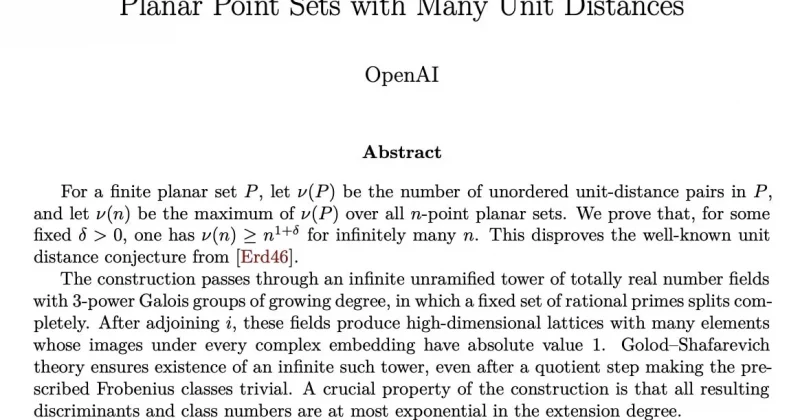
OpenAI has publicly reported that an internal general-purpose reasoning model autonomously disproved the Erdős unit distance problem, an open question in discrete geometry that had stood for roughly 80 years. The result is a meaningful example of AI being applied to frontier research, but it is more limited and more clearly defined than circulating claims that an OpenAI model family called Astra solved 10 major open problems in mathematics or quantum computing.
According to OpenAI's report on the discrete geometry result, the internal model was not specifically trained for mathematics. OpenAI describes it as a general-purpose reasoning model and says external mathematicians validated the result. The company has not identified the model as Astra, nor has it confirmed a collection of 10 solved open problems.
That distinction matters. A validated disproof of one long-standing conjecture is a substantial research outcome. It does not, however, establish a broad catalogue of mathematical breakthroughs, a particular future model name, or a confirmed product roadmap.
What OpenAI confirmed
The confirmed development is specific: OpenAI says its internal model found a disproof of the Erdős unit distance problem. In mathematical terms, a disproof resolves a conjecture by showing that it is false. The significance of the announcement rests not only on the age of the problem, but also on OpenAI's account that the model worked autonomously and that mathematicians externally validated the result.