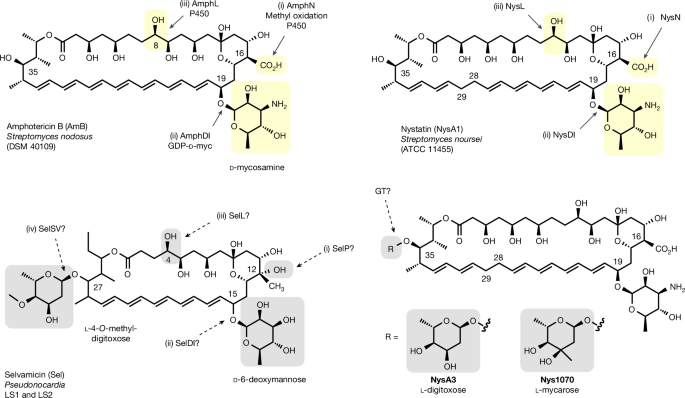
MainThe rising prevalence of life-threatening fungal infections, coupled with emerging resistance against most clinically approved antifungal agents, represents a major global health problem1,2,7,8,9,10,11,12. With few new classes of antifungal drugs in development9,10,11, amphotericin B (AmB), nystatin A1 (NysA1) and related polyenes remain frontline treatments for fungal infections. Polyenes are complex polyketide natural products with broad-spectrum antifungal activity3,13 (Fig. 1). In addition, AmB is the main treatment for leishmania, a parasitic disease common in the global south14,15. Although polyenes have largely evaded resistance even after extensive clinical use16, they suffer from high toxicity and low solubility17,18. The amphiphilic polyenes are suggested to act as a ‘sterol sponge’, extracting ergosterol from the microbial cell membrane giving rise to their antimicrobial activity4,19. Similar interactions with cholesterol in human cell membranes are thought to be responsible for polyene toxicity20. Less toxic liposomal formulations of AmB have been developed21, but these are expensive to produce, limiting availability in the less affluent regions of the world. The provision of more effective, safer and affordable antifungal drugs remains a critical unmet need.Fig. 1: Polyenes and post-PKS tailoring enzymes.Confirmed tailoring steps in yellow for AmB and NysA1 include oxidation of a C16-methyl substituent by cytochrome P450 (AmphN, NysN), to a carboxylic acid group. This is followed by C19 glycosylation (AmphDI or NysDI) and then C8 or C10 hydroxylation by a second P450 (AmphL or NysL). The GT enzyme(s) required for addition of the second C35 sugar of NysA3 and Nys1070 have not been identified. Proposed tailoring steps in selvamicin biosynthesis are similar, in which C15 glycosylation and C4 hydroxylation are carried out by SelDI and SelL, respectively, except an Fe(II)/2-oxoglutarate dependent enzyme (SelP) is predicted to hydroxylate C12, and SelSV is postulated to install 4-O-methyl-l-digitoxose23.Glycosylation plays a key role in modulating both the activity and solubility of polyenes. Most polyenes have a mycosamine sugar, present at C19 in AmB and NysA1 (Fig. 1), that is essential for bioactivity22. A few polyenes have been identified with multiple glycosyl units, including selvamicin (Fig. 1) and most recently mandimycin23,24. Although their biosynthetic gene clusters (BGC) have been sequenced, none of the enzymes from these pathways have been characterized. Nystatin congeners NysA3 and Nys1070 are also proposed to possess a second C35 sugar but they were isolated in very low quantities, preventing further development25,26. Furthermore, semi-synthetic polyene derivatives have been produced that include extra sugar moieties or other groups that improve solubility and reduce toxicity27. Furthermore, the C16-carboxylate group in AmB, NysA1 and most other polyenes also contributes to polyene toxicity27,28,29, and synthetic derivatives with alternative substituents, including amides, at C16 have been shown to have reduced toxicity5,6,27,30. Because polyenes are complex molecules, their synthetic modification typically requires many steps, extensive use of protecting groups and deleterious reagents. For example, a very promising AmB derivative that includes a modified sugar and a C16-amide moiety was recently introduced6, with considerably reduced toxicity. However, this ‘renal-sparing’ AmB derivative required 12 chemical steps to synthesize in 0.7% overall yield from AmB6, which is difficult to produce itself. The development of more atom and step efficient methods for producing polyene derivatives that are not reliant on toxic and/or expensive reagents, would be highly desirable in future endeavours to deliver improved and affordable polyene drugs.Here we report genome mining studies leading to the discovery of new polyene natural products and pathways, including previously undescribed glycosyltransferase (GT) enzymes. We demonstrate that these newly discovered GTs can be used to produce polyene derivatives, in vitro and in vivo, with several different glycosyl groups. We also expand the substrate and reaction scope of an amidotransferase to functionalize the detrimental carboxylic acid substituent common to most polyenes. The addition of a second sugar, combined with carboxylate modification, leads to new polyene derivatives with increased antifungal activity, lower toxicity and higher solubility than the parent polyenes used at present in the clinic. Our enzymatic approach is also more efficient and cleaner than the synthetic methods used so far to produce improved polyenes.Discovery of polyene GTsInitially, we sought to characterize the GT enzyme that installs the second sugar (4-O-methyl-l-digitoxose) of selvamicin (Fig. 1). Although selvamicin has low antifungal activity23, we reasoned that this GT may be useful for derivatizing the more therapeutically relevant polyenes AmB and NysA1. The selvamicin BGC has a TDP-l-digitoxose (thymidyl diphosphate-l-digitoxose) subcluster with a putative GT enzyme, SelSV, that was predicted to add the second sugar23. As SelSV’s function has not been determined experimentally, we overproduced the enzyme in Escherichia coli and, in the absence of the putative native aglycone and TDP-sugar substrates, we tested its in vitro activity using TDP-d-glucose together with either AmB or NysA1 as substrates (Extended Data Fig. 1). Liquid chromatography with high-resolution mass spectrometry (LC–HRMS) analysis revealed products consistent with the addition of glucose to AmB and NysA1 (Supplementary Fig. 1). Only very low levels (less than 1%) of the glucose-polyenes were produced, probably due to the substantial differences between the native SelSV substrates and those used in the assays (Extended Data Fig. 1b). The SelSV sequence was therefore used to identify homologues that might accommodate larger polyenes. First, we explored Streptomyces noursei (American Type Culture Collection (ATCC) 11455), which in addition to NysA1 is reported to produce low levels of the NysA3 and Nys1070 congeners, each with a second C35 sugar25,26 (Fig. 1 and Supplementary Table 1). Although the nystatin BGC encodes a single GT (NysDI) that introduces d-mycosamine, there are no genes present in the BGC, or elsewhere on the S. noursei (ATCC 11455) genome, that have been shown to encode enzymes responsible for the incorporation of second sugars in NysA3 and Nys1070. Analysis of the S. noursei genome sequence revealed a candidate GT, which we named SnNysSV, that is present in a small cluster of genes resembling the SelSV subcluster that we predicted may introduce l-digitoxose onto C35 of NysA1 (Supplementary Fig. 2 and Supplementary Table 2). Wider bioinformatics analysis revealed that several strains possess similar putative GTs, along with polyene-like BGCs, and three of these that we named SaNysSV, MycS3 and KfuSV, were selected for investigation (Supplementary Fig. 3 and Supplementary Table 3). SaNysSV from Streptomyces albulus (DSM40492) shows very high identity to SnNysSV (98% id). Genes mycS3 from Streptomyces netropsis (DSM40846) and kfuSV from Streptomyces kasugaensis (DSM40819) were both located in previously unreported polyene-like BGCs. The putative GTs were overproduced in E. coli and assayed in vitro with TDP-d-glucose and AmB or NysA1. All showed higher activity than SelSV, with KfuSV showing the highest activity with both AmB and NysA1 (Fig. 2 and Extended Data Fig. 1b). KfuSV was also shown to glycosylate three more polyene scaffolds with TDP-d-glucose (Supplementary Fig. 4). The sugar substrate scope of KfuSV was further explored with AmB or NysA1, using tandem enzyme assays31 to generate 19 TDP sugars from available sugar precursors (Extended Data Fig. 1). Glycosylated polyene derivatives could be detected by LC–HRMS with 11 of the 19 TDP sugars tested (Fig. 2 and Supplementary Figs. 5 and 6), which indicates KfuSV is a particularly flexible enzyme for polyene glycodiversification.Fig. 2: Glycosylation of AmB and NysA1 by SelSV, NysSV, MycS3 or KfuSV.a, Glycosylated variants of AmB and NysA1 generated using KfuSV and TDP sugars. A set of 19 TDP sugars were tested, of which 11 were shown to be substrates for KfuSV (also see Extended Data Fig. 1). The regioselectivity of the GTs was confirmed in reverse glycosylation assays with native products (Fig. 3). aSugar added to AmB and/or NysA1. b, RP-HPLC chromatogram showing conversion of AmB and NysA1 into glucosylated derivatives by KfuSV. Control traces refer to substrates incubated in the absence of KfuSV.NysSV is responsible for NysA3 productionSaNysSV is found on the S. albulus genome within a small cluster of six genes that we predict produce TDP-l-digitoxose, and which have high identity to the SnNysSV cluster in S. noursei (more than 95%) (Fig. 3a). Neither NysSV clusters are associated with any other identifiable BGCs. Further analysis of the S. albulus genome sequence revealed a separate putative nystatin-producing BGC elsewhere on the chromosome. S. albulus has also been reported to produce low quantities of NysA1 (ref. 32), but there are no reports of this strain producing diglycosylated nystatin variants. LC–HRMS analysis of S. albulus fermentation supernatant showed a minor amount of NysA1, with the main polyene product possessing a mass consistent with NysA3 (Supplementary Fig. 7). Nuclear magnetic resonance (NMR) characterization of NysA3 has not been reported and its structure was based mainly on degradation studies33,34. We therefore purified the main product from S. albulus and carried out detailed NMR analysis, confirming the presence of C35-l-digitoxose consistent with the previously proposed structure for NysA3 (refs. 33,34) (Supplementary Fig. 8).Fig. 3: Organization of BGCs and reverse glycosylation reactions confirming the function of NysSV, MycS3 and KfuSV in polyene biosynthesis.a, The NysSV-containing deoxysugar cluster in S. noursei and S. albulus. b, The mycoheptin and mandimycin BGC. c, Comparison of the kasufungin and selvamicin BGC. d, Glycosylation reaction of MycS3 in mandimycin biosynthesis. e, Final steps in the biosynthesis of kasufungin A. The differences in structure between kasufungin A and selvamicin are highlighted in blue. f, HPLC analysis of the reverse glycosylation reaction of NysA3 catalysed by SnNysSV. g, HPLC analysis of reverse glycosylation of kasufungin B catalysed by KfuSV.The fact that both S. albulus and S. noursei produce NysA3 and possess similar nysSV clustered with TDP-l-digitoxose biosynthesis genes, albeit remote from the main Nys BGCs, suggests that NysSV is responsible for the production of NysA3. To test this, we incubated NysA3 and TDP with both NysSV enzymes, which resulted in the production of NysA1 (Fig. 3f and Supplementary Fig. 9). Given that GT-catalysed reactions are reversible35, the fact that both NysSV enzymes remove l-digitoxose from the C35 position with high efficiency fully supports their role in the biosynthesis of NysA3. Furthermore, the entire SaNysSV subcluster was expressed in a heterologous host Streptomyces albus (J1074). NysA1 was then incubated with lysate from the resulting S. albus::nysSV-subcluster strain that resulted in production of NysA3, providing further evidence that the NysSV subcluster produces l-digitoxose and transfers this sugar to C35 of NysA1 (Supplementary Fig. 10). The observation that the NysSV subclusters and nystatin BGC are at separate chromosomal loci is notable given genes for most reported bacterial natural product pathways are clustered together36,37. We also showed that S. albulus produces very high levels of NysA3 (759 ± 10 mg l−1) with only a minor quantity of NysA1 (Extended Data Fig. 2). By contrast, S. noursei produces NysA1 as the main product (555 ± 14 mg l−1 in our hands). Targeted gene expression analysis (quantitative polymerase chain reaction with reverse transcription, RT–qPCR) in the two nystatin-producing strains showed that the NysSV subcluster is expressed to a higher level in S. albulus than in S. noursei, which could account for the higher level of NysA3 production we observe in S. albulus (Supplementary Fig. 11). The fact that S. albulus produces higher levels of a rare polyene with a second sugar that improves solubility, and may affect other properties, makes this a useful production host.MycS3 glycosylates dihydromycoheptinMycS3 was found in S. netropsis (DSM40846), which is reported to produce mycoheptin, structurally related to AmB38,39,40 (Fig. 3b,d). Mycoheptin possesses the common C19-d-mycosamine but does not have a second sugar. We used PacBio to re-sequence and assemble the S. netropsis (DSM40846) genome de novo, which revealed a large 115 kb BGC that we named myc. This BGC includes 6 polyketide synthase (PKS) genes composed of 19 modules and several tailoring enzymes predicted to produce mycoheptin. Also present within the BGC is a putative TDP-deoxysugar subcluster that includes mycS3 (Fig. 3b and Supplementary Fig. 12). Analysis of S. netropsis culture supernatant revealed a main product, which was isolated and confirmed by NMR to correspond with the previously determined structure of mycoheptin40 (Fig. 3d and Supplementary Fig. 13). LC–HRMS, UV–visible light (UV–Vis) and NMR analysis also revealed the presence of low quantities of a dihydromycoheptin congener, which has undergone reduction of the C30=C31 double bond (Extended Data Fig. 3 and Supplementary Fig. 14). Another pentaene congener was also isolated and shown by NMR experiments to possess two l-digitoxose residues at C35, sharing the same structure as mandimycin that was recently isolated from a different strain24 (Supplementary Fig. 15). To explore its function in vitro, MycS3 was incubated with dihydromycoheptin and TDP-l-digitoxose, which resulted in addition of a single l-digitoxose (Supplementary Fig. 16). The product of this assay is also evident in very low quantities from LC–HRMS analysis of S. netropsis (DSM40846) extracts, suggesting it is an intermediate on the pathway to mandimycin (Fig. 3d).KfuSV is involved in kasufungin biosynthesisS. kasugaensis is known to produce aminoglycosides41, but has not been reported to produce polyenes. Analysis of the S. kasugaensis genome sequence did, however, reveal a single polyene-like BGC that includes kfuSV (Fig. 3c and Supplementary Fig. 17a). This BGC (that we named kfu) is similar in organization to the selvamicin BGC23, with five genes encoding a 15 module PKS, a subcluster containing kfuSV and genes predicted to be involved in the biosynthesis of TDP-l-digitoxose. Further detailed bioinformatics analysis enabled a structure of the kfu PKS macrolactone core to be proposed (Supplementary Fig. 17b–d). Reverse-phase-high-performance liquid chromatography (RP-HPLC) and LC–HRMS analysis of S. kasugaensis fermentation extracts revealed the production of five polyenes with UV–Vis absorbance typical of pentaenes (Extended Data Fig. 4). On the basis of the predicted structures of the five polyenes, we named these kasufungin A–E and a pathway was proposed (Fig. 3e and Extended Data Fig. 4). Although kasufungin A is the most functionalized (likely to be the end product), kasufungin B is most abundant and was therefore isolated and subjected to detailed NMR analysis, which shows it possesses a unique structure (Supplementary Fig. 18). In addition to differences in the macrolide structure (at C3, C5, C12 and C29), kasufungin B has different sugars (d-mycosamine and l-digitoxose) compared with selvamicin.Kasufungin B was then incubated with KfuSV and TDP, which resulted in the formation of kasufungin D, confirming its role in installing the l-digitoxose moiety (Fig. 3g and Supplementary Fig. 19). Furthermore, we found that SelSV can also catalyse reverse glycosylation with kasufungin B, but not with selvamicin (Fig. 3g and Extended Data Fig. 5). This suggests SelSV does not recognize 4-O-methyl-l-digitoxose and that selvamicin is glycosylated with l-digitoxose by SelSV, which is subsequently 4-O-methylated by the putative methyltransferase SelSI23. Initial attempts to crystalize KfuSV, and the related GTs, were unsuccessful. Instead, an AlphaFold model of KfuSV was generated showing a typical GT-B fold similar to that of related bacterial GTs such as YjiC42 (Supplementary Fig. 20). The structural model was used to guide active site mutagenesis, which revealed His13 is likely to hydrogen bond to the C35-OH, and may function as a general base. More active site residues (H294, T299 and D318) may also contribute to catalysis and/or substrate binding (Supplementary Fig. 20). KfuSV T297A also showed improved activity with non-native polyene substrates, suggesting that the substrate scope of KfuSV may be further expanded through enzyme engineering.To further explore whether the flexible KfuSV could be used to derivatize other polyenes in vivo, the entire KfuSV subcluster was introduced into S. nodosus (AmB producer). Heterologous expression of this l-digitoxose subcluster led to the production of new AmB and AmA (the tetraene analogue of AmB) derivatives with masses consistent with the addition of a dideoxysugar (Fig. 4a and Supplementary Fig. 21). We isolated the most abundant AmB derivative from the fermentation of the engineered S. nodosus strain and subjected this to detailed NMR analysis (Supplementary Fig. 22). Our NMR data, when compared to the NMR data reported for AmB43, are fully consistent with the addition of l-digitoxose onto C35 (AmB-l-digitoxose, Fig. 4b). Heterologous expression of the corresponding SaNysSV subcluster in S. nodusus also resulted in the same AmB-l-digitoxose derivative (Supplementary Fig. 23), demonstrating that the new GT enzymes can be deployed in vivo, as well as in vitro, to derivatize medically relevant polyenes. Such fermentation methods can ultimately lead to more cost-effective production of improved polyene antifungal agents.Fig. 4: Amphotericin-deoxysugar derivative, bioactivity data and carboxylic acid derivatization.a, RP-HPLC analysis of a new glycosylated AmB derivative produced by expression of the KfuSub plasmid, possessing the KfuSV subcluster, in S. nodosus (compared with no production in S. nodosus alone or S. nodosus with an empty plasmid). HPLC absorption was measured at 405 nm, which is specific for the AmB chromophore. The AmB-l-digitoxose product was fully characterized by NMR (Supplementary Fig. 22). b, Structures of AmB and AmB-l-digitoxose. c, Structures of pimaricin with C12 modifications and nystatins with extra C16-carboxylate modifications. bPercentage conversions for the PcsA-catalysed carboxylate-modification reactions. d, Horse blood haemolysis EC50 (µM) data for sugar modified (AmB-l-digitoxose and NysA3) and the parent polyenes (AmB and NysA1) were obtained from (n = 3) biological replicates and error bars represent ±standard deviation (s.d.). e, Schematic of the PcsA-catalysed carboxylic acid functionalization reaction, along with a structural model, generated by AlphaFold, highlighting (blue mesh) the tunnel between N and C termini (predicted using CAVER). a.u., arbitrary units.Source dataEnzymatic modifications improve bioactivityHalf-maximal inhibitory concentration (IC50) values were determined for AmB-l-digitoxose and NysA3 (Fig. 4b) with ten clinically relevant fungal pathogens defined as critical or high risk by the World Health Organization44, including drug-resistant species, such as the Aspergillus fumigatus cyp51ATR34/L98H isolate45 (Table 1). The IC50 values indicate that the addition of l-digitoxose to AmB increases antifungal activity against eight of the ten pathogens tested, including Candida albicans ATCC 90028 (2.7-fold) and Fusarium oxysporum (2-fold). NysA3 is also more potent than the parent NysA1 with six of the pathogens tested, most notably with Fusarium solani (10.2-fold). AmB-l-digitoxose and NysA3 do, however, show increased haemolysis of red blood cells (half-maximum effective concentration (EC50)), which is used as an indicator of polyene toxicity28 (Fig. 4d). Although the origins of enhanced bioactivity of AmB-l-digitoxose and NysA3 are unclear, in the case of nystatin the C35 sugar seems to prevent isomerization. The parent NysA1 exists as a mixture (roughly 55:45) of bioactive and inactive isomers in buffer46,47, which is evident as two peaks on HPLC analysis (Fig. 3f). With NysA3, however, only a single peak is present in HPLC, suggesting the second C35 sugar shifts the equilibrium in favour of the bioactive isomer (Extended Data Fig. 6), which may contribute to the improved antifungal activity we observe.Table 1 IC50 values for AmB, NysA1 and their derivatives against fungal pathogensFull size tableGiven that the C35 sugar improves both antifungal activity and solubility of clinically relevant polyenes, we sought to explore whether C16-carboxylate derivatization might mitigate the toxicity of NysA3 (for example, enhancing selectivity for the fungal versus mammalian cell membrane). Rather than using the costly synthetic procedures that were used previously to produce less toxic AmB variants5,6,27, we sought to develop more efficient and cleaner enzymatic methods to introduce C16 modifications. For example, an amidotransferase, PcsA, was shown to install a C12-primary amide moiety found in the smaller polyene rimocidin48,49. PcsA is predicted to possess an N-terminal glutamine hydrolase domain, releasing ammonia that is channelled through a molecular tunnel to a C-terminal domain, where it intercepts a polyene acyl-AMP intermediate (Fig. 4e). PcsA was shown to transform the C12–CO2H of rimocidin and related pimaricin (natamycin) to the amide (C12–CONH2) in vivo or using crude cell free extracts49. However, PcsA was reported not to accept larger polyenes, including nystatin, and attempts to purify the enzyme failed as the addition of affinity tags onto either terminus led to loss of function49. Notwithstanding this, we identified a loop region at which a His6-tag could be inserted, enabling the purification of PcsA. Contrary to the earlier studies49, we showed that PcsA can accept larger polyenes. Both NysA1 and NysA3 C16-amide derivatives (Nys11 and Nys31) were produced with 98% and 96% conversion, respectively, compared with pimaricin (natamycin) that is very similar to the native substrate and gives near-complete conversion (Pim1) under similar assay conditions (Fig. 4c and Supplementary Figs. 24–26). PcsA also catalysed amidation of a range of other polyenes, including candicidin (used to treat yeast infections), CE-108, dihydromycoheptin and mandimycin (Supplementary Figs. 27–31). In addition to broad polyene scope, we also showed glutamine derivatives with modified side chains can transfer alternative nucleophiles (NH2OH and NH2NH2) through the tunnel to form various polyene hydroxamic acid derivatives (Pim2, Nys12, Nys32, rimocidin, CE-108, dihydromycoheptin, mandimycin and candicidin hydroxamates) and, in the case of pimaricin (natamycin), an acyl-hydrazine derivative was also observed in small quantities (Pim3) (Fig. 4c and Supplementary Figs. 24–31). NMR confirmed the structures of the polyene C16 derivatives (Supplementary Figs. 32–44).Finally, we evaluated the antifungal activity and toxicity of the new polyene variants (Table 1, Extended Data Figs. 7 and 8 and Supplementary Figs. 45–47). In addition to enzymatically generated polyene C16 derivatives, the NysA3 carboxylic acid was also chemically modified with serinol to generate a serinol amide derivative (Nys34). Although inaccessible with PcsA, the serinol amide modification was previously shown to be most effective for improving the characteristics of AmB6. The acyl-hydrazine derivative of NysA3 was also prepared for comparison of bioactivity data. Overall, we observe that nystatin variants combining C35 sugar and C16 modifications (Nys31, Nys32, Nys33 and Nys34) show higher antifungal activity against most fungal pathogens tested than either parent molecule NysA1 or NysA3, and in several cases are more potent than AmB (the most effective clinically relevant polyene antifungal agent). Notably, Nys33 is 2.5-fold and 5-fold more potent than clinically relevant AmB and NysA1, respectively, when tested against azole-resistant A. fumigatus cyp51ATR34/L98H. The NysA3 derivatives also show twofold to ninefold better activity than NysA1 with the Fusarium species tested and the AmB-resistant Candida albicans ATCC 200955. Moreover, all the dual functionalized nystatin variants show reduced haemolysis (Fig. 5a) compared with both NysA3 and AmB, indicating these derivatives also have lower toxicity to mammalian cells.Fig. 5: Comparing the bioactivity and toxicity of sugar and C16 modified polyenes with AmB and NysA1.a, Horse blood haemolysis EC50 (µM), used as an indicator of toxicity, comparing NysA3 and its C16 modified derivatives (Nys31 and Nys34) to AmB. The experiments were performed in (n = 3) biological replicates and error bars represent ±s.d. b, The structures of AmB and Nys34. c–e, Dose–response curves of HEK293 (c), A549 (d) and HEPG2 (e) cells incubated with varying concentrations of AmB (red) and Nys34 (blue). All cell lines were tested in (n = 3) biological replicates and error bars represent ±s.d. f, Treatment of A. fumigatus infection of immunosuppressed CD1 mice with Nys34 at 5 mg kg−1 q8h ×4 and AmB at 1 mg kg−1 once a day ×2. Mice were immunosuppressed with triamcinolone before intranasal inoculation with 5 × 10⁵ CEA10 spores (5 male and 4 female in the AmB group; 5 male and 5 female in other groups). Treatment was initiated 8 h postinoculum and the mice were culled 32 h after the first treatment. Lungs were homogenized and plated on SDA. Following incubation for 48 h at 37 °C, CFUs were counted and normalized per gram of lung tissue. Each point represents data from an individual mouse. The Nys34 treatment arm was significantly different from the vehicle (non-treatment) arm P = 0.0017 one-way analysis of variance with Dunnett’s post hoc test. Statistical tests were two-sided, with α = 0.05. Error bars show the mean with standard error of the mean. g–i, UV–Vis ergosterol titration binding studies of AmB (g), NysA1 (h) and Nys34 (i) with increasing molar ratios of ergosterol (0–5 eq.). j–l, Dose–response curves of AmB (j), NysA1 (k) and Nys34 (l) (dark shaded lines) with S. cerevisiae, compared with AmB, NysA1 and Nys34 precomplexed with 5 molar equivalents of ergosterol (light shaded lines). For j and k measurements were taken in biological duplicates whereas l was taken in biological triplicates with error bars shown as ±s.d.Source dataNys34 reduces fungal burden in miceOne of the more promising derivatives, Nys34 (Fig. 5b), was also shown to have between threefold and eightfold lower toxicity than AmB in human embryonic kidney 293 (HEK293) cells, A549 lung cells and human hepatoma (HEPG2) liver cells (Fig. 5c–e). In contrast to the parent polyene NysA1, which shows acute toxicity at low doses (4.4 mg kg−1) in mice18, Nys34 was well tolerated following intraperitoneal (i.p.) injection of 3 repeat doses (10 mg kg−1, every 8 h (q8h)), however, mice showed signs of toxicity following a fourth dose. Population pharmacokinetics studies were carried out at a single dose of 10 mg kg−1 i.p., revealing concentration–time profiles consistent with a one-compartment model with first-order absorption and elimination (Extended Data Fig. 9). The estimated absorption rate constant (ka) and elimination rate constant (kel) were ka = 4.82 h−1 and kel = 0.082 h−1, corresponding to half-lives of roughly 9 minutes and 8.5 hours, respectively. Distribution of Nys34 to all main organs tested, including the lungs, was observed. Using a population pharmacokinetics model, we defined a toxic exposure level on the basis of our observed toxic regimen (10 mg kg−1, q8h ×4). Candidate regimens were evaluated by Monte Carlo simulation with 5 mg kg−1 q8h ×4 resulting in <0.5% probability of exceeding toxic Cmax or area under the curve thresholds. Using this dosing regimen in a mouse invasive aspergillosis model, Nys34 reduced A. fumigatus counts (colony forming units, CFUs) in lungs by 87%, achieving statistical significance from the vehicle (P = 0.0017, Fig. 5f). Furthermore, no overt signs of toxicity were observed. Treatment with AmB at 1 mg kg−1 per day, which was previously shown to be effective at improving survival in a murine model, reduced A. fumigatus tissue burden by 35% after 2 days, but this change did not reach statistical significance50 (Fig. 5f).The promising in vitro and in vivo activity of Nys34 prompted an investigation into its mechanism of action. Unlike AmB and NysA1 (refs. 6,19), UV–Vis titration experiments show no evidence of Nys34 binding to ergosterol (Fig. 5g–i). Furthermore, precomplexation19 of Nys34 and ergosterol (1:5) had no effect on antifungal activity, whereas NysA1 and AmB showed considerable 3.4-fold and 11.8-fold reductions in IC50 with yeast Saccharomyces cerevisiae (Fig. 5j–l), and a similar trend was observed for A. fumigatus IC50 values with precomplexation (Supplementary Fig. 48). This indicates that Nys34 has a different mechanism of action from the extramembranous sponge formation that is proposed to account for the activity of the parent polyenes4,6,19. Taken together, the results presented here indicate that the nystatin variants, especially Nys34, show improved properties over the parent polyenes used in the clinic, and have substantial potential for further clinical development.ConclusionA few polyenes, such as selvamicin, mandimycin and NysA3, have previously been isolated with an extra sugar moiety, but the GTs responsible for these modifications had not been characterized. Through genome mining, we identified and characterized a family of GTs capable of efficiently installing a variety of second sugars onto clinically relevant polyenes. Several of these GTs were located within previously undescribed polyene biosynthetic pathways, which guided the isolation and characterization of a new family of kasufungin natural products. We also expanded the substrate and reaction scope of the amidotransferase PcsA, demonstrating that this enzyme can accept larger polyenes and glutamine derivatives. This enables the introduction of amide, hydroxamate and acyl-hydrazine functionality in place of the detrimental carboxylic acid group present in manypolyenes.Most previous efforts to improve polyene therapeutics have relied on chemical synthesis5,6,20,27. However, the structural complexity of polyenes makes regioselective derivatization challenging, often necessitating extensive protecting-group strategies and multistep synthetic routes. Such approaches are costly and can restrict access to improved analogues and treatments. Earlier attempts to enzymatically diversify polyene scaffolds were met with limited success. For example, the GTs responsible for installation of the mycosamine sugar present in most polyenes are highly substrate selective and therefore poorly suited to glycodiversification51. By contrast, the GTs described here, particularly KfuSV, showed high substrate promiscuity, accepting a broad range of sugar donors and polyene acceptors.The efficient and selective enzymatic installation of a second sugar, together with carboxylate modification, improves antifungal activity, reduces toxicity and increases the solubility of polyenes relative to widely used parent natural products, including several World Health Organization essential medicines. In a mouse infection model, Nys34 emerged as a promising lead compound, showing in vivo efficacy through reduction of fungal burden in invasive aspergillosis without substantive signs of toxicity. Notably, the two structural modifications present in Nys34 substantially altered its mechanism of action, eliminating ergosterol binding. Although further studies will be required to define this alternative mechanism, these findings demonstrate that targeted regioselective derivatization can fundamentally reshape the biological properties of clinically important polyene scaffolds. In addition to Nys34, several of the other polyene derivatives generated enzymatically in this study (for example, Nys31) show equally promising bioactivity and may also prove valuable for combating other fungal infections.Taken together, the previously undescribed polyenes, enzymes, biosynthetic pathways and methodologies reported here provide a powerful platform for optimizing bioactivity and modulating the mechanism of action of polyene therapeutics. The enzymes and pathways described here are also amenable to engineering, which could enable further structural diversification and fine-tuning of polyene bioactivity. Directed evolution and strain engineering could also assist the development of scalable bioprocesses, making improved polyene therapeutics more widely available.MethodsIn vitro GT glycosylation assaysFor GT assays with TDP glucose; GT enzyme (5–20 µM), TDP-glucose (2 mM), MgCl2 (1 mM) and polyene substrates, including amphotericin B (AmB), AmB-aglycone, nystatin A1 (NysA1) and mycoheptin and dihydromycoheptin, at 100 µM concentration were incubated in a total reaction volume of 50 µl in Tris-HCl buffer (50 mM, pH 7.4) at 30 °C for 24 h. For TDP sugars other than TDP glucose with available sugar-1-phosphates, an extra step was required in which the TDP sugar was produced from the corresponding sugar-1-phosphate. In this first step, deoxythymidine triphosphate (2 mM), sugar-1-phosphate (2 mM), MgCl2 (2.2 mM) and Cps2L (50 µM) in a total volume of 50 µl in Tris-HCl buffer (50 mM Tris-HCl, pH 7.4) were incubated for 24 h at 37 °C in a shaking thermomixer. After 24 h, the temperature was adjusted to 30 °C and GT (5–20 µM) and polyene (100 µM) were added. Assays were then incubated for a further 24 h at 30 °C. For TDP sugars with no available sugar-1-phosphate, TDP sugars were produced from the corresponding sugar. In this modified first step, deoxythymidine triphosphate (2 mM), ATP (2 mM), sugar (2 mM), MgCl2 (2.2 mM), NahK_ATCC15697 or GalkSpe4 (50 µM) and Cps2L (50 µM) in a total volume of 50 µl in Tris-HCl buffer (50 mM Tris-HCl, pH 7.4) was incubated for 24 h at 37 °C in a shaking thermomixer. After 24 h, the temperature was adjusted to 30 °C and GT (5–20 µM) and polyene (100 µM) were added. Assays were then incubated for a further 24 h at 30 °C.For all assays (1, 2 or 3 steps), reactions were quenched by heating to 95 °C for 5 min, followed by the addition of 1 reaction volume of methanol. The protein was then pelleted by centrifugation, and the supernatant was analysed by analytical RP-HPLC and LC–HRMS. Assays were analysed on a Shimadzu Analytical ultrahigh-performance liquid chromatography (UHPLC) apparatus with a Kinetex 5 μm XB-C18 100 × 4.6 mm (Phenomenex) column, with a flow rate of 1 ml min−1, using a solvent system of water and methanol with 0.1% formic acid and a gradient of 60–78% methanol over 12 min. Heptaenes were monitored at 405 nm and pentaenes at 350 nm. LC–HRMS was performed on an Agilent 1290 Infinity II coupled to a 6560 Ion Mobility quadrupole time of flight (Q-TOF) LC–MS apparatus and 1290 Infinity II HPLC coupled to a 6546 LC–Q-TOF (Agilent Instruments), using a Luna Omega 5 μm 100 × 2.1 mm (Phenomenex) column, with a flow rate of 0.5 ml min−1, using a solvent system of water and methanol and a gradient of 60–95% methanol over 15 min. On LC chromatograms, tetraenes were monitored at 304 nm, pentaenes at 350 nm and heptaenes at 405 nm.GT-catalysed reverse glycosylation of polyenesEach of the polyenes (25–100 μM, kasufungin B, NysA3, semipurified selvamicin) were incubated with TDP (2 mM), MgCl2 (1 mM), GT (KfuSV, NysSV, SelSV, 25 μM) in 50 mM Tris-HCl buffer pH 7.5–8, 30 °C overnight, in a 50 μl reaction. The reactions were quenched with methanol (50 μl) and centrifuged (10,000 rpm, 5 min). The supernatant was analysed by HPLC and masses were confirmed by LC–MS using the same conditions as mentioned above in the in vitro GT glycosylation assays section.MycS3 assay with dihydromycoheptin and TDP-l-digitoxoseReverse glycosylation of NysA3 was performed to generate TDP-l-digitoxose. A 200–300 μM solution of NysA3 was incubated with TDP (2 mM), MgCl2 (1 mM) and KfuSV (50 μM) in 50 mM Tris-HCl buffer pH 7.5–8, at 30 °C overnight, in a 2-ml reaction. The reactions were quenched with an equal volume of methanol to inactivate enzyme and centrifuged (10,000 rpm, 5 min). The supernatant was concentrated under vacuum to reduce the volume to one-quarter, applied to silica filled in a small syringe (silica C18 100 Å, 30 μm, silica bed 4 ml) and washed twice with an equal volume of H2O to elute TDP-l-digitoxose. The filtrate volume was reduced to one-fifth under vacuum and used for MycS3 assays.For assays with MycS3, a solution of dihydromycoheptin (50 µM) in MycS3 reaction buffer (1 mM MgCl2, 50 mM Tris-HCl, pH 7.5) was incubated with the TDP-l-digitoxose containing concentrated filtrate (25 μl) and MycS3 (25 μM) at 30 °C overnight in 50-μl reactions. The reactions were quenched with methanol (50 μl) and centrifuged (10,000 rpm, 5 min) before the supernatant was analysed by HPLC and LC–MS. In separate experiments, dried S. netropsis (DSM40846) methanolic extract containing crude dihydromycoheptin, was resuspended in MycS3 reaction buffer (1 mM MgCl2, 50 mM Tris-HCl, pH 7.5) was incubated with the TDP-l-digitoxose containing concentrated filtrate (25 μl) and MycS3 (25 μM) at 30 °C overnight in 50-μl reactions. The reactions were quenched with methanol (50 μl) and centrifuged (10,000 rpm, 5 min) before the supernatant was analysed by LC–HRMS. HPLC analysis was performed on a Shimadzu Analytical UHPLC with a Kinetex 5 μm XB-C18 100 × 4.6 mm (Phenomenex) column, with a flow rate of 1 ml min−1, using a solvent system of water and methanol (+0.1% formic acid) and a gradient of 60–78% methanol over 12 min, with UV monitored at 350 nm. LC–HRMS was performed on an Agilent 1290 Infinity II coupled to a 6560 Ion Mobility Q-TOF LC–MS and 1290 Infinity II HPLC coupled to a 6546 LC/Q-TOF (Agilent Instruments), using a Luna Omega 5 μm 100–2.1 mm (Phenomenex) column, with a flow rate of 0.5 ml min−1, using a solvent system of water and methanol and a gradient of 60–95% methanol over 15 min.In vitro PcsA reaction conditionsEnzyme activity assays were carried out in a reaction containing 100 µM polyene (pimaricin, rimocidin, CE-108, NysA1, NysA3, mycoheptin, dihydromycoheptin, kasufungin B or candicidin) and l-glutamine, l-glutamic acid γ-hydroxamate or l-glutamic acid γ-hydrazide (2 mM), ATP (4 mM), MgCl2 (10 mM) and 25 µl of eluted protein in Tris buffer (125 mM Tris and 25 mM NaCl, pH 7) in a total volume of 50 µl. In addition, l-glutamine analogues (l-glutamic acid γ-methylamide, l-glutamic acid γ-ethylamide (l-theanine), l-glutamic acid γ-methyl ester and l-glutamic acid γ-ethyl ester) were also tested but no activity was observed. The reactions were quenched with methanol (50 µl) after overnight incubation at 30 °C, and centrifuged (10,000 rpm for 5 min). Assays were analysed on a Shimadzu Analytical UHPLC with a Kinetex 5 μm XB-C18 100 × 4.6 mm (Phenomenex) column, using 1 ml min−1 flow rate with a solvent system of water and methanol each containing 0.1% formic acid, using a gradient of 60–78% methanol over 12 min. LC–HRMS was performed on an Agilent 1290 Infinity II coupled to a 6560 Ion Mobility Q-TOF LC–MS instrument, using a Luna Omega 5 μm 100 × 2.1 mm (Phenomenex) column, using a 0.5 ml min−1 flow rate with a solvent system of water and methanol each containing 0.1% formic acid, and a gradient of 60–80% methanol over 15 min.Expression of S. albulus nysSV-subcluster in S. albus
Enzymatic glycosylation and amidation reshapes polyene bioactivity - Nature
Pathways to previously undescribed polyenes, including unusual enzymes that introduce more sugars onto polyene scaffolds, are discovered, and their accessibility through clean and efficient fermentation and potential for safe use as antifungal treatments is described.
12,923 words~59 min read