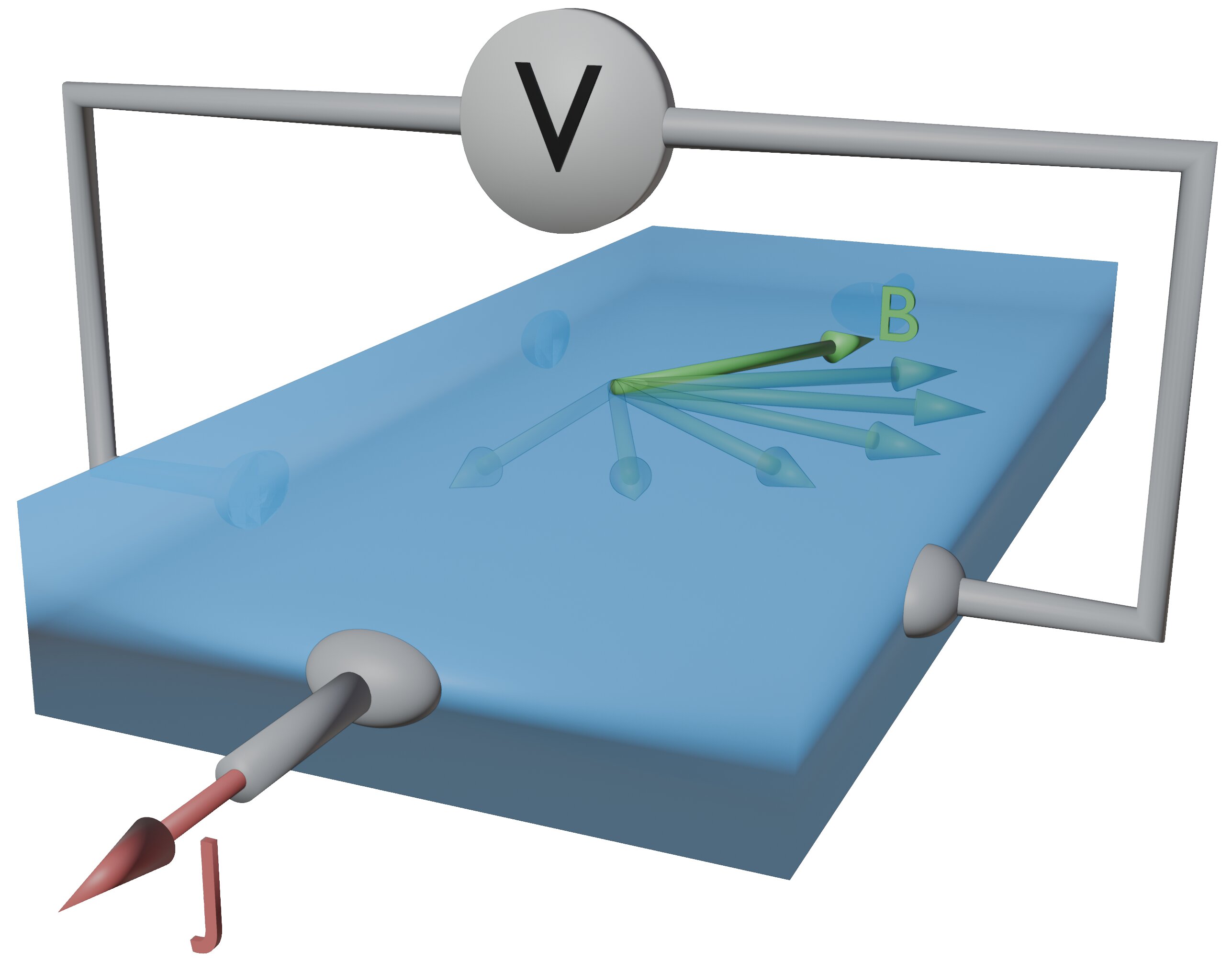
In the "planar Hall effect," researchers send a current ("J") through a thin, flat sample and observe whether an electric voltage ("V") is produced in response to a magnetic field ("B") in the same plane as the sample. If it is, the pattern of how the voltage responds to rotating the magnetic field in the plane of the sample tells researchers about the properties of the material. Credit: Yamada Akiyoshi
The planar Hall effect is a tabletop diagnostic tool for special quantum properties useful in basic research and technological applications. Or so it was thought, because careful calculation by Kobe University researchers clarifies the conditions under which this effect may also appear in classical materials. This makes the diagnostic more meaningful and enables more purposeful design.
In the hunt for materials with properties that are useful for quantum computing or spintronics, researchers have used the "planar Hall effect" as a tabletop diagnostic tool: The researchers send a current through a thin, flat sample and observe whether an electric voltage is produced in response to a magnetic field in the same plane as the sample.
If it is, the pattern of how the voltage responds to rotating the magnetic field in the plane of the sample tells researchers about the properties of the material.