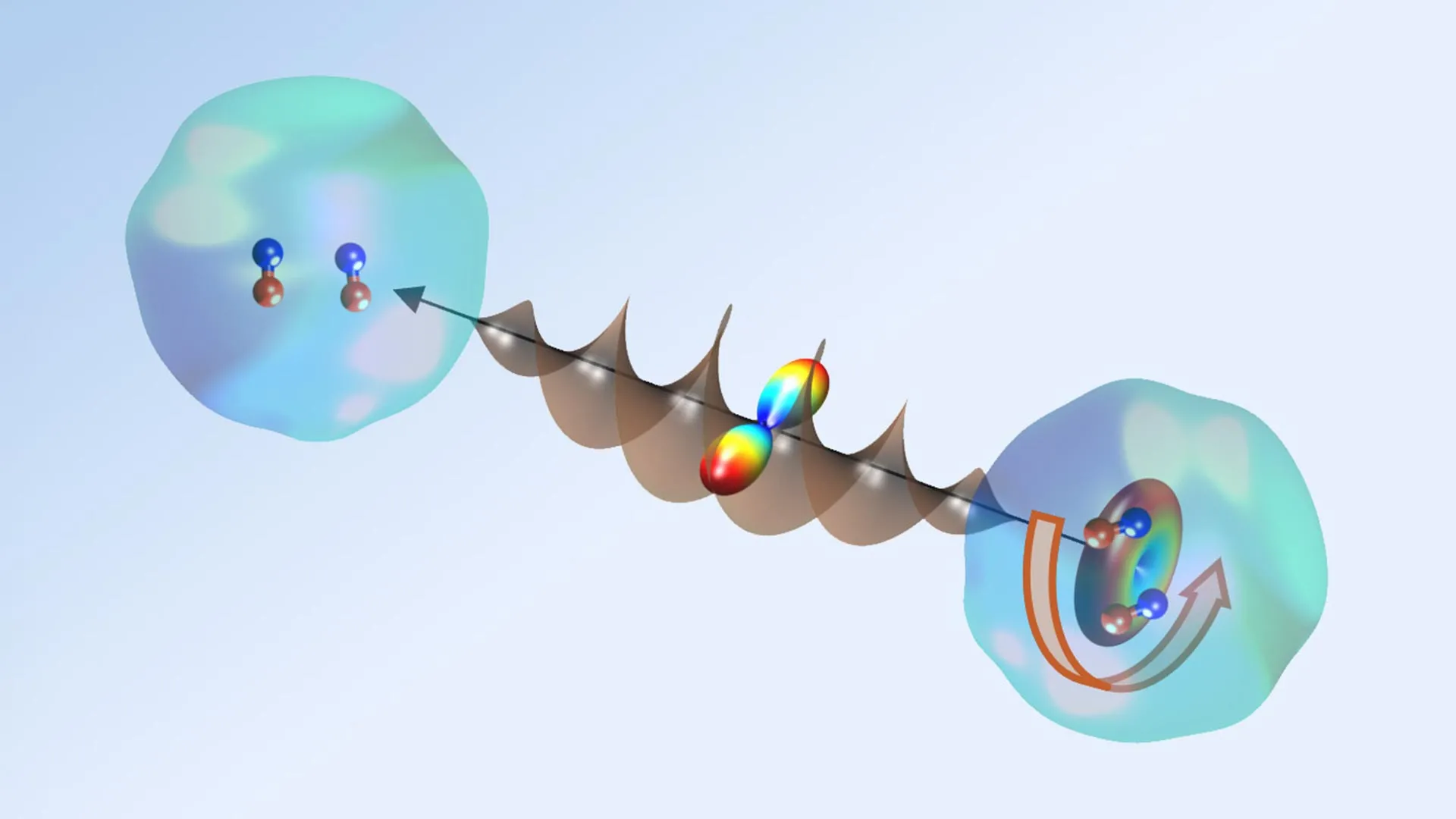
An international research consortium including EPFL has developed a powerful technique to observe elusive dynamic phenomena inside magnetic materials. The advance could help enable future low-energy computing technologies.In magnetic materials, the microscopic spins of atoms – often visualized as tiny compass needles – constantly interact with each other. When one spin is disturbed, the disturbance ripples through the material like a wave on water. These waves are called spin waves, and their smallest quantized packets of energy are called magnons.Because magnons carry and process information without moving electric charge, they generate far less heat than conventional electronics, making them attractive building blocks for next-generation, energy-efficient computing. However, many of the most interesting magnon phenomena occur at nanometer-scale wavelengths, where their interactions become rich and complex. At this tiny scale, existing techniques struggle to keep up.Now, researchers have introduced a technique called magnon momentum microscopy (MMM), which uses soft X-rays to capture the full two-dimensional distribution of magnons in a single image. Rather than detecting individual spin waves, MMM provides a broad view of magnon activity across different directions and wavelengths. The method, developed by researchers from the Max Born Institute (MBI) and Helmholtz-Zentrum Berlin (HZB) in Germany, the Università degli Studi di Napoli Federico II (UniNa) in Italy, and the Laboratory of Nanoscale Magnetic Materials and Magnonics (LMGN) in EPFL’s School of Engineering, has been published in Nature Physics.Soft-X-ray magnon momentum microscopy. 2026 EPFL CC BY SA“MMM enables omnidirectional imaging of magnon excitations, including both linear and nonlinear behavior, down to unprecedentedly small wavelengths and across a wide range of frequencies,” says LMGN head Dirk Grundler. “This research would not have been possible without samples of yttrium iron garnet – a widely studied magnetic material – featuring nanoscale microwave-to-magnon transducers developed in EPFL’s Center of MicroNanoTechnology (CMi).”Toward ultra-efficient magnon-based computingBy applying MMM to the yttrium iron garnet, the international team uncovered a striking phenomenon: when magnons are strongly driven, they become unstable and spontaneously redistribute their energy across a broad range of directions and wavelengths. Such nonlinear behavior is important because it marks the point where magnons no longer behave as independent waves, but begin to strongly interact and self-organize. These interactions can lead to entirely new collective states and enable functionalities that are impossible in conventional electronic systems.Understanding and controlling nonlinear magnon dynamics is considered a key step toward future magnonic technologies, including unconventional computing architectures in which information could be routed, amplified, or processed using interacting spin waves with extremely low energy consumption.Because MMM is based on X-ray scattering, it works across a wide range of materials, can probe buried layers beneath the surface, and provides selective sensitivity to the magnetic properties of specific chemical elements. It imposes no restrictions on magnon frequency, making it broadly applicable across the field.The results establish MMM as a versatile new platform for studying nanoscale spin-wave physics, and may accelerate the development of magnon-based devices for future computing.ReferencesWittrock, S., Klose, C., Perna, S. et al. Soft-X-ray momentum microscopy of nonlinear magnon interactions. Nat. Phys. (2026). https://doi.org/10.1038/s41567-026-03318-z
A new window into the hidden world of spin waves
An international research consortium including EPFL has developed a powerful technique to observe elusive dynamic phenomena inside magnetic materials. The advance could help enable future low-energy computing technologies.
504 words~2 min read