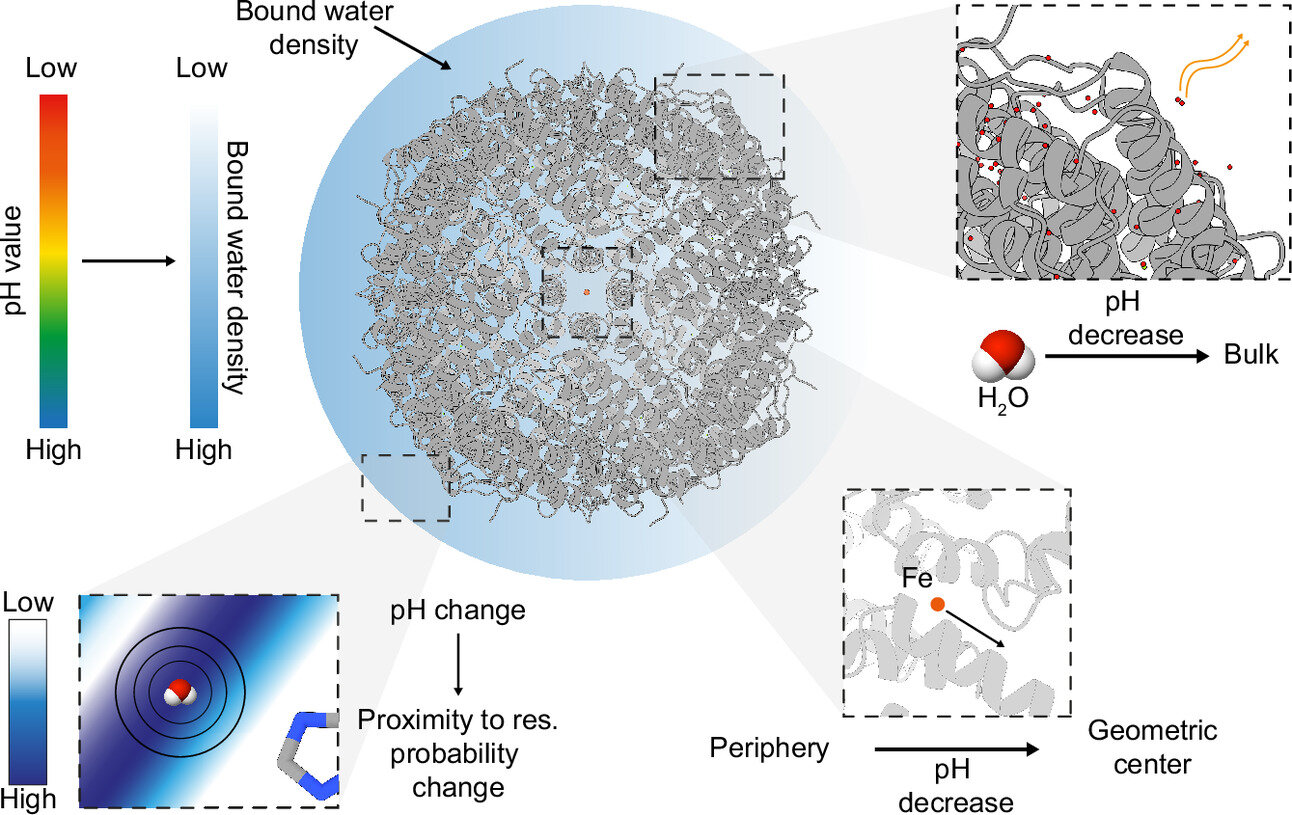
Solvation layer effects as a function of pH. The modeled waters belonging to the solvation layer numerically differ with decreasing pH. Credit: Proceedings of the National Academy of Sciences (2026). DOI: 10.1073/pnas.2525949123
Proteins systematically lose their protective hydration shell when their environment becomes more acidic. Until recently, this was just a theory. State-of-the-art imaging techniques have helped researchers at Martin Luther University Halle-Wittenberg (MLU) directly observe this process for the first time at the level of the individual water molecule. This has answered a question in biochemistry that had remained unanswered for 50 years.
In an article published in Proceedings of the National Academy of Sciences, the team writes that this knowledge could help to develop more stable proteins.
Proteins are the machines of a cell, controlling all of the vital processes in an organism—from growth to metabolism. Their function depends largely on their spatial structure. Proteins are enveloped by a shell of water molecules which, in turn, helps to determine their shape and function.
However, up until now, little had been known about the precise interaction between proteins, water molecules and their environment.