The transformation of a liquid into a solid is familiar in nature. Lava flowing from a volcano eventually cools and hardens into rock, while water in a lake can freeze into ice during a cold winter. When materials undergo these phase changes, important physical properties can change as well, including density and refractive index, which affect how sound and light travel through them.
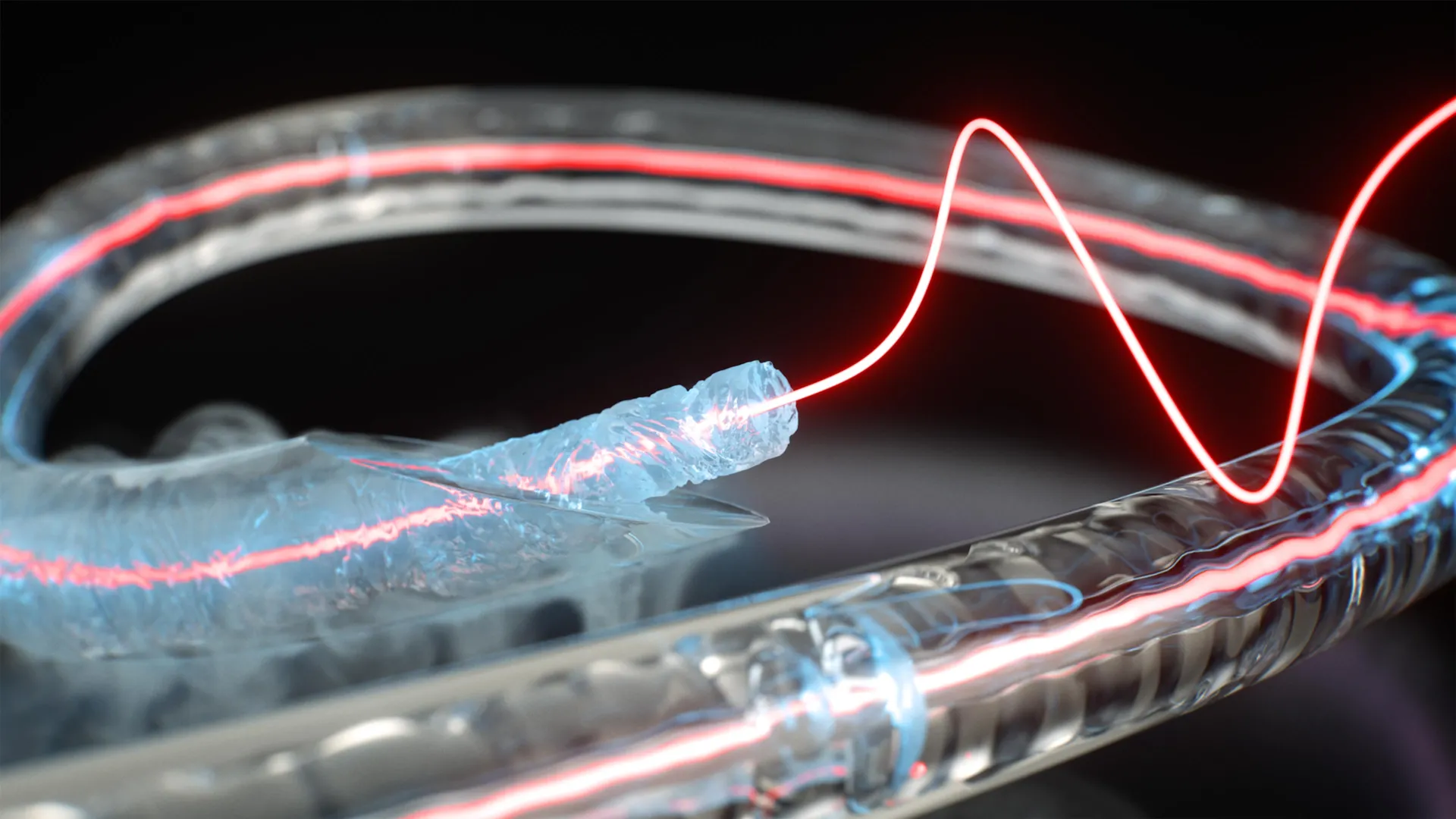
A related process plays an important role in manufacturing optical fibers. Glass preforms are heated until their structure becomes loose enough to be drawn into extremely thin fibers. Light travels through the fiber core, allowing information to move rapidly across long distances. This ability has made optical fibers essential to modern telecommunications.
Scientists have also developed specialized optical fibers for technologies including fiber lasers, fiber endoscopes, and fiber sensors. Some hollow core fibers can be filled with gases or liquids, allowing them to map temperature distributions or even function as tiny laboratories for chemical experiments.
Freezing a Liquid Core at Extreme Temperatures
Researchers from the Max Planck Institute of the Science of Light (MPL) in Erlangen, the Leibniz University Hannover (LUH) and the Leibniz Institute for Photonic Technologies (IPHT) in Jena have now taken liquid core optical fibers (LiCOF) in a new direction.