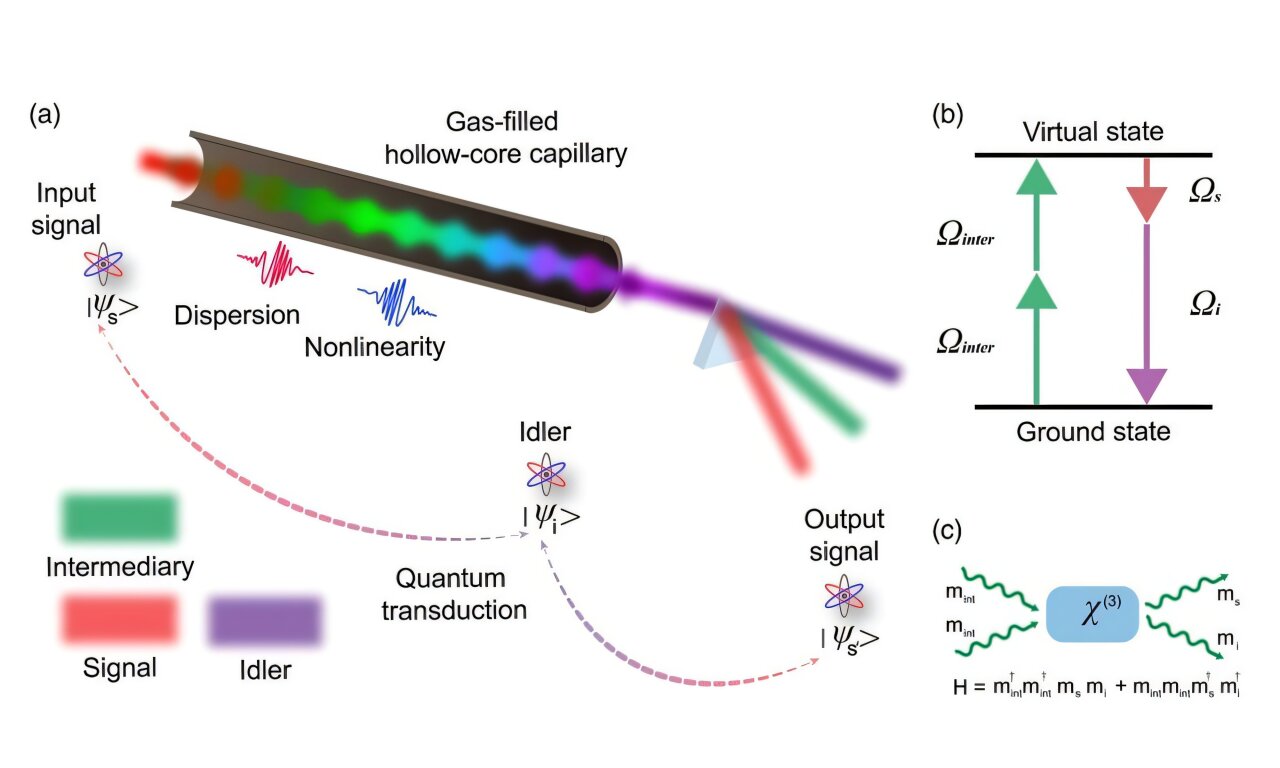
The gas-filled hollow-core waveguide enables efficient four-wave mixing by guiding light through a gas-filled core, allowing an intermediary laser to convert light to a new frequency while preserving the spectral phase required for coherent quantum information transfer. Credit: H. Zhang et al.
Quantum technologies promise secure communication networks, powerful forms of computing and new sensing tools. One of the major challenges, however, is that different quantum systems often operate at different wavelengths of light. Quantum memories, trapped ions and other quantum devices may work best in the ultraviolet or visible range, while long-distance communication over optical fibers works most efficiently at telecommunications wavelengths.
Building practical quantum networks will require reliable ways to translate quantum information between these different optical bands without losing the information carried by the light.
A new study published in Advanced Photonics Nexus explores a promising route to achieving that goal through a process known as four-wave mixing (FWM).
The research team—from UCLA, SLAC National Accelerator Laboratory, the University of Rochester and the University of Ottawa—investigated whether FWM can preserve one of the most important properties of a quantum light signal: its phase. Phase describes part of a light wave's structure and plays a central role in encoding and transmitting quantum information.