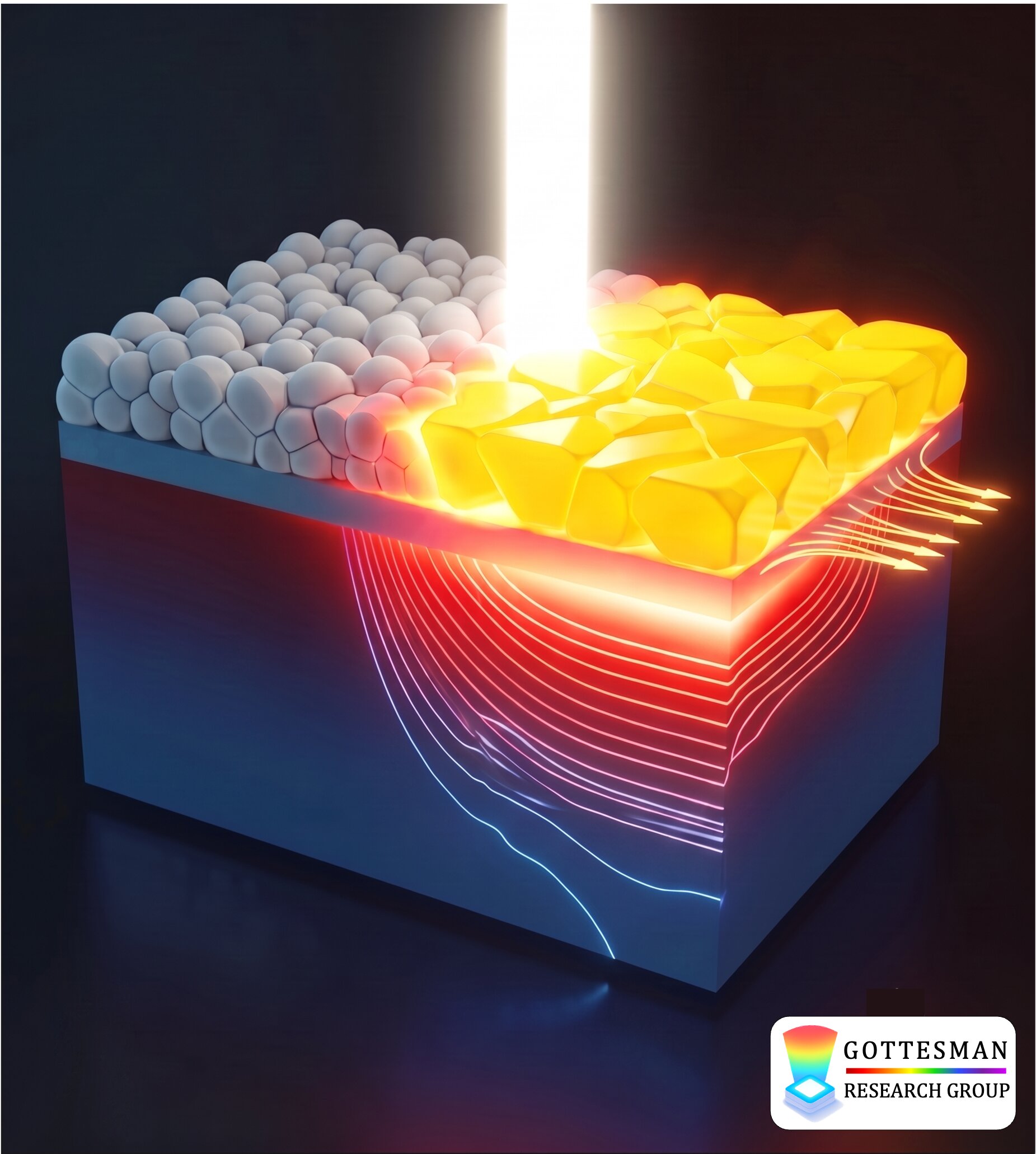
A flash of light rearranges a crystal, and another flash puts it back while the glass below stays cool. Credit: The Gottesman Research Group
A flash of light lasting a fraction of a millisecond could help create better materials for solar energy. Researchers used ultrafast heating at rates of up to 10 million degrees Celsius per second to rearrange the atoms inside a semiconductor, producing a version that generated up to 50 times more electrical current from light than the same material in its ordinary form.
Because the flash heats only the semiconductor coating and not the surface it sits on, the method works on transparent conducting glass, the see-through conducting surface used in touchscreens and solar cells, which conventional furnaces would ruin. The method could eventually help improve solar technologies and other advanced electronic devices.
Researchers have developed a way to use extremely short flashes of light to control the internal structure of semiconductor materials, potentially improving technologies used to convert solar energy into electricity.
In the process, the team heated a coating to nearly 2,000°C (3,600°F) while the glass sheet supporting it, known as the substrate, stayed below 100°C (212°F), a combination that conventional heating cannot achieve. Neither the glass nor its conducting coating tolerates temperatures much above 500–600°C (932–1,112°F), which is why high-temperature processing on these surfaces has been considered out of reach.