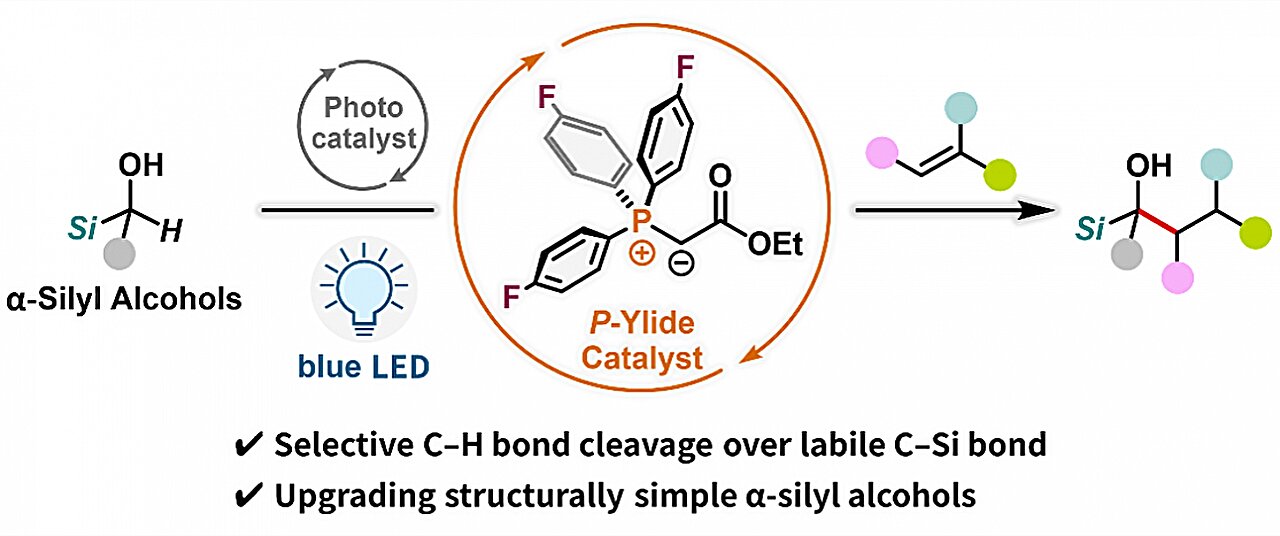
Research overview: α-C–H alkylation of α-silyl alcohols by phosphonium ylide hydrogen-atom transfer catalyst. Credit: Kanazawa University
α-Silyl alcohols are unique organosilicon compounds bearing a silyl group and a hydroxy group on the same carbon atom. Because these compounds serve as precursors to reactive species, such as carbanions and carbon radicals, they are pivotal building blocks for synthesizing pharmaceuticals and functional materials. However, their synthesis often requires multistep procedures and suffers from poor functional group tolerance. Developing simpler and more versatile synthetic methodologies has therefore become increasingly important.
"Chemists have utilized these compounds mainly in the Brook rearrangement—the 1,2-silyl group migration from carbon to oxygen—to generate reactive chemical species that can form new chemical bonds. Despite such unique reactivity and utility, little attention has been paid to the tedious procedures required for their preparation," explains Dr. Matsumoto.
To overcome these limitations, the researchers focused on hydrogen-atom transfer (HAT), a homolytic process in which a hydrogen atom in a molecule is abstracted by an active radical species to generate a new radical intermediate. They envisioned a photocatalytic system that promotes HAT from α-silyl alcohols to furnish carbon-centered radicals, which subsequently react with alkenes to afford functionalized α-silyl alcohols.