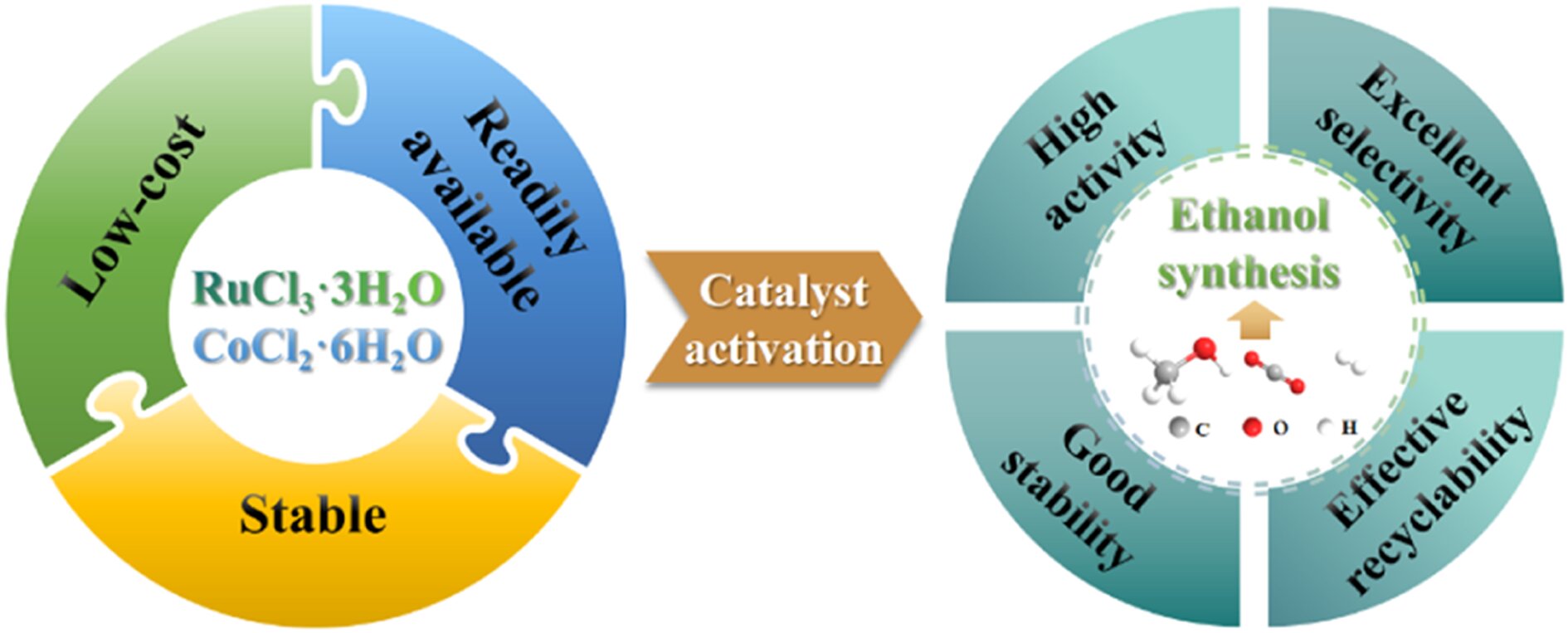
Visual abstract: Efficient ethanol synthesis with a stable Ru–Co catalytic system after CO activation of low-cost catalyst precursors. Credit: Catalysis Science & Technology (2026). DOI: 10.1039/d6cy00285d
An international team of researchers has developed a homogeneous catalytic process that converts methanol, carbon dioxide and hydrogen into ethanol using inexpensive and stable catalyst precursors.
Published in Catalysis Science & Technology, the study addresses a key challenge in efforts to transform captured carbon dioxide into useful chemicals. While ethanol can be produced from carbon dioxide and hydrogen, many existing homogeneous catalytic systems rely on expensive or complex catalyst precursors that can be difficult to deploy at an industrial scale.
In the study—a collaboration among researchers from The University of Manchester, the Institute of Chemistry, Chinese Academy of Sciences, the University of Chinese Academy of Sciences, Tianjin University of Science and Technology, and Fuzhou University—the team designed a homogeneous catalytic system using commercially available ruthenium chloride hydrate and cobalt chloride hexahydrate.
After activation with carbon monoxide, the catalyst converted methanol, carbon dioxide and hydrogen into ethanol under relatively mild reaction conditions of 170°C (338°F).