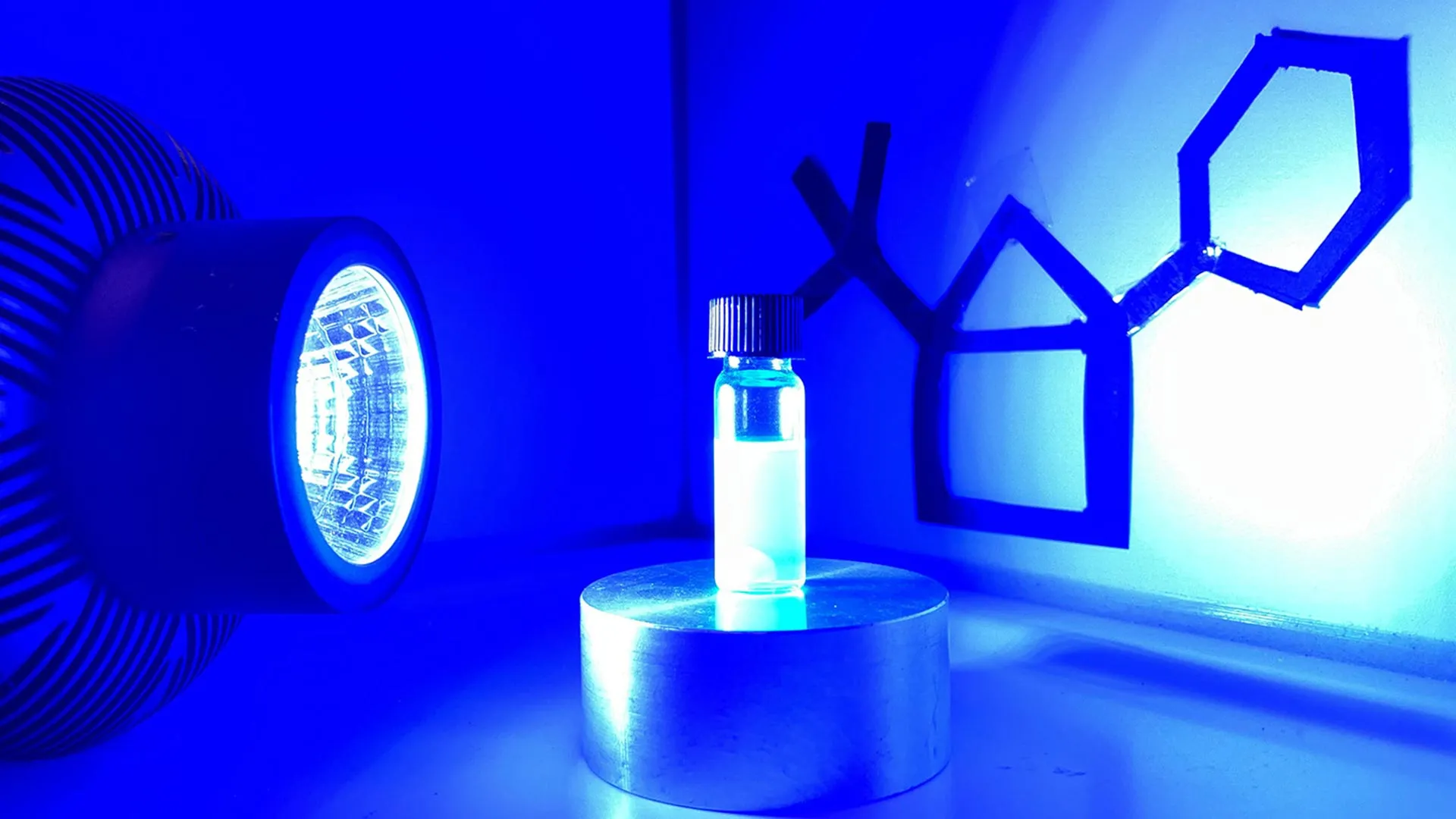
EPFL researchers have developed a simple way to create highly selective catalysts by letting two small molecules assemble themselves. The approach is more sustainable compared to traditional ones and will facilitate the discovery of new reactions for producing pharmaceuticals and other valuable chemicals.Many medicines, plastics and agricultural chemicals are made through a series of carefully controlled chemical reactions. At the heart of many of these reactions are catalysts, molecules that guide atoms into new arrangements without being consumed themselves. Designing new catalysts, however, is often a slow process of building and testing one complex molecule after another.An important consideration is chirality. Like our left and right hands, chiral molecules are mirror images that cannot be superimposed. Although they contain the same atoms, the two forms often behave differently in living organisms, making precise control over chirality essential in drug development.A team led by Giuseppe Zuccarello (SNSF Ambizione Fellow) at EPFL has now demonstrated a different strategy. Instead of synthesizing a single sophisticated catalyst, the researchers combined two readily available molecules that spontaneously assemble into an effective chiral catalyst. Instead of spending weeks synthesizing a new catalyst, chemists can simply mix two components and allow them to organize themselves into an active structure. Their work is published in Nature.The new catalyst tackles one of the hardest challenges in synthetic chemistry: selectively moving a single hydrogen atom while controlling the three dimensional arrangement of the final product. The reaction relies on light and proceeds through highly reactive radical intermediates, which are notoriously difficult to guide with precision.The EPFL team solved this problem by dividing the catalyst into two parts. One component provides the chiral environment that determines the product's handedness, while the other carries out the hydrogen atom transfer. Once mixed together, the two molecules form an active catalyst through non covalent interactions, meaning they associate without forming permanent chemical bonds.This modular design offers a major practical advantage. Because the two components can be varied independently, researchers can rapidly generate and test many different catalyst combinations without having to synthesize a completely new catalyst each time.To demonstrate the concept, the researchers applied the method to a family of ring-shaped molecules called 2 aryl pyrrolidines. These structures are common building blocks in pharmaceutical compounds. Starting from an equal mixture of left and right handed molecules, the self assembled catalyst produced material strongly enriched in a single preferred form while maintaining high yields.Mechanistic studies suggest that the catalyst performs an elegant relay. It first removes a hydrogen atom from the target molecule and later returns one, with both steps thought to occur within the same chiral environment. This coordinated sequence gives the catalyst an unusual level of control over the reaction.Beyond this specific transformation, the work introduces a broader design principle. Rather than building increasingly elaborate catalysts from scratch, chemists may be able to create powerful new systems by allowing simple components to organize themselves.The researchers believe the modular strategy could streamline the discovery of new asymmetric radical reactions, expanding the toolkit available for making pharmaceuticals and other complex molecules.FundingSwiss National Science Foundation (SNSF)ReferencesNavadheer Yalamanchili, Jules Hugo Alexandre, Robert L. Anderson, Giuseppe Zuccarello. Enantioselective hydrogen atom relay via non-covalent catalyst assembly. Nature 01 June 2026. DOI: 10.1038/s41586-026-10692-4
Modular chemistry speeds up the search for better catalysts
EPFL researchers have developed a simple way to create highly selective catalysts by letting two small molecules assemble themselves. The approach is more sustainable compared to traditional ones and will facilitate the discovery of new reactions for producing pharmaceuticals and other valuable chemicals.
533 words~2 min read