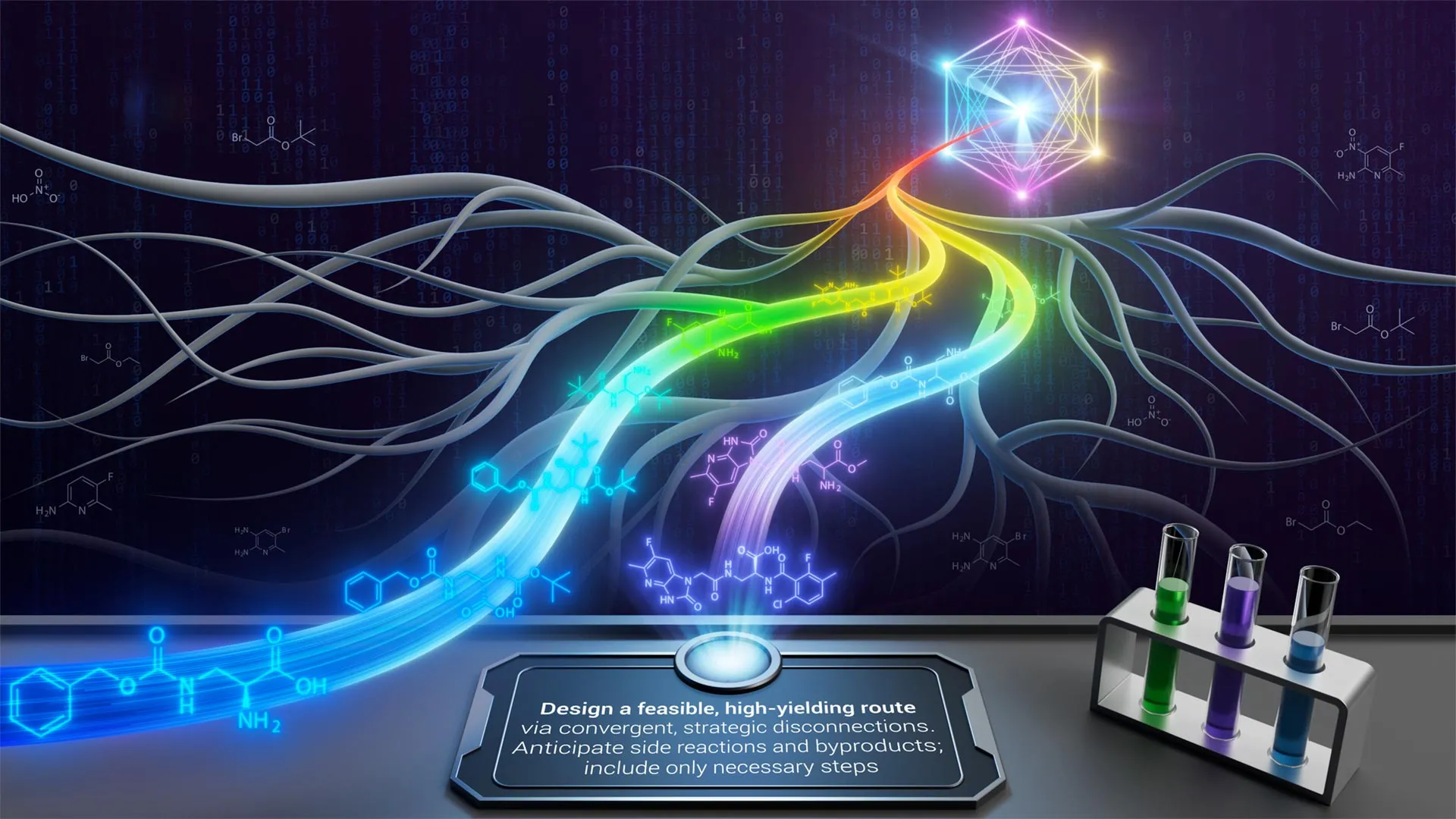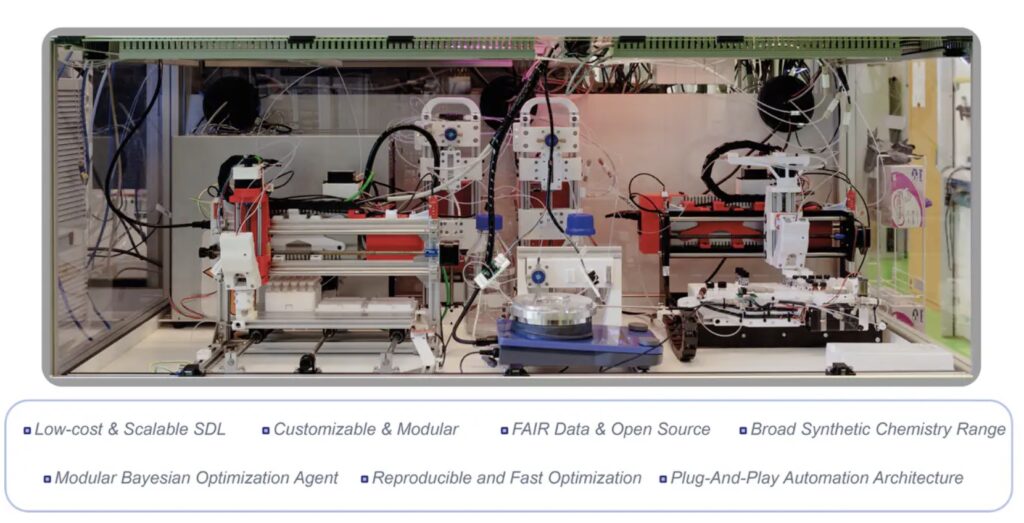
Image credit: HIMS / Nature Synthesis.
In a paper published in Nature Synthesis, researchers led by Professor Timothy Noël of the University of Amsterdam’s Van ’t Hoff Institute for Molecular Sciences present an advance in autonomous laboratory systems for synthesis optimisation. A versatile, modular design and the option for “human-in-the-loop” analytics, RoboChem Flex caters to all synthesis laboratories, large or small. The paper provides all the information to build their own system.
According to Professor Noël, this new version of the RoboChem concept developed by his group will democratise the use of autonomous, sophisticated AI-powered synthesis systems. Such systems are often very expensive, so that only well-funded institutions can afford them. “We find such an exclusive privilege counterproductive to science. Scientific progress requires scalable, cost-effective tools that empower researchers across all resource levels. So we have now developed our system to be widely used, also by less well-established groups, boosting research capabilities, innovation opportunities, and scientific influence.”
Cost down, versatility up
Presented in the journal Science in early 2024, the first RoboChem system featured an autonomous system for flow chemistry, coupled to a benchtop NMR system for analysis, and controlled by an integrated machine learning AI-unit. In their original paper, the group demonstrated RoboChem’s power in accelerating chemical discovery of molecules relevant to pharmaceutical and other applications. Working autonomously round the clock, the system can optimise the synthesis of ten to twenty molecules all by itself, something that would take a PhD student several months.