(Image credit: SanDisk)
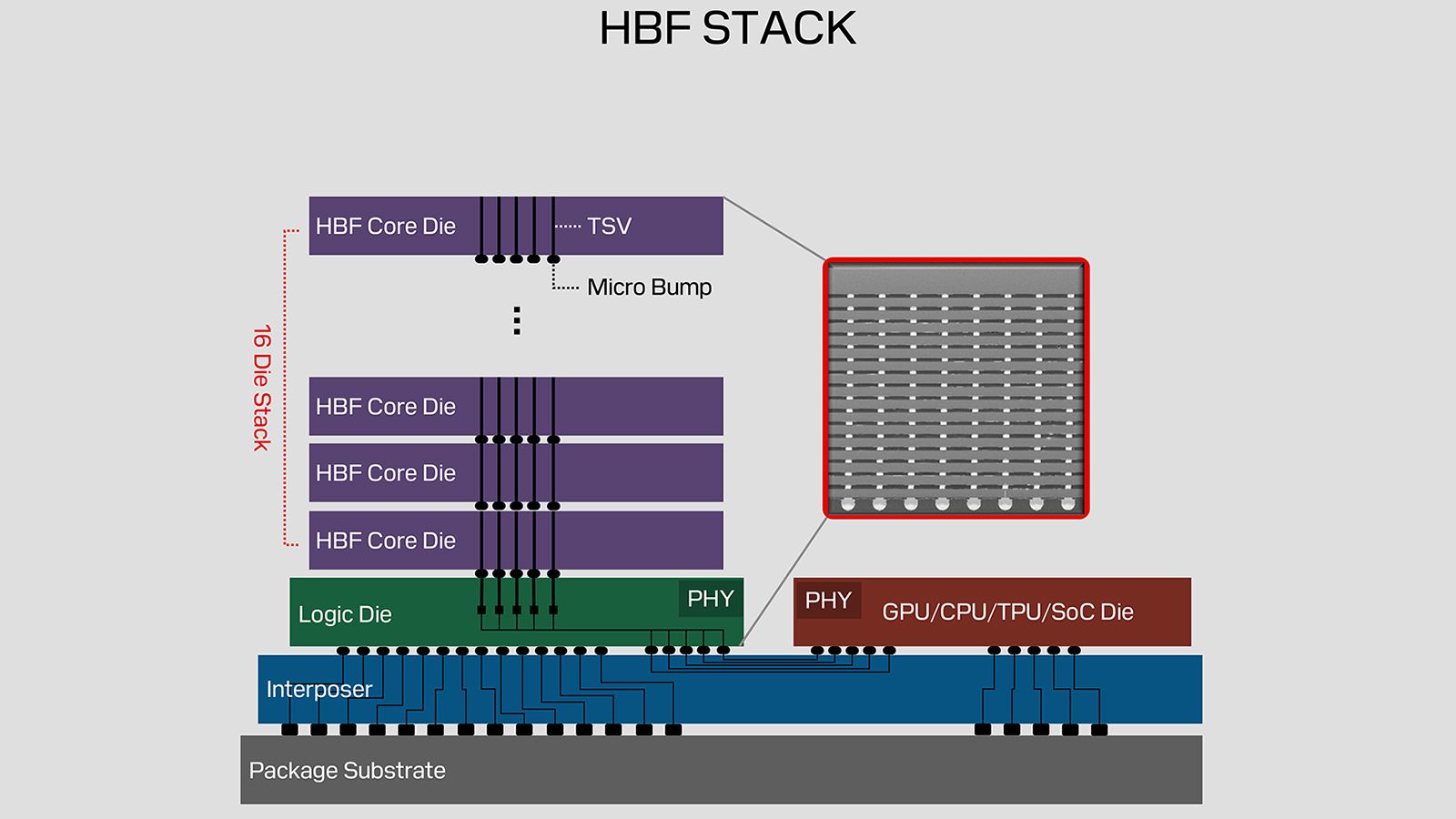
Sandisk and SK hynix on Tuesday formally introduced the High Bandwidth Flash (HBF) specification, their jointly developed storage technology that promises to bring together the non-volatility of 3D NAND and the performance of High Bandwidth Memory (HBM), which will be handy for AI inference systems. The specification was released through the Open Compute Project (OCP), so it will be an open standard rather than a proprietary interface.Tom's Hardware Premium RoadmapsThe initial specification defines HBF packages with capacities of up to 512GB using either 8-Hi or 16-Hi NAND die stacks, though these will not be standard 3D NAND stacks, but rather specialized devices with a fast interface. In fact, Sandisk once called them HBF core dies rather than 3D NAND die stacks.Performance of HBF is divided into three bandwidth grades ranging from approximately 0.4 TB/s to 3.0 TB/s (though we are not sure whether this figure describes the full HBF subsystem or per-package bandwidth). Such a huge performance range implies that Sandisk and SK hynix expect HBF to have a multi-year roadmap featuring multiple implementations and generations of HBF. It is noteworthy that the most capable implementation of HBF (3 TB/s) is set to beat the memory bandwidth of a single HBM4 memory stack (2 TB/s), though it will be unlikely to beat HBM4 when it comes to latency.