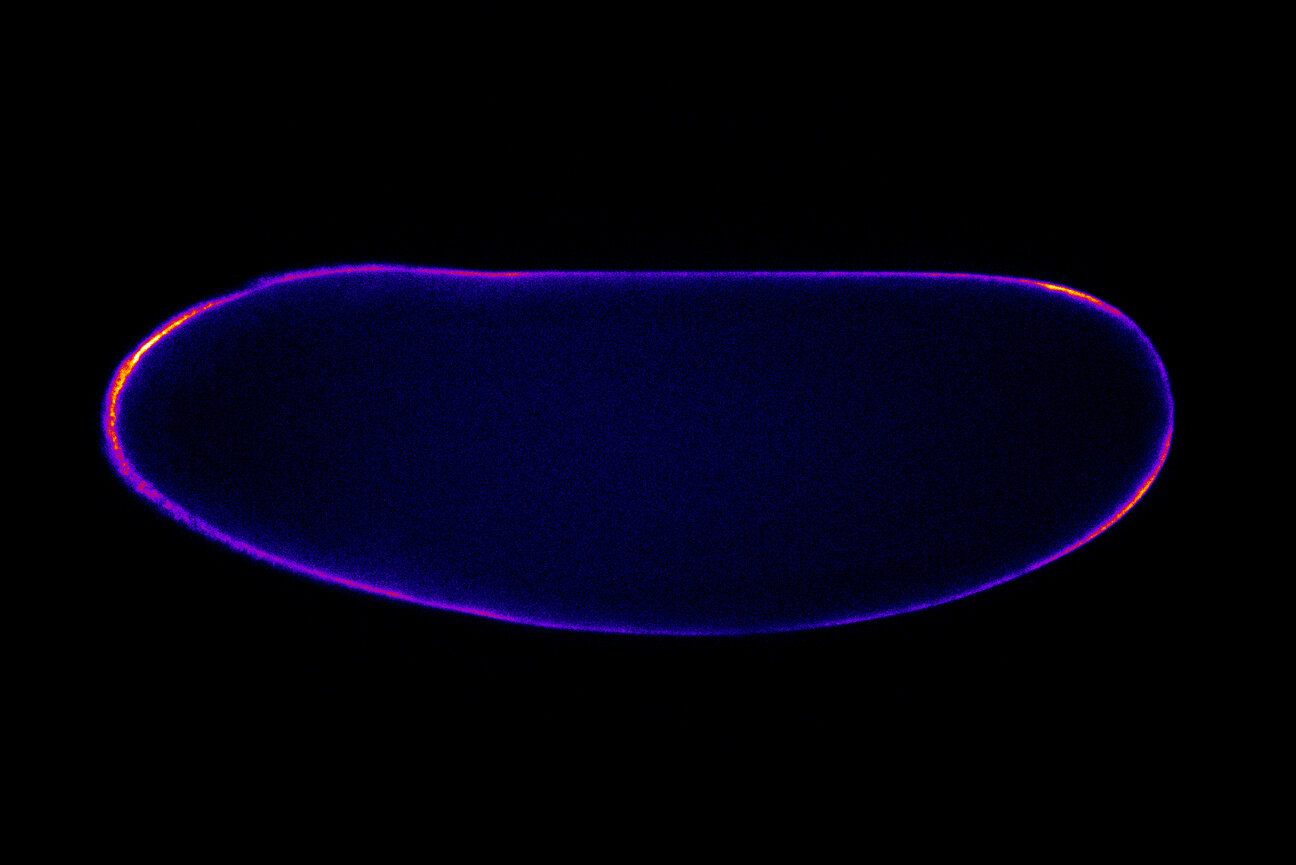
An embryo expressing a PIP3 marker. Credit: Lehmann Lab/Whitehead Institute
Every embryo of an organism that reproduces sexually faces an early and consequential decision: which of its cell lineages will make up the mortal body, and which will become the germline, the lineage that eventually makes eggs or sperm and carries genetic information to the next generation. Get this wrong, and an organism can live but cannot reproduce and, evolutionarily, ceases to exist.
Like most embryos, fruit fly embryos begin as one mega-cell, the fertilized egg cell, full of the ingredients for future development. What's different in fly embryos is that not all cells form at the same time. Before most of the embryo has been subdivided into individual cells, a small group of cells that will eventually produce eggs or sperm has already begun to form. These primordial germ cells emerge at the back end of the embryo, where small buds rise from its surface and pinch free from the shared interior.
A new study from the lab of Whitehead Institute Director Ruth Lehmann reveals that this process depends on preparations made before the buds appear. The researchers found that a protein, aptly named Germ Cell-less (GCL), produced at the posterior, organizes a distinct region of the embryo's membrane so that the molecular machinery needed to separate the future germ cells can assemble.