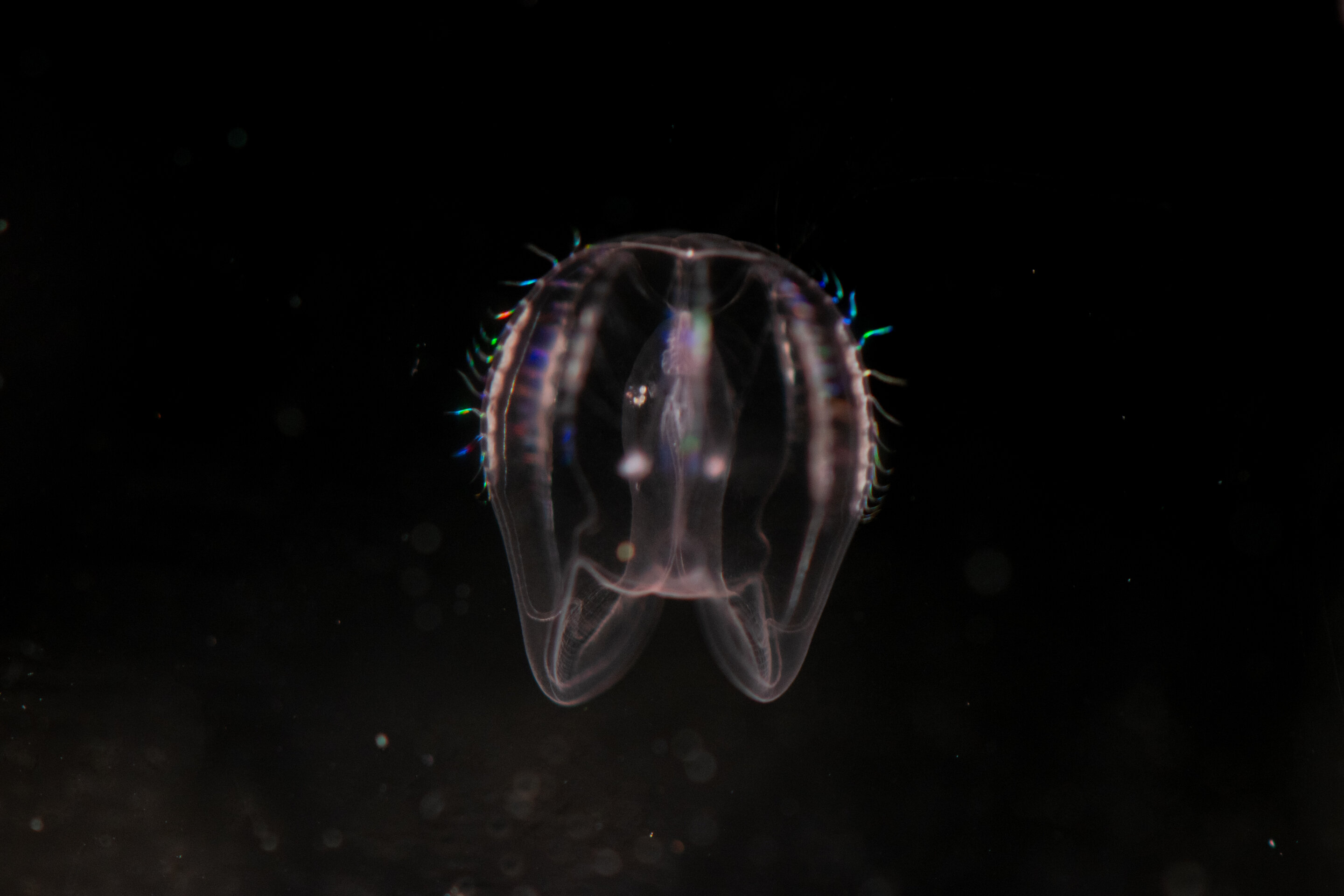
A comb jelly of the species Mnemiopsis leidy. Credit: Lisa-Marie Barf
In order for vertebrate embryos to develop their body axes, they require what is known as an embryonic signaling center. This group of cells provides the instructions that determine where up and down, left and right, and front and back are. Biologists at Friedrich Schiller University Jena have now discovered that even cnidarians—which form the sister group to all other multicellular animals, according to current understanding—possess this fundamental coordinate system. The study is published in the journal Nature.
Together with his student Hilde Mangold, the biologist Hans Spemann discovered the so-called "organizer" during embryonic development in 1924. In doing so, they transplanted tissue from a specific area—the blastopore—of an amphibian embryo into another and observed that the resulting animal developed a second axis. The two researchers concluded from this that the transplanted group of cells organizes the three-dimensional structure of a multicellular animal during an early phase of embryogenesis.
Hans Spemann was awarded the Nobel Prize in 1935 for the discovery of this elementary coordinate system. Hilde Mangold, his former student, had died in 1924.