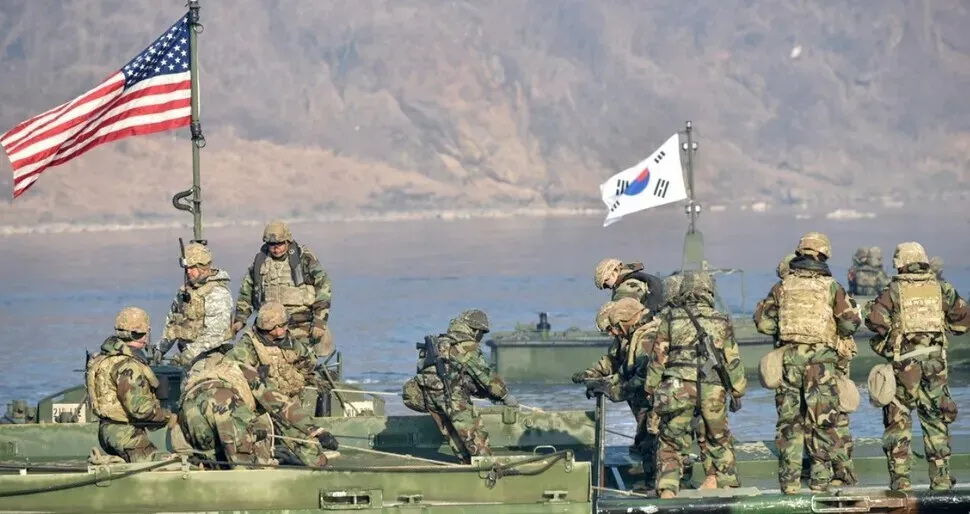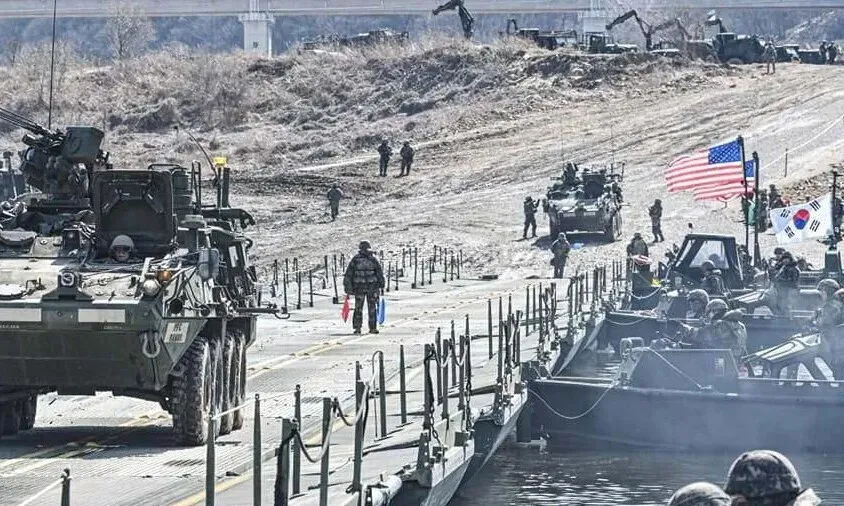
Armored vehicles cross a river during a joint river-crossing drill between South Korea and the US in South Korea on March 6, 2023. (via ROK Army on Facebook)
In June, the Hankyoreh published the series “Debunking OPCON Doubts” as a deep dive into points of contention over Korea regaining wartime operational control (OPCON) of its armed forces. After publishing this report, several readers emailed us with questions about what happens after OPCON is transferred, specifically whether the ROK/US Combined Forces Command (CFC) would cease to exist and whether a general from the ROK Army would command the United States Forces Korea (USFK). Others noted the so-called Pershing Principle, which states that American armed forces may never be commanded by a foreign army, and questioned whether the ROK Army would be able to truly command US forces. We respond to these questions in an easy-to-understand Q&A format below. Q. Some claim that the CFC, currently a key part of the combined defense posture, will be dismantled upon Korea regaining OPCON. Is that true?A. It is not true that the CFC will be dismantled. In a US-Korea summit meeting held in February 2007, during the George W. Bush and Roh Moo-hyun administrations, the two nations agreed that OPCON would be transferred to Seoul on April 17, 2012, and that a parallel command structure would be created after the dissolution of the CFC in which the ROK Army would lead and the US Army would play a supporting role. Under this system, the joint command structure of the CFC would cease to exist, as the ROK Army would be controlled by Korea while the US Army would remain under US control. However, during the Moon Jae-in administration in 2018, Korea and the US signed a document called the “Guiding Principles Following the Transition of Wartime Operational Control” in which they agreed to establish the “future Combined Forces Command” — a structure that is similar to the current CFC system. Under this future reincarnation, which would replace the CFC after the OPCON transfer, a four-star general from the ROK Army would serve as commander while the deputy commander position would be held by a four-star general from the US Army. At present, the position of CFC commander is held by a US Army general, with a ROK Army general serving as deputy commander. Both this future formulation and the current CFC share a joint command structure, so the basic framework, organization and functions would be almost identical.Q. If the commander of the future CFC is in charge of the ROK Army, does that mean a general from the ROK Army would command the USFK? When OPCON is returned to Korea, what exactly is the authority being transferred?A. The ROK Army commander of the future CFC would only control the operations of a portion of the USFK as stipulated in the Operational Plan (OPLAN). The US would continue to exercise operational control over other US forces. The Korean Peninsula is currently in a DEFCON 4 state of readiness, so Korea maintains operational control of the ROK Army during times of peace.If a crisis on the Korean Peninsula were to escalate enough for the CFC commander to declare DEFCON 3, the OPLAN states that the South Korean armed forces and USFK would fall under the CFC’s operational control. This means that the CFC would exercise operational control over the South Korean military.The question of which South Korean and USFK units are designated in the plan according to the agreement between the two sides’ governments is treated as a military secret and has not been made public. According to records and accounts from former senior military figures, most of the South Korean military has been designated, with the exceptions of the Capital Defense Command, Special Warfare Command, and the 2nd Operations Command, which is tasked with defending regions in the rear. In contrast, only a portion of USFK has reportedly been designated.