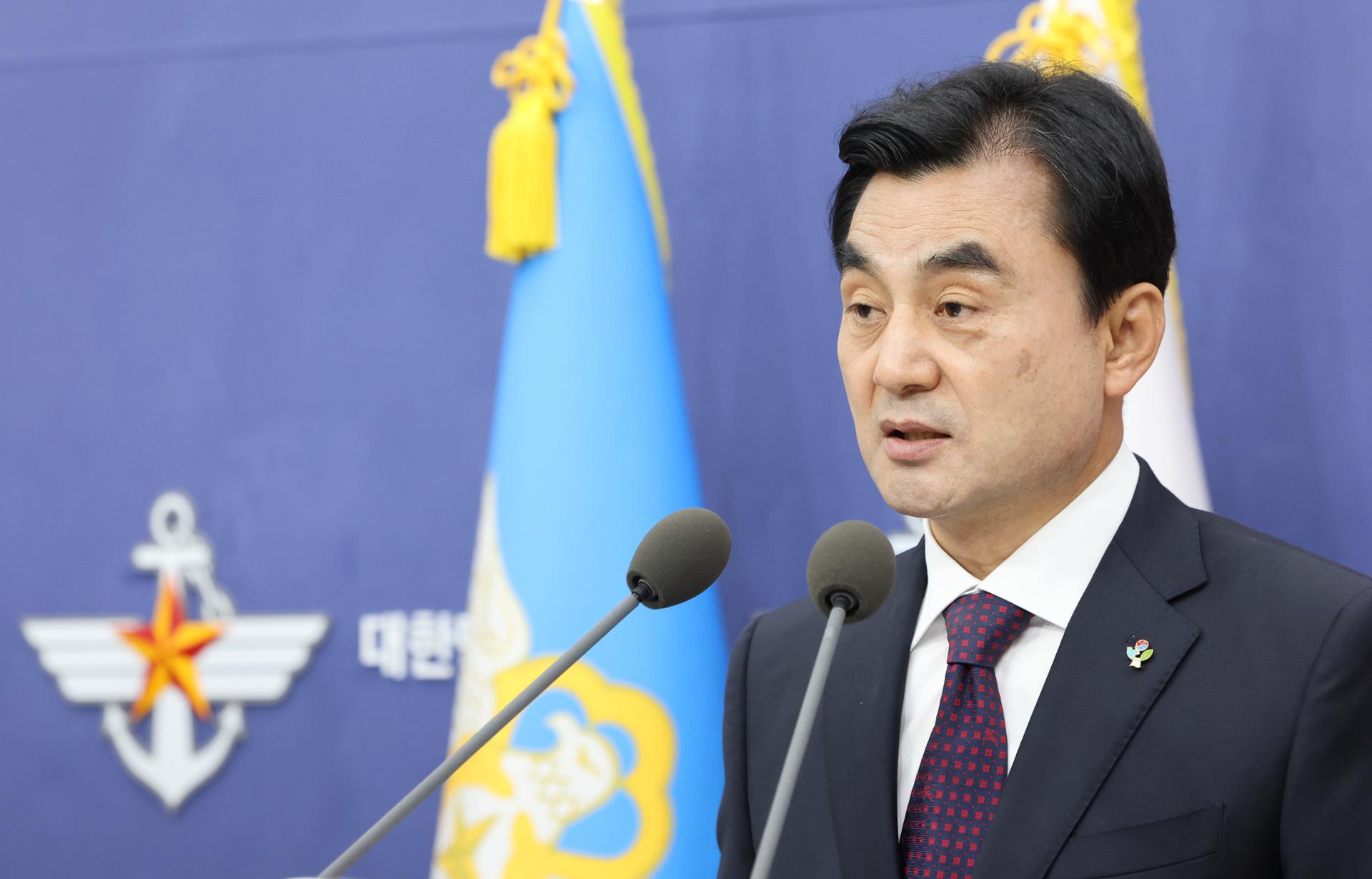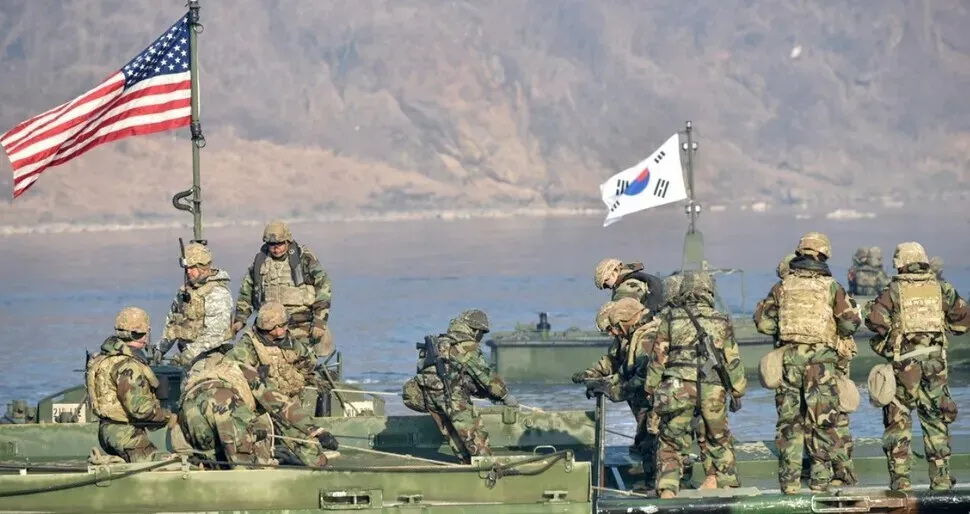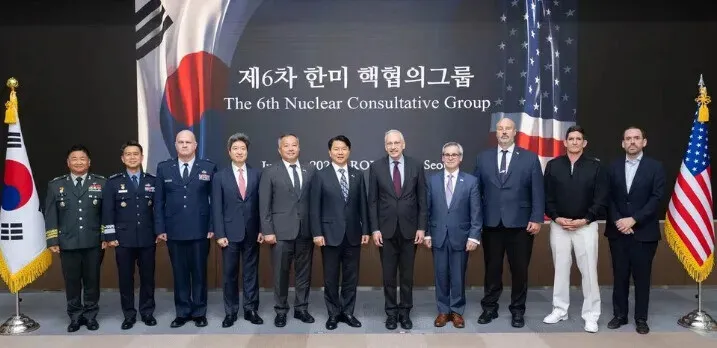
President Lee Jae Myung conducts a review of forces during an event commemorating Armed Forces Day on Oct. 1, 2025. (courtesy Blue House)
Editor’s note: Korean President Lee Jae Myung has promised to recover the wartime operational control (OPCON) of the Korean armed forces from a US-led joint command and means to complete the transfer as early as the end of 2027. Lee reiterated his commitment to the plan on June 19 by arguing that the US shouldn’t hold OPCON when Korea is taking fiscal responsibility for its own defense. But the Americans’ apparent position on the OPCON handover is that meeting milestones takes priority over timing, with the commander of US Forces Korea, Gen. Xavier T. Brunson, proposing that the transfer could take place in the first quarter of 2029. Given the evident disagreement between the two sides, even some in Korea have objected that the Korean military still lacks the necessary capabilities. On the occasion of the anniversary of the start of the Korean War on June 25, the Hankyoreh will be reviewing the controversy over the OPCON handover from several angles. On May 26, South Korean Minister of National Defense Ahn Gyu-back asserted that there would be “no major issues with South Korea defending itself if wartime OPCON were returned tomorrow.”His remarks came at the inaugural meeting of the Future Defense Strategy Committee, which took place in the Jinhae District of Changwon, South Gyeongsang Province, with President Lee Jae Myung in attendance.In response, Lee asked, “Wouldn’t it be correct to say there would be ‘no issues at all,’ rather than ‘no major issues?’” Ahn replied, “There would be no issues at all.”The message signaled that with the return of OPCON, South Korea would regain military sovereignty and be capable of waging war if push came to shove.But conservatives have called for a cautious transition rather than a speedy return of OPCON, insisting that the South Korean military still does not have the necessary capabilities. In their view, South Korea’s armed forces lack the kind of intelligence assets that the US uses to monitor North Korea, possess limited precision strike capabilities, and have an inadequate command and control system.Yet in reality, the troops that would be sent from the Combined Forces Command to defend South Korea in an emergency would include almost no US presence.The ground forces would consist of 99% South Korean troops. South Korea would also account for 95% of naval forces and 90% of air forces. The framework is one in which the South Korean armed forces would assume the majority of responsibility in the event of a kinetic conflict on the Korean Peninsula.Currently, the 28,500 troops in US Forces Korea include 18,000 from the Army and 8,000 from the Air Force.In particular, USFK would not be deployed to wage war directly in the early stages of a conflict.“A considerable portion of the USFK ground forces would be deployed for US national evacuation operations in the early stages of a war, when large numbers of casualties occur,” explained a South Korean government official.The same official said the US military was “progressively reducing the scale of US troops in its Korean Peninsula operational plan.”The president’s confidence that there would be “no issue at all” if OPCON were regained tomorrow is rooted in the determination that the Republic of Korea has, as he said in an Armed Forces Day commemorative address last October, “developed a stronger defense power than ever before in its history.”According to figures from Statistics Korea (now the Ministry of Data and Statistics) and other sources, North Korea’s annual nominal gross domestic product (GDP) amounted to around 43.7 trillion won in 2024, while South Korea’s national defense budget for the same year was 59.4 trillion won. In other words, South Korea’s defense spending was bigger in scale than the entire North Korean economy.The difference in defense spending between South and North Korea was estimated by the Stockholm International Peace Research Institute (SIPRI) in 2018 to be about 26 times, with South Korea spending around US$43.07 billion in comparison with North Korea’s US$1.6044 billion.North Korea has allocated as much as 15.8% of its total budget to defense expenditures, pledging to accelerate the “contributing to the steady expansion and strengthening of the powerful self-defensive nuclear deterrent and war capabilities.” In reality, the fact that South Korea’s GDP is approximately 59 times larger (according to 2024 figures) suggests it is unlikely to bridge the widening gap.Since OPCON transfer preparations began in earnest in 2007, investments purely toward bolstering the South Korean military’s capabilities (not including personnel costs) have reached a cumulative total of 176.3 trillion won (around US$114 billion). Much of that has been spent on building the intelligence, surveillance and reconnaissance (ISR) capabilities that would allow for real-time battlefield situations; immediate precision strike capabilities against strategic and tactical targets; and command and control capabilities for instantaneous decisions reflecting both military capabilities and intelligence.The focus has been on reinforcing the three sets of capabilities that were reported as the standards set by South Korea and the US when they reached an agreement on a conditional OPCON transfer in 2014.In the past, the South Korean military has had to rely on US intelligence assets — including spy satellites and reconnaissance aircraft — to gauge North Korean activities. Before the introduction of Green Pine radar for ballistic missile detection in 2012, it would not have even known if North Korea had fired a ballistic missile without intelligence from the US. Lacking its own independent network for monitoring the North, it was fully dependent on US information.Today, the situation is totally different.South Korea currently operates five of its own military spy satellites, which allow it to check on the Korean Peninsula in two-hour units. If it succeeds with the launch of 30 to 40 microsatellites to complement the spy satellites, it will be able to monitor North Korean military threats more or less in real time, including mobile missile launcher activities.Already, South Korea is monitoring North Korea with four Global Hawk high-altitude unmanned aircraft acquired from the US. Last April saw the release of a medium-altitude unmanned aerial vehicle (MUAV) that represents South Korea’s first-ever strategic-class drone. This drone is capable of monitoring ground targets in real time while flying at altitudes of 10,000 km and higher.“The South Korean military has the necessary capabilities to exercise operational control,” affirmed Lee Sung-choon, a professor of North Korean studies at Dongguk University and former director of the Ministry of National Defense’s Institute for Military History.In terms of precision strike capabilities, South Korea has acquired Hyunmoo-2, Hyunmoo-3, Hyunmoo-4, and Hyunmoo-5 missiles, along with long-range air-to-surface Taurus missiles.The Hyunmoo-5, which has been in combat position in front-line units since late 2025, is a powerful ballistic missile with a warhead weight of 8 metric tons and the ability to destroy underground bunkers in North Korea. Analysts view it as a key weapon in completing the “massive punishment and retaliation” component of the South Korean military’s “three-axis” system for responding to North Korean nuclear and missile threats (the other components being the kill chain and “Korean air and missile defense”).In the area of command and control (C2), the South Korean armed forces operate a battlefield management system with an integrated military intelligence management system (MIMS) based on the Korean Joint Command & Control System (KJCCS).While meeting with members of the US Senate and House of Representatives at the Shangri-La Dialogue in Singapore on May 31, Ahn Gyu-back stated that he “fully explained about South Korea’s capabilities, including the agreement between South Korea and the US in 2020 that 94% of the conditions for the OPCON transfer had already been met.”A senior South Korean government official said, “Based on what was agreed on in 2014, South Korea has already achieved independent operation levels in its ISR, precision strike, and command and control capabilities.”“The capabilities that the South Korean armed forces have established are those that are possible for military powers backed by economic and technical capabilities, such as the US, the UK, France or Israel,” they added.Some in the US and South Korean military have argued for the need to adjust and supplement the conditions for an OPCON transfer in response to changes in how wars are being fought — including the increased threat of drone use — and North Korea’s development of hypersonic missiles and other new weapons. Their position is that the air defense network must be bolstered due to the South Korean military’s lack of drone prevention capabilities and the strong probability that North Korea would use a mixture of super-large rocket launchers, short-range missiles, various cruise missiles, and hypersonic missiles.Some generals in the reserves and active service also insist that a transfer would be premature, maintaining that South Korea would need the same kind of hardware and software that the US possesses to exercise OPCON capabilities.But others argue that trying to keep up with changing conditions will only result in the OPCON transfer being put off indefinitely.Kim Jung-sup, a senior research fellow at the Sejong Institute, recalled, “When Roh Tae-woo talked about regaining operational control as a pledge in the 1987 presidential election, people talked about how it was ‘too early,’ and we’re hearing the same things nearly 40 years later, even after our military’s capabilities have improved greatly.”“The OPCON transfer should be viewed as a matter of will and policy choices rather than a question of conditions or capabilities,” he argued.By Kwon Hyuk-chul, staff reporterPlease direct questions or comments to [english@hani.co.kr]