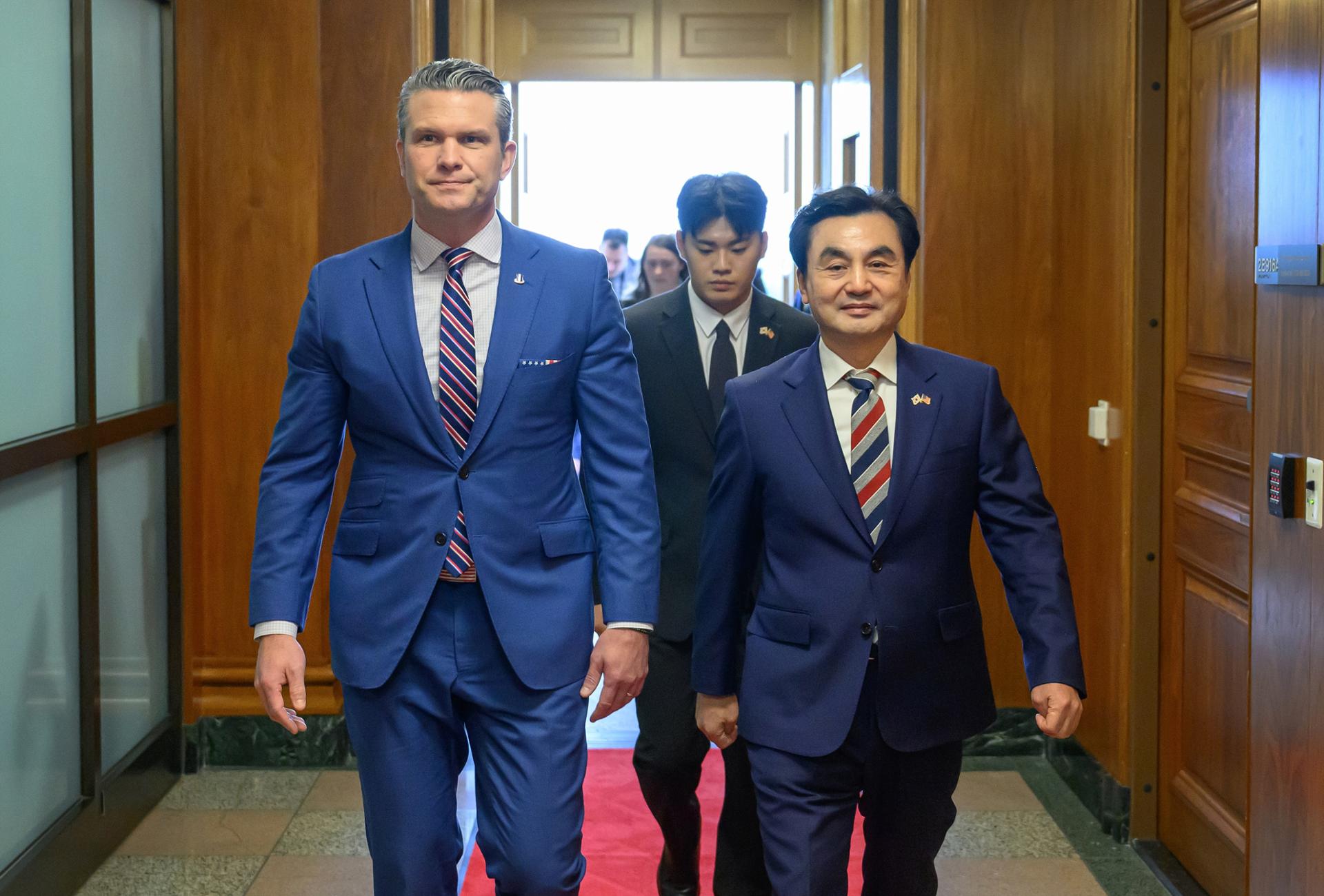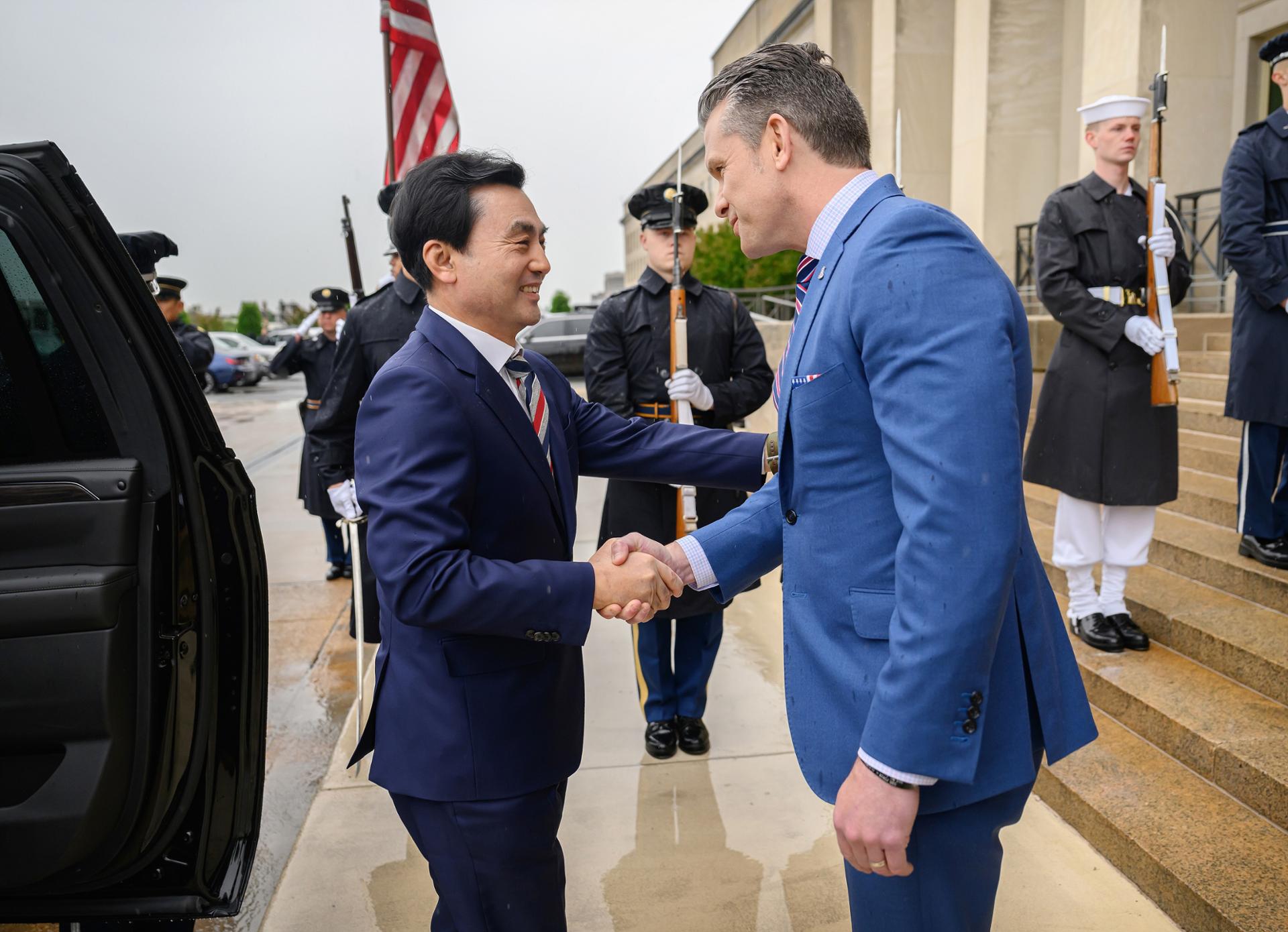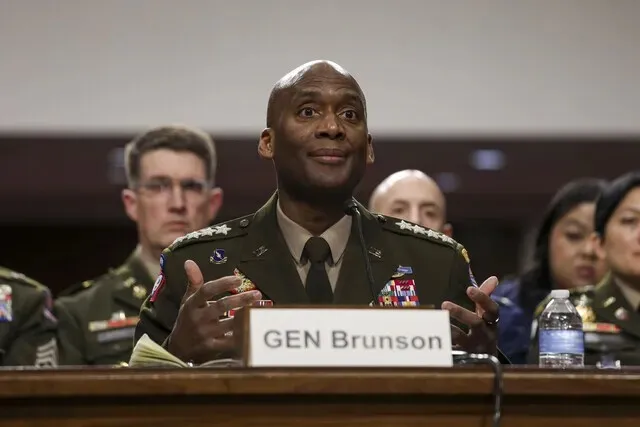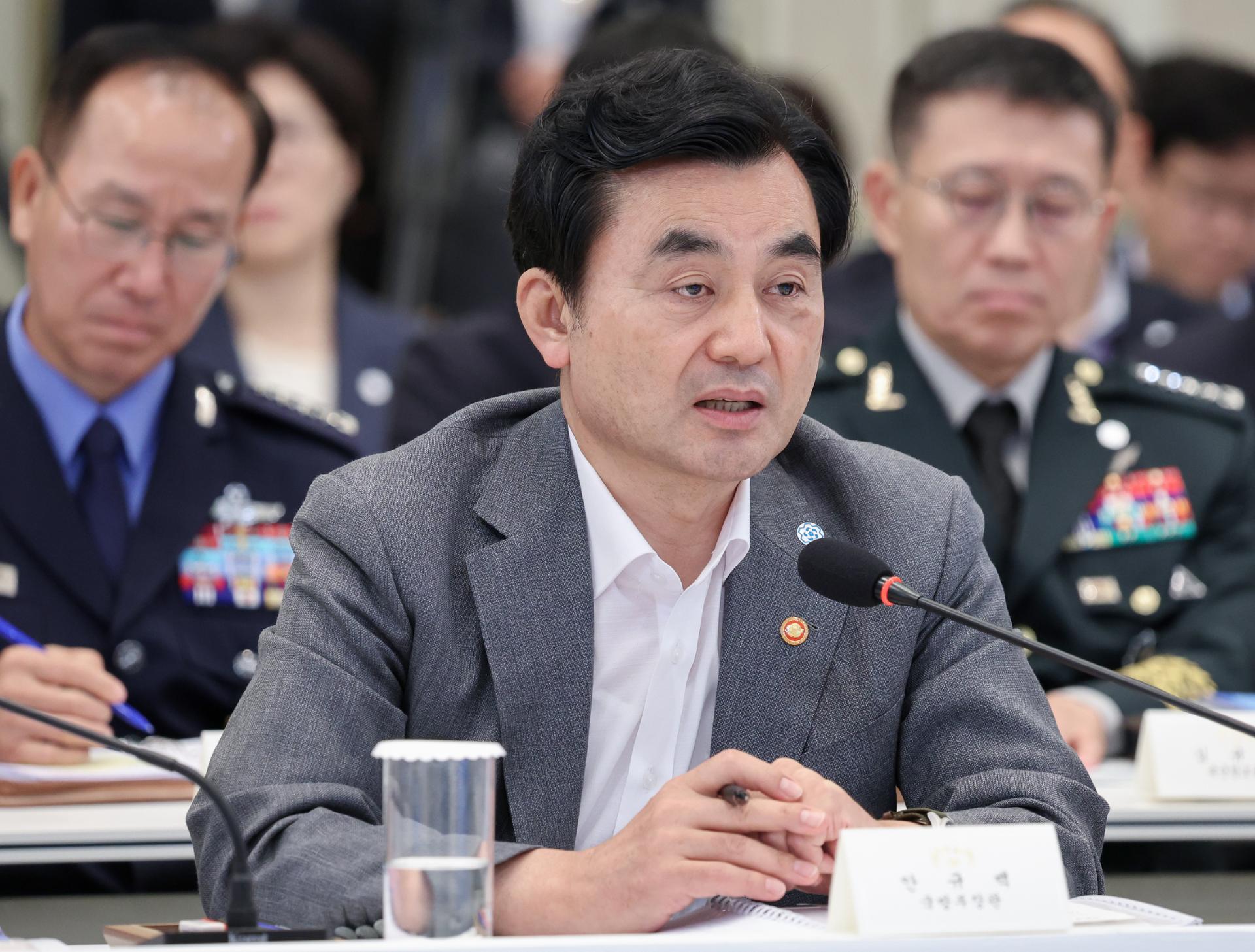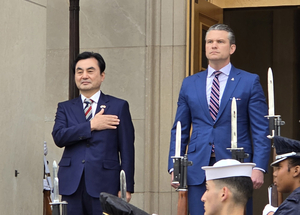
Seoul plans to complete final OPCON review within a year South Korean Defense Minister Ahn Gyu-back (left) and US Defense Secretary Pete Hegseth attend a ceremony, ahead of their talks at the Pentagon near Washington on May 11. (Joint Press Corps via Yonhap) South Korea seeks to accelerate the transfer of wartime operational control, with the final review possibly completed in about a year, a senior Defense Ministry official said Wednesday, suggesting a possible timeline that differs from a 2029 target recently presented by the US side.A ranking ministry official familiar with the matter said the assessment and verification of the Future Combined Forces Command’s full mission capability could begin immediately after the allies complete the preceding full operational capability assessment.“If the target year is set after this year’s FOC verification, we will move straight into FMC,” the official told reporters. “After the FMC assessment and verification are completed, the allies will enter the final stage of the OPCON transition process.”FMC, or full mission capability, is the final phase of the three-stage process. The allies are conducting the second-phase FOC, or full operational capability, assessment this year. The first phase, initial operational capability, was completed in 2019.In 2015, Seoul and Washington agreed to proceed with a conditions-based OPCON transition plan and set out the three-stage assessment process to verify whether South Korea has secured the capabilities needed to lead combined forces after the transfer.Under the plan, the allies envisioned the Future Combined Forces Command as the wartime command structure after OPCON transfer, with a South Korean four-star general leading the combined command and a US four-star general serving as deputy commander.Currently, the Combined Forces Command, led by a US four-star general, exercises wartime OPCON, which has remained under US authority since the 1950-53 Korean War.According to the official, Seoul and Washington had sought a roadmap to accelerate OPCON transition during the latest Korea-US Integrated Defense Dialogue, held in Washington from May 12-13. The work has been delayed, as more issues need to be addressed.The roadmap is expected to be completed before this year’s Security Consultative Meeting, the annual defense ministerial talks between Seoul and Washington, the official added. If completed, it could pave the way for Seoul to seek a target year for the transition at this year’s SCM.Under one possible scenario outlined by the official, the allies could set 2027 as the target year, complete the FMC process within about a year and recommend a specific transfer date at next year’s SCM.But the key question is whether Seoul and Washington can narrow their differences over the timeline.The South Korean government has pushed to complete the transfer before President Lee Jae Myung’s term ends in 2030, while US military authorities have maintained a more cautious, conditions-based approach.In April, Gen. Xavier Brunson, who commands USFK and the allies’ Combined Forces Command, told a congressional hearing that the allies were pursuing OPCON transition “not later than the second quarter of fiscal year 2029,” while stressing that the transfer should remain conditions-based.He also said he had submitted a roadmap to senior US defense officials outlining steps needed to meet the conditions for the transfer.The ministry official stressed that the transition is ultimately a political and policy decision, though military assessments would remain the basis of the process.“OPCON transition is decided at the political and policy level from beginning to end,” the official said, adding that military authorities provide advice through assessments and reports.The official also said the Defense Ministry is closely analyzing how South Korea and the United States would respond to a North Korean nuclear attack after OPCON is transferred.The issue has drawn attention because South Korea does not possess nuclear weapons, while the allies’ nuclear deterrence framework is led by the United States.The official said the matter is being discussed through the Nuclear Consultative Group, the bilateral body launched under the 2023 Washington Declaration.“We are conducting an in-depth analysis,” the official said. “The issue was also discussed at the recent Korea-US Integrated Defense Dialogue.”On South Korea’s push to acquire nuclear-powered submarines, the official said the Defense Ministry’s role is limited, as key issues such as uranium enrichment and spent fuel processing largely fall under the jurisdiction of the US State Department and Department of Energy.The ministry explained the strategic and operational need for nuclear-powered submarines during recent defense talks with Washington. However, the official said the issue would require broader diplomatic efforts beyond military channels.Separately, the official said the allies formally discussed South Korea’s proposal for dividing management responsibilities inside the Demilitarized Zone during the latest KIDD.Under Seoul’s proposal, areas north of the South Korean military fence inside the DMZ would remain under the jurisdiction of the United Nations Command, while areas south of the fence would be managed by the South Korean military.The official said the US side showed understanding of the proposal’s necessity, describing the discussion as “significant progress.”
South Korea seeks quicker OPCON transfer than US timeline suggests
South Korea seeks to accelerate the transfer of wartime operational control, with the final review possibly completed in about a year, a senior Defense Ministry
811 words~4 min read