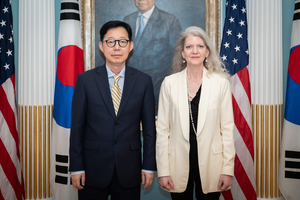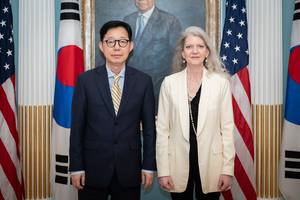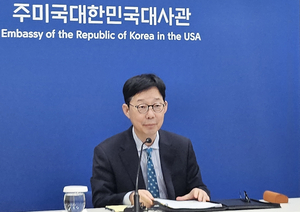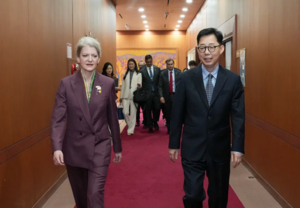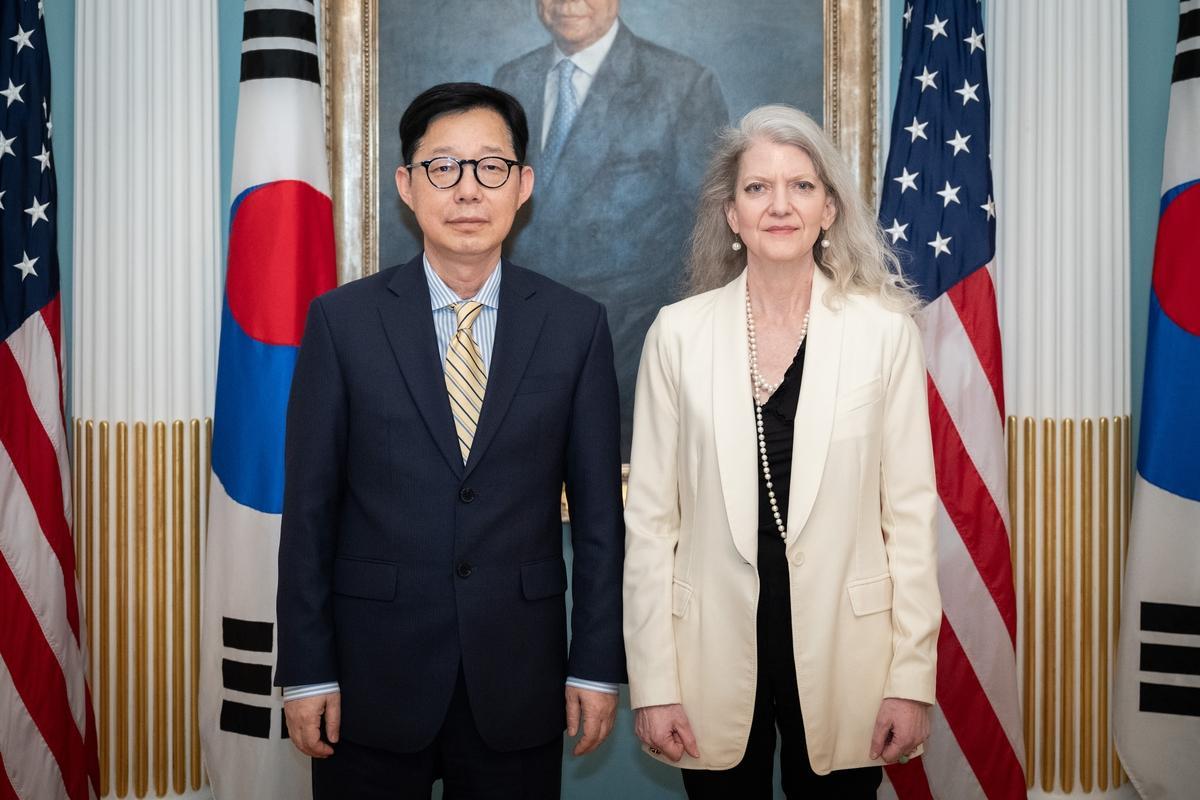
South Korea's First Vice Foreign Minister Park Yoon-joo, left, and U.S. Under Secretary of State for Political Affairs Allison Hooker pose for a photo before their talks at the State Department in Washington, May 19. Courtesy of foreign ministryWASHINGTON — A senior U.S. diplomat will visit Seoul in the coming weeks to launch bilateral working groups to implement agreements from a summit between South Korean President Lee Jae Myung and U.S. President Donald Trump in October, the countries' governments said Tuesday.Under Secretary of State for Political Affairs Allison Hooker will lead a U.S. delegation to the South Korean capital, Seoul's foreign ministry and the State Department said, after she and Korea's First Vice Foreign Minister Park Yoon-joo held talks at the department in Washington.Park arrived in the U.S. capital on Monday as part of efforts to accelerate progress in the implementation of the summit agreements, including U.S. cooperation on Seoul's push to build nuclear-powered submarines and secure rights to civil uranium enrichment and spent nuclear fuel reprocessing."Under Secretary Hooker will lead an interagency delegation to Seoul in the coming weeks to launch bilateral working groups to continue implementing understandings from President Trump's October 2025 visit to the ROK," the department said in a media note. ROK is short for South Korea's official name, the Republic of Korea.The department did not elaborate on the understandings, but it apparently referred to those specified in a joint fact sheet released to outline bilateral summit agreements on security, trade, investment and other bilateral issues.In the fact sheet, the U.S. codified its approval for South Korea to build nuclear-powered, conventionally-armed attack submarines, and its support for a process that will "lead to the ROK's civilian uranium enrichment and spent fuel reprocessing for peaceful uses."In its press release, South Korea's foreign ministry said Park and Hooker agreed to hold a "kick-off" meeting for the implementation of bilateral agreements in the security sector based on the shared understanding that the two sides should make tangible progress through the swift implementation of the agreements outlined in the fact sheet.Park's visit to Washington this week came amid concerns over the seemingly slow implementation of those agreements.During their talks, Park and Hooker discussed efforts to advance the "broad and enduring" alliance between the two countries, including in security and economic cooperation, it said.Both sides reaffirmed the importance of ensuring the freedom of navigation through the Strait of Hormuz and in global waterways, according to the department.The U.S. side reaffirmed its commitment to the defense of South Korea, including through its "extended deterrence" commitments. Extended deterrence means the U.S.' commitment to using the full range of its military capabilities, including nuclear arms, to defend its allies.At the talks, Hooker emphasized that the U.S. expects continued progress in the bilateral trade and industrial partnership, and underscored the need to ensure "fair" treatment of U.S. companies and the prompt resolution of market access barriers.Park explained to Hooker the outcomes of a summit between President Lee Jae Myung and Japanese Prime Minister Sanae Takaichi in South Korea's southern city of Andong on Tuesday, and reaffirmed Seoul's commitment to strengthening ties with Japan and trilateral cooperation with the U.S. and Japan, according to the ministry.Ahead of his talks with Hooker, Park met with U.S. Deputy National Security Adviser Andrew Baker and other officials at the White House National Security Council (NSC).Park called for close bilateral communication to ensure the swift and smooth implementation of agreements in the joint fact sheet, the ministry said.Baker said the U.S. NSC will actively support related consultations, it said.
Senior US diplomat to visit Seoul soon to launch working groups on October summit agreements - The Korea Times
WASHINGTON — A senior U.S. diplomat will visit Seoul in the coming weeks to launch bilateral working groups to implement agreements from a summit b...
589 words~3 min read