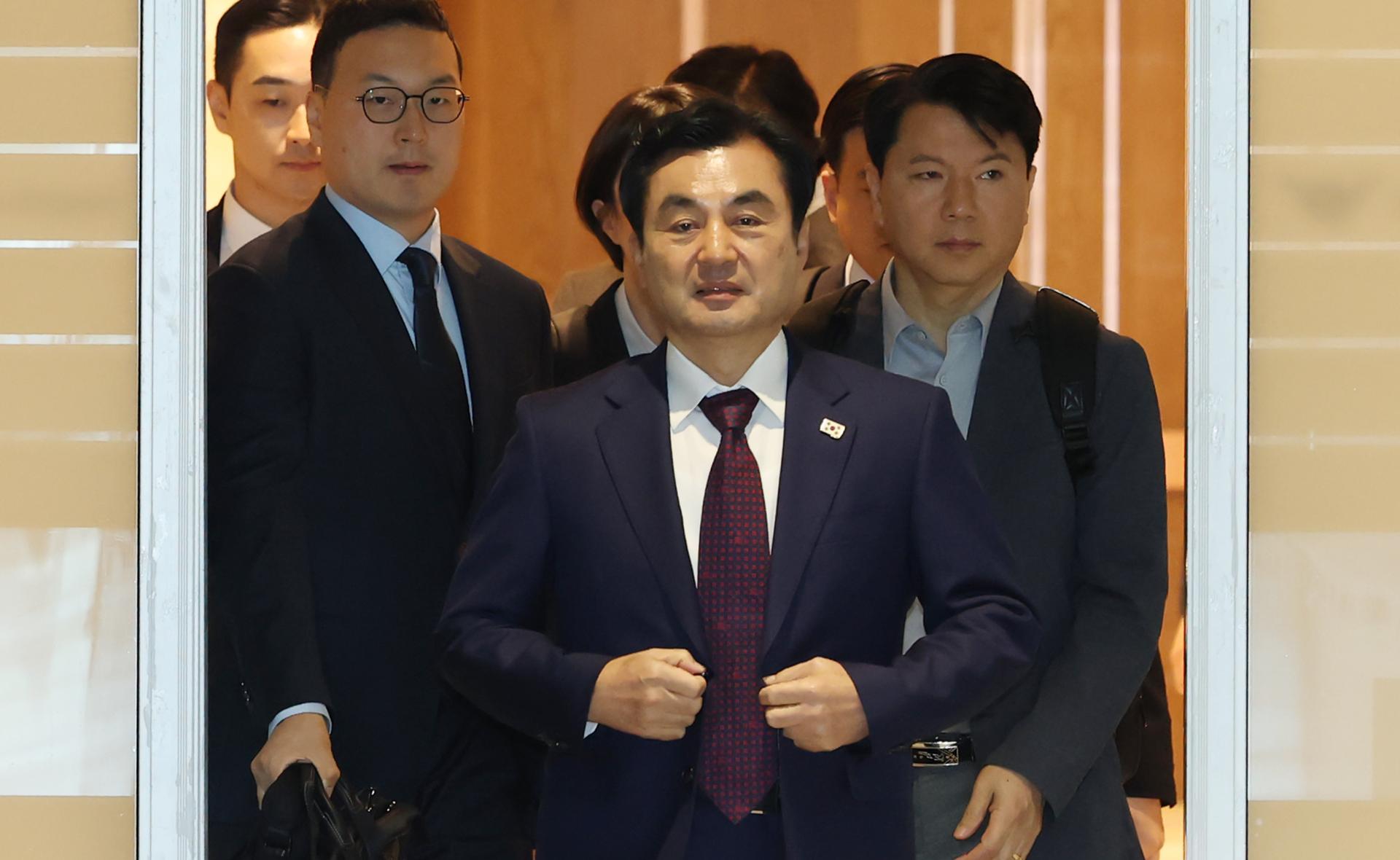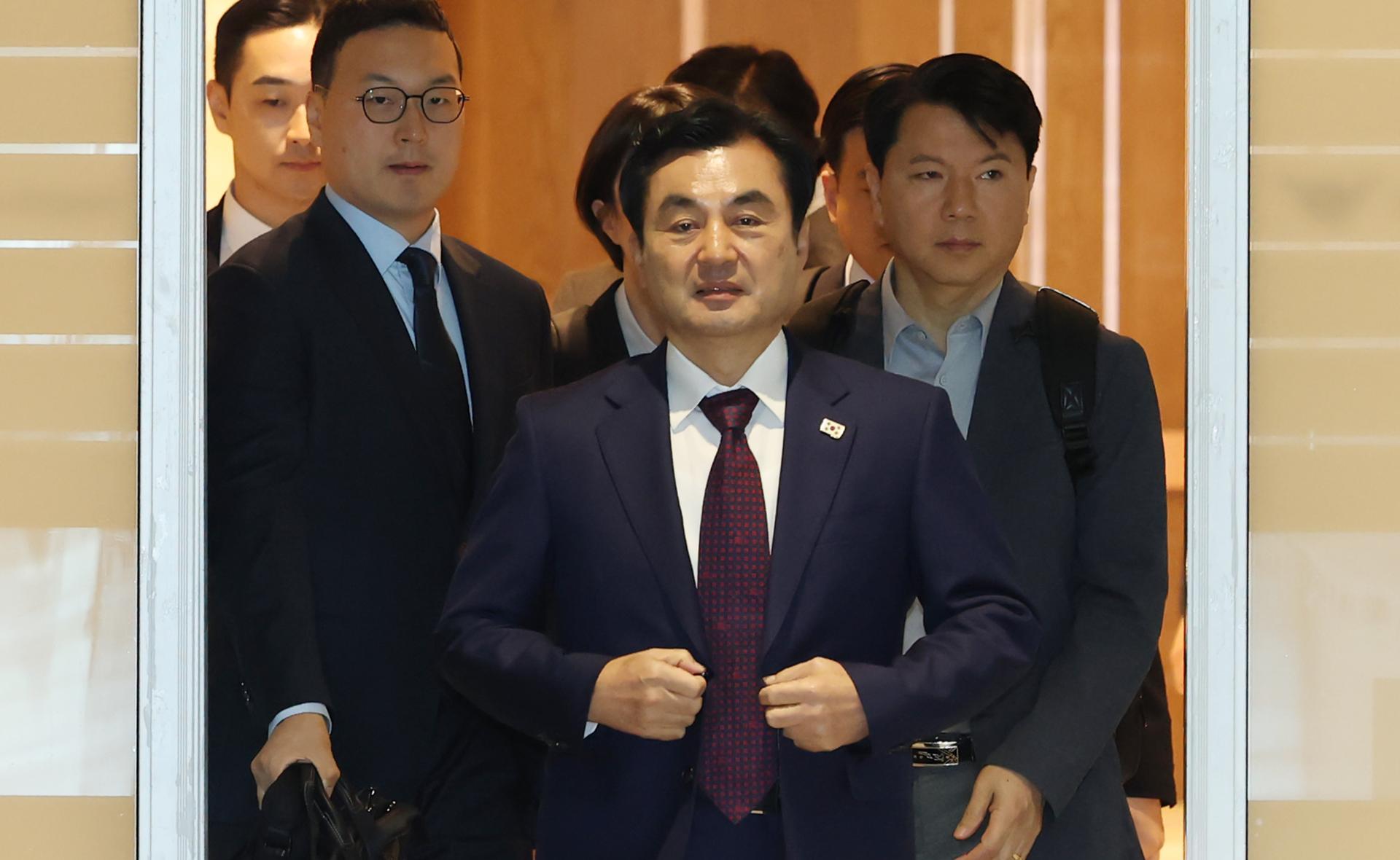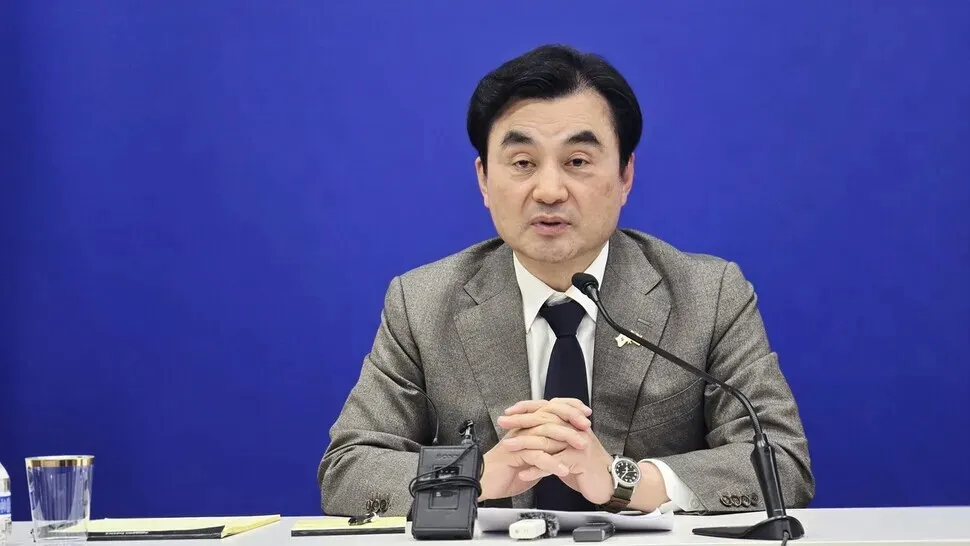
South Korean Defense Minister Ahn Gyu-back speaks to Korean correspondents at the Korean Embassy in Washington, DC, on May 12, 2026. (Kim Won-chul/Hankyoreh)
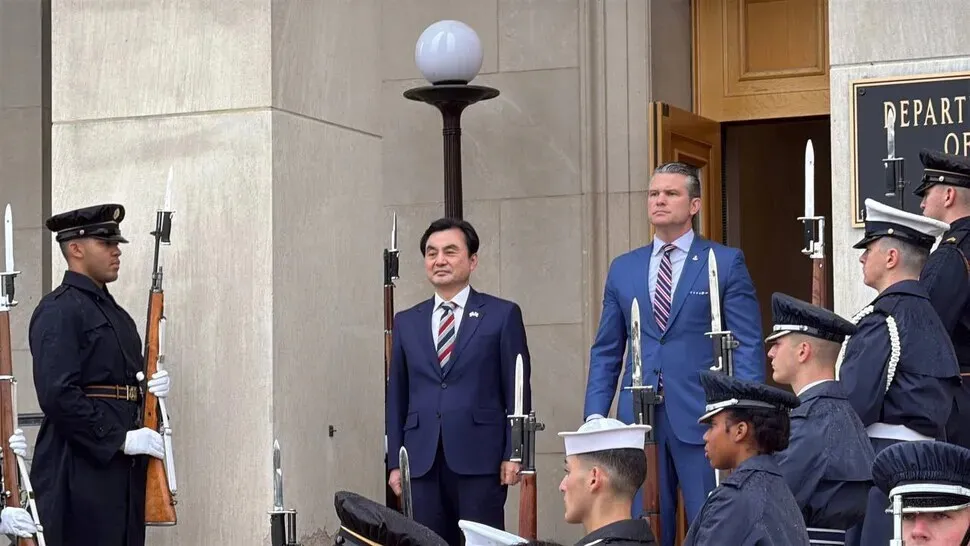
South Korean Minister of National Defense Ahn Gyu-back said Tuesday that he had communicated to Washington that Seoul intended to “participate as a responsible member of the international community” in the normalization of passage through the Strait of Hormuz.According to sources, the US did not explicitly request support in terms of South Korean military assets or troop deployment, and the South Korean side outlined its principles at the outset.In a talk with overseas correspondents at the Korean Embassy in Washington on Tuesday, Ahn shared details of his meeting with US Secretary of Defense Pete Hegseth a day earlier.Regarding the Strait of Hormuz issue, he explained, “Basically, I communicated that we would participate as responsible members of the international community and examine plans for contributions in stages.”In terms of what the “contributions in stages” would entail, Ahn said he has mentioned the expression of support, the dispatching of personnel, the sharing of intelligence, and assistance with military assets as needed.“I communicated that we would consider ideas for contribution going forward based on a general consideration and in compliance with the procedures of international and domestic law,” he said.In an explanation after the meeting, a senior South Korean government official said, “We first explained our basic position that we are actively taking part in discussions on international coordination to guarantee safe passage in the Strait of Hormuz and that we are in close communication with the relevant countries, including the US.”They added that it was “not true that Secretary Hegseth made any explicit requests or applied overt pressure, as some reports have suggested.”The official further said there had been no US request for military asset deployments during the meeting.Ahead of the meeting on Monday, Hegseth said, “[W]e look to our partners to stand shoulder-to-shoulder with us” — a remark that analysts took to mean Washington was demanding South Korea take on a greater role in securing passage through the strait.Commenting on allegations about the strike against the South Korean vessel HMM Namu near the strait, a senior government official said that the government joint investigation team is still carrying out its investigation.“At the current time, we cannot make any conclusions about the model of airborne object or what countries did what,” they added.“Our armed forces have basically stated that they will participate in the investigation in the necessary areas and provide technical analysis and advising,” they said.“The government can only decide the level of response once the investigation findings have come,” they continued.A senior South Korean government official confirmed that Seoul had “had many discussions” with the US about the Namu incident but said there were “many elements” that they could not comment on regarding specific discussions. When asked if the South Korean government had been later than the US in making a determination, the official said, “We cannot reach any conclusions without matters being finalized.”“There will need to be a conclusion from the government’s joint investigation team,” they stressed.On the issue of the transfer of wartime operational control back to South Korea, Ahn quoted Hegseth as saying he fully supported such a transfer “based on conditions” and hoped the transfer would proceed quickly in accordance with that.“From our position, we firmly maintain that the transfer of operation control should take place quickly,” Ahn said, adding that there was “no wavering at all on that point.”But the actual timeline and detailed conditions of the transfer appeared to be under discussion between the two sides.A senior South Korean government official confirmed, “Details regarding the operational control transfer are under discussion between South Korea and the US, and there are some differences because it’s a two-way conversation.”“Those differences have been largely bridged, and considerable progress has been made,” they added.The same official explained that “very honest discussions” have been underway on the bilateral alliance continuing to respond to threats jointly even after the transfer has taken place.Ahn said the questions of US Forces Korea troop reductions and strategic flexibility in USFK’s role “were not discussed at all” in the meeting on Monday.A senior government official explained, “The meeting yesterday was not an occasion for reaching an agreement or deal on any issue, but one for communicating on the various issues that have arisen on both sides.”On the matter of Seoul’s pursuit of nuclear-powered submarine construction, Ahn said, “I think security issues should be approached on a different track from economic issues.”“We shared the view that because the US is at war with Iran and there are trade issues involved, this is not a matter to be resolved all at once, but that we should hold working-level discussions quickly in consideration of factors such as issues relating to China and North Korea,” he explained.While some outlets have recently reported on discussions about the removal of Terminal High Altitude Area Defense (THAAD) equipment, a senior South Korean government official said that “nothing of that nature was discussed at the meeting yesterday.”“I saw the report, and it appeared to be contrary to the facts,” he added.The senior Korean government official explained that the US visit and meeting had taken place at Seoul’s suggestion.“There are a number of issues to be addressed between the two sides, and this was a procedural step to seek understanding and support through mutual communication,” they said.“It is not being assigned any special significance,” they added.Commenting on the mood at the meeting, the official said, “I had the sense that there was a positive feeling based on mutual trust.”“There were discussions on various matters in a cordial atmosphere,” they said.By Kim Won-chul, Washington correspondentPlease direct questions or comments to [english@hani.co.kr]