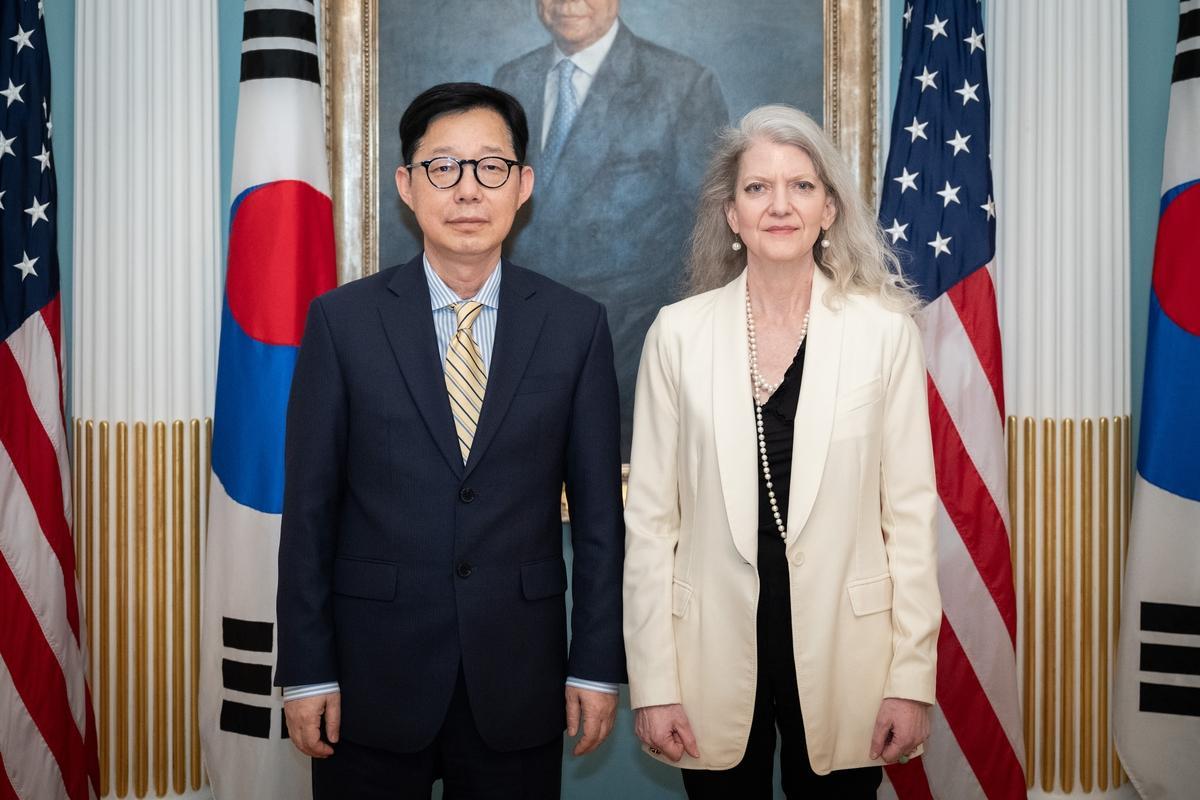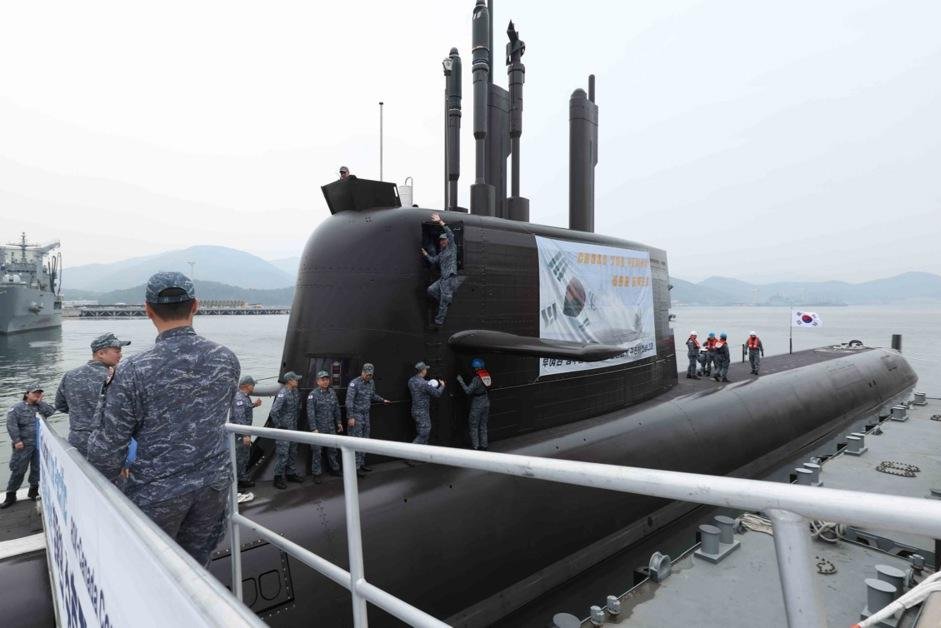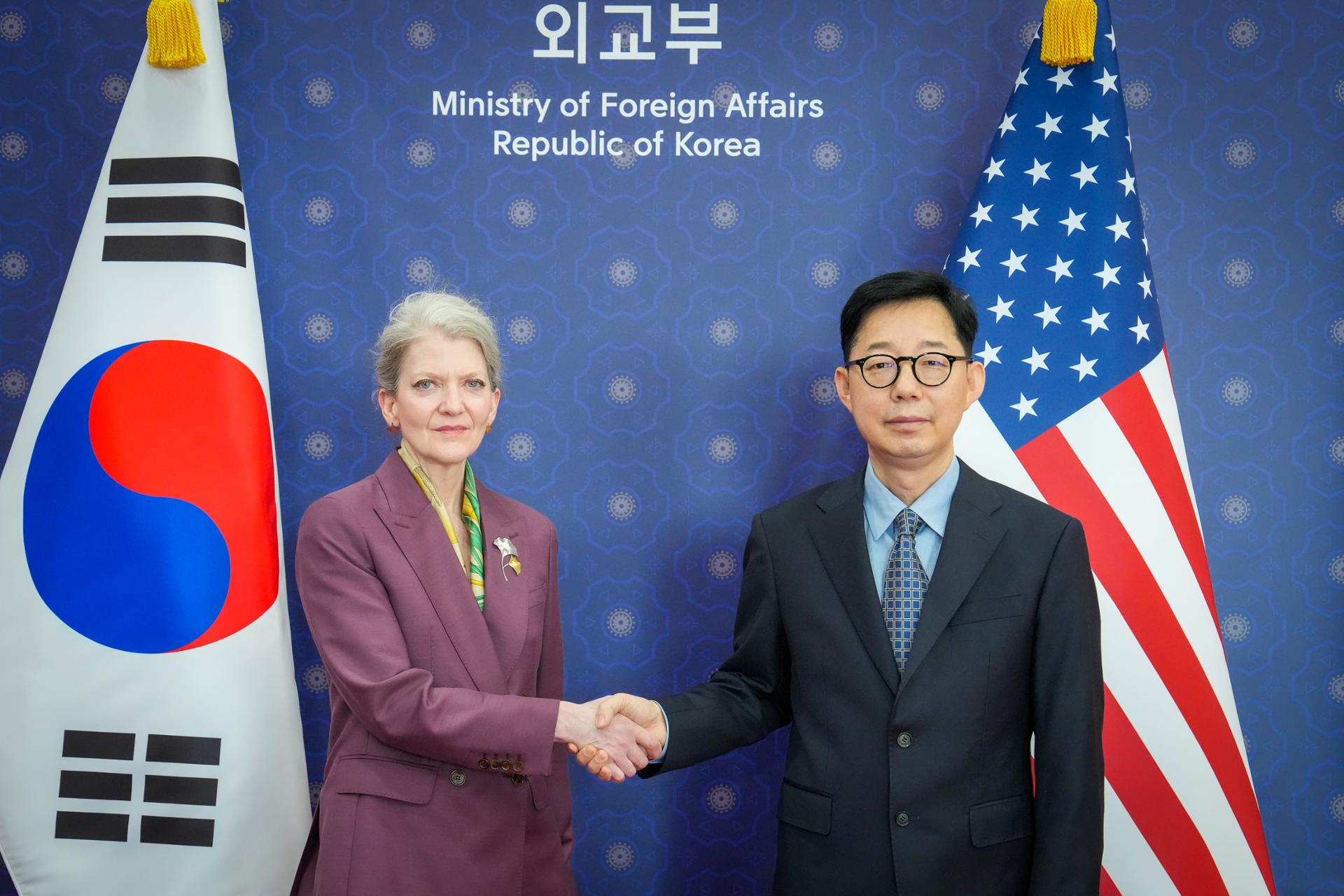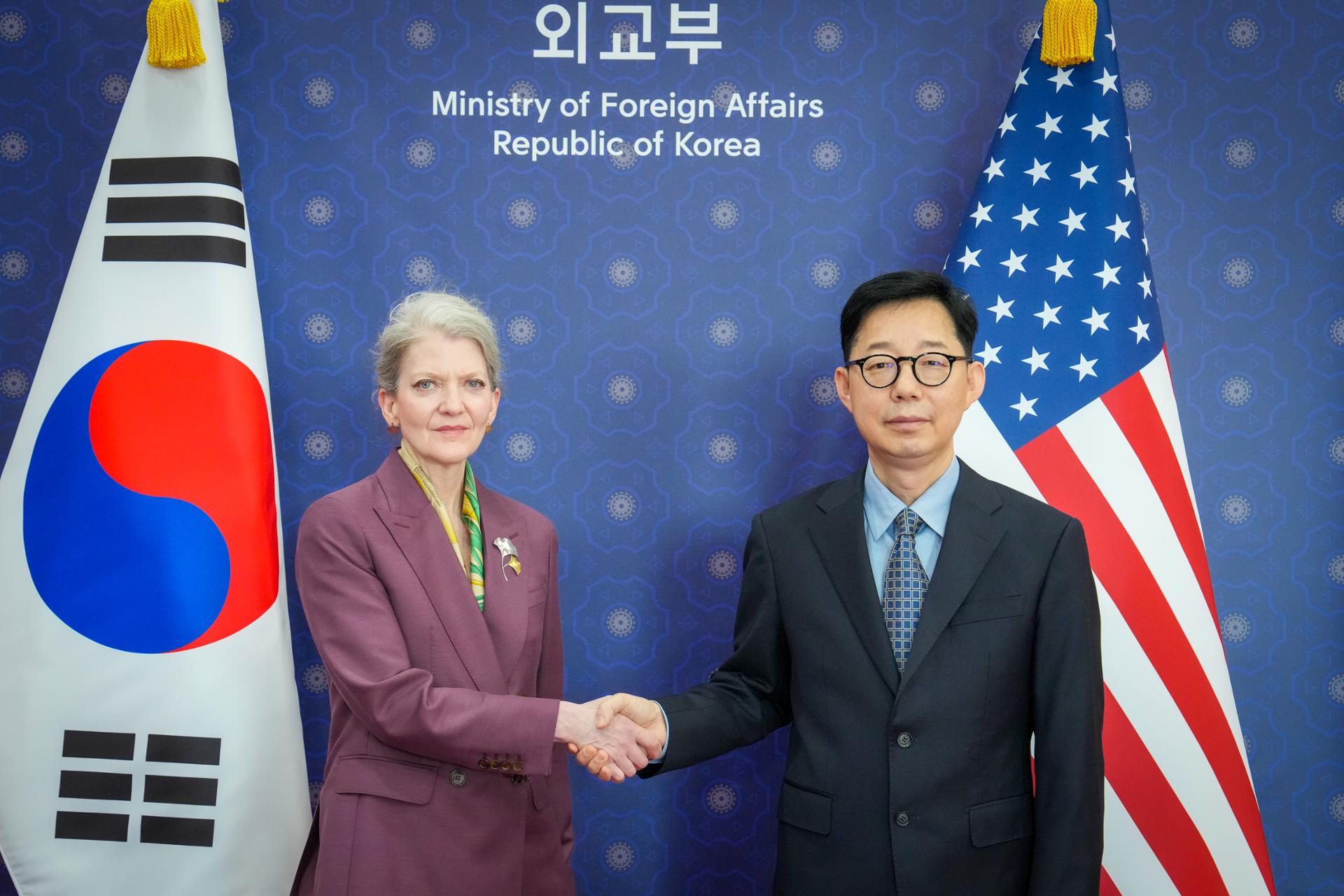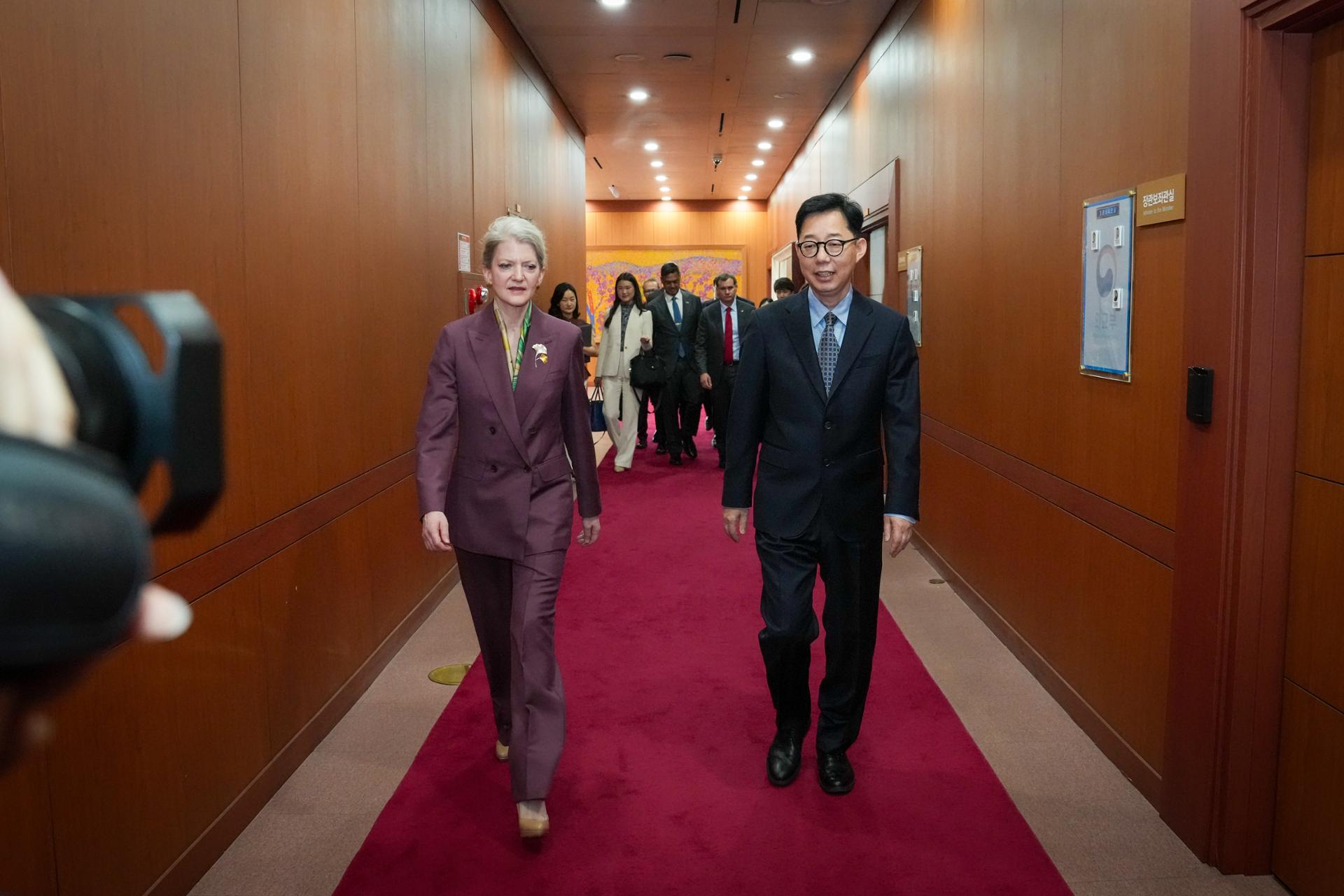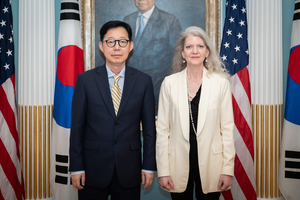
South Korea's First Vice Foreign Minister Park Yoon-joo (left) and US Under Secretary of State for Political Affairs Allison Hooker pose for a photo before their talks at the State Department in Washington, on Monday in this photo released by Seoul's foreign ministry. (Ministry of Foreign Affairs) South Korea and the United States are set to launch bilateral working groups on nuclear-powered submarines and other nuclear cooperation issues, as Seoul formally began internal military procedures to acquire nuclear-powered submarines, officials said Tuesday.The moves mark the clearest sign yet that the allies are accelerating implementation of agreements reached during last year’s summit between President Lee Jae Myung and US President Donald Trump, including US cooperation on Seoul’s efforts to acquire nuclear-powered submarines and expand its civilian nuclear fuel cycle capabilities, including uranium enrichment and spent fuel reprocessingAccording to Seoul’s Foreign Ministry and the US State Department, US Under Secretary of State for Political Affairs Allison Hooker will lead an interagency delegation to Seoul in the coming weeks to launch bilateral working groups to implement agreements reached during Trump’s October 2025 visit to South Korea.The announcement came after Hooker held talks in Washington on Monday with First Vice Foreign Minister Park Yoon-joo, who visited the US capital this week to push for faster implementation of the summit agreements.“Under Secretary Hooker will lead an interagency delegation to Seoul in the coming weeks to launch bilateral working groups to continue implementing understandings from President Trump’s October 2025 visit to the ROK,” the State Department said in a media note, referring to South Korea by the acronym for its official name, the Republic of Korea.In a separate statement, Seoul’s Foreign Ministry said Park and Hooker agreed to hold a “kick-off” meeting for the implementation of bilateral agreements in the security sector, based on a shared understanding that the two sides should swiftly produce tangible outcomes from the agreements outlined in the Joint Fact Sheet adopted during the summit.The working groups are expected to focus on some of Seoul’s most sensitive and ambitious security goals, including nuclear-powered submarines, civilian uranium enrichment and spent fuel reprocessing. The issues have long faced resistance within the US nonproliferation establishment.In the Joint Fact Sheet, Washington formally endorsed South Korea’s pursuit of nuclear-powered, conventionally armed attack submarines and supported a process that would “lead to the ROK’s civilian uranium enrichment and spent fuel reprocessing for peaceful uses.”The latest developments come amid growing concerns in Seoul over the slow pace of follow-up negotiations for agreements reached more than six months ago.Diplomatic sources here said implementation talks had been delayed by a combination of factors, including disagreements over trade and investment issues, the Iran war and the Trump administration’s focus on preparations for the recent US-China summit.Officials dealing with nuclear energy, arms control and nonproliferation issues at the US State Department and Department of Energy were also reportedly tied up with negotiations involving Iran’s nuclear program, the government sources here have noted.Observers have additionally viewed US dissatisfaction with Seoul’s pace in implementing planned investment projects in the United States, as well as Washington’s concerns regarding Seoul’s handling of the Coupang data leak case, as factors affecting security consultations.During Monday’s talks, Hooker emphasized the need for continued progress in bilateral trade and industrial cooperation and stressed the importance of ensuring fair treatment for US companies and swiftly resolving market access barriers, according to the State Department.The remarks reinforced perceptions in Seoul that Washington continues to link security cooperation with broader economic and trade issues, including South Korea’s planned $350 billion investment package in the US.Within the South Korean government, there has reportedly been growing concern that implementation of the agreements could lose momentum if Trump enters an early lame-duck phase amid falling approval ratings linked to the Iran war and economic concerns, as well as speculation that Republicans could lose congressional power in November’s midterm elections.Against that backdrop, Seoul is believed to be seeking to institutionalize the agreements as quickly as possible during Trump’s presidency.Separately on Tuesday, South Korea’s Navy formally began the domestic acquisition process for nuclear-powered submarines by submitting a statement of required capability to the Joint Chiefs of Staff, according to materials submitted by the Ministry of Defense to the office of Rep. Kang Dae-sik of the main opposition People Power Party.The submission marks the first formal step in the military procurement process for a new weapons system. The JCS is expected to review the request and finalize a decision later this month.Following approval, the project would proceed through feasibility studies, preliminary research and consultations on total project costs before entering system development.The Defense Ministry is also pursuing special legislation for nuclear-powered submarines to establish a dedicated regulatory framework beyond existing defense acquisition and nuclear safety laws, reflecting what would be South Korea’s first military use of a nuclear reactor.The South Korean government is reportedly considering domestically built nuclear-powered submarines with a displacement of around 5,000 tons using low-enriched uranium fuel below the 20 percent threshold, which is regarded as posing a relatively low proliferation risk.Officials expect construction to take roughly a decade once working-level agreements with the United States are finalized.The government is also reportedly preparing to unveil a national blueprint later this month for the development of South Korea’s nuclear-powered submarines, detailing their intended missions, deployment plans, construction schedule and fuel supply strategy.
S. Korea, US to launch nuclear sub working groups
South Korea and the United States are set to launch bilateral working groups on nuclear-powered submarines and other nuclear cooperation issues, as Seoul formal
885 words~4 min read