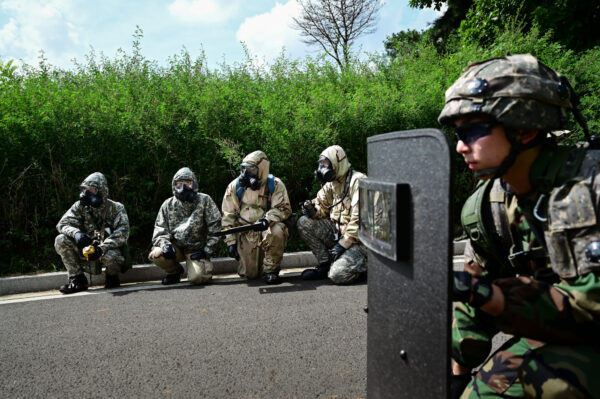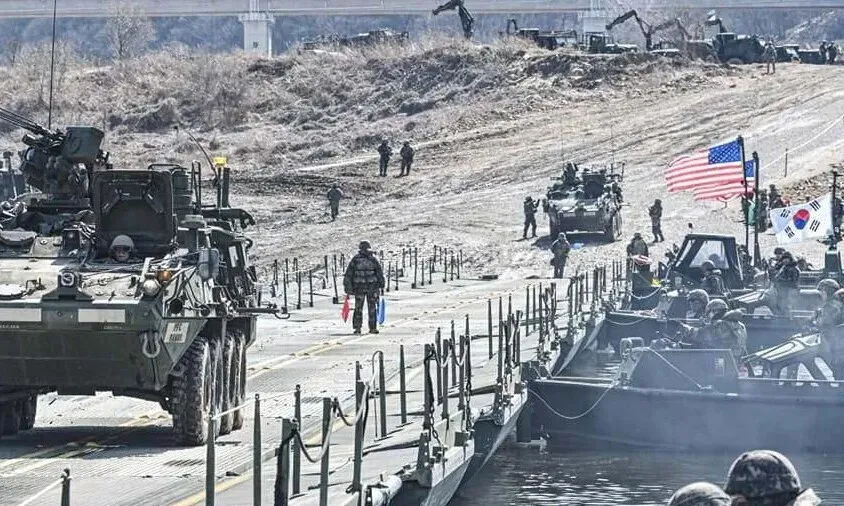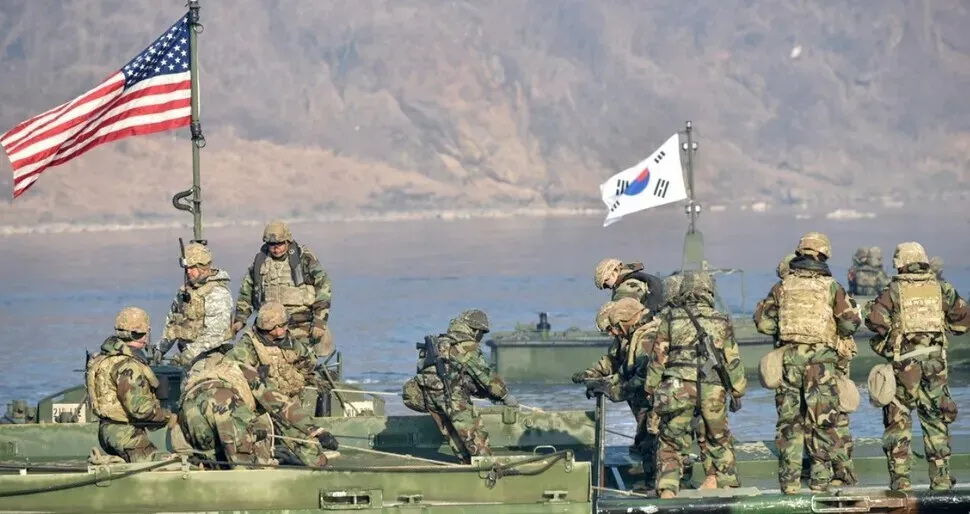
Troops from South Korea and the US complete construction on a joint bridge during a combined wet gap crossing exercise, near the Imjin River in Paju, Gyeonggi Province, from March 11 to 20, 2024. (via USFK website)
The controversy over wartime operational control of South Korea’s military dates back to 1950, during the early stage of the Korean War.On July 14, 1950, President Syngman Rhee sent a letter to US Gen. Douglas MacArthur, commander of the United Nations Command (UNC), proposing the transfer of “command authority” over the South Korean land, sea, and air forces — now known as operational control — to the UNC. The general accepted this in his reply dated four days later, and such authority was transferred to the head of the UNC. In their agreed minutes to the bilateral mutual defense treaty, signed in November 1954 shortly after the war ended, Seoul and Washington concurred that as long as the UNC was responsible for South Korea’s defense, the command would maintain operational control of the country’s military.Changes to UNC authority came in the 1960s. In September 1965, South Korean troops deployed to Vietnam under UNC control were placed under Seoul’s command. After the North’s commando raid on the Blue House on Jan. 21, 1968, South Korea was given operational control over counterintelligence operations that April.With South Korea seeing its national power grow and Cold War tensions starting to ease in the 1980s, efforts to regain wartime operational control gained momentum.During the 1987 presidential election, Roh Tae-woo, the candidate of the Democratic Justice Party, pledged to reclaim such authority. In December 1994, the Kim Young-sam administration negotiated the restoration of peacetime operational control, citing factors like the first North Korean nuclear crisis. In February 2007, the Roh Moo-hyun administration agreed with the US on Seoul regaining wartime operational control (OPCON) by April 17, 2012. April 17 was chosen by reversing the date — July 14 — on which Rhee had transferred such control in 1950.Citing an unstable security situation including the North’s second nuclear test in 2009, the Lee Myung-bak administration in June 2010 agreed to postpone the transfer to Dec. 1, 2015. The succeeding Park Geun-hye government in April 2014 decided on a further delay after Pyongyang’s third nuclear test. Seoul and Washington subsequently agreed not to specify a date for the transfer, just to conduct it after mutually agreed conditions were met. The Moon Jae-in administration emphasized a “prompt transfer of OPCON,” but this never materialized, and the succeeding President Yoon Suk-yeol showed no interest in the switch.Despite these twists and turns, South Korea and the US completed assessment in 2019 and verification in 2029 of the first phase of “initial operational capability” for a new combined forces command, which will replace the outgoing CFC following the transfer. The Phase 2 evaluation of full operational capability was completed in 2022, and the two sides plan to verify it at their annual Security Consultative Meeting this fall. Once the defense ministers of both countries complete the third phase — assessment and verification of full mission capability — they will recommend a transfer date to their respective presidents. The incumbent Lee Jae Myung administration hopes to regain OPCON as early as late next year. The Pentagon has expressed a more cautious stance regarding the transfer than the Ministry of National Defense in Seoul. At the Shangri-La Dialogue last month, US Secretary of Defense Pete Hegeth called the proposed move “encouraging,” but added, “I think we have to find the balance of where our military OP (operational) plans and the responsibilities that US uniformed members have had for decades now [are] honored, as we phase over to wartime OPCON transfer for the Republic of Korea, which we welcome the fact that they want that.”By Kwon Hyuk-chul, staff reporterPlease direct questions or comments to [english@hani.co.kr]