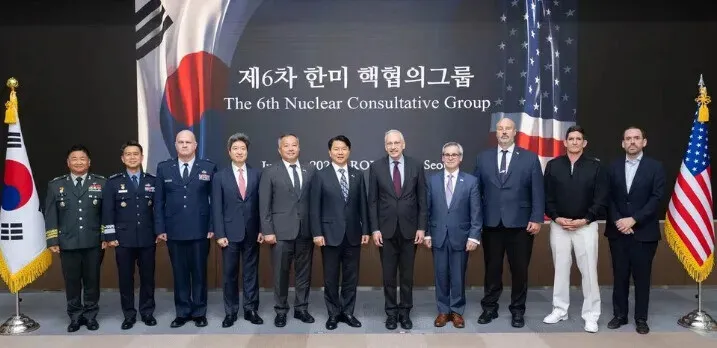
Opponents of South Korea's efforts to regain wartime operational control (OPCON) argue that doing so could weaken the US commitment to retaliate with nuclear weapons if North Korea launches a nuclear attack on the South. Some speculate that if a South Korean general were to replace the US general as commander of combined forces in Korea — as would be the case once OPCON is returned to Seoul — the US general would no longer be responsible for defending Korea, thereby casting doubt on the implementation of extended deterrence. However, such arguments fundamentally misunderstand US nuclear strategy, the institutional framework governing relations between Korea and the US, and the concept of extended deterrence. Korea and the US’ responses to North Korea’s nuclear program are grounded in a tailored deterrence strategy between two nations. “Regardless of who has OPCON, US extended deterrence [including the nuclear umbrella] operates through separate high-level political and military mechanisms such as the mutual defense treaty between Korea and the US, as well as the two sides’ Nuclear Consultative Group,” said Cho Seong-ryoul, a visiting professor at Kyungnam University who previously served as Korea’s consul general in Osaka. “The idea that the US would abandon its commitment to the alliance simply because it no longer holds OPCON reflects a misunderstanding of how the two countries' military cooperation actually works,” he added. In other words, the legal and political commitments behind the US pledge to defend South Korea — including its extended deterrence commitment — will remain intact even after the OPCON transfer. The Nuclear Consultative Group is a bilateral consultative body aimed at strengthening the Korea-US alliance and extended deterrence. It officially launched following the Washington Declaration announced by the leaders of both countries in April 2023, which was during the Yoon Suk-yeol administration in South Korea. Since the inauguration of the Lee Jae Myung administration, the fifth meeting of the group was held in Washington, US, in December 2025, while a sixth meeting was held on June 11 in Seoul. Behind Washington’s pledge of extended deterrence lies a demand it expects Seoul to follow: if North Korea uses its nuclear arsenal, the US will retaliate with nukes in turn, so South Korea should refrain from pursuing its own nuclear weapons. If extended deterrence were to disappear and Korea were to acquire nuclear weapons, some are concerned that Japan and Taiwan could also move to develop their own nuclear arsenals. That is, if the US withdraws extended deterrence following the transfer of OPCON, it would have to be prepared to set off a possible nuclear domino effect in Northeast Asia. It is not possible to include provisions regarding the use of US nuclear weapons in the operational plans of the current Combined Forces Command or its post-OPCON transfer incarnation to authorize the use of such weapons. The US president has the exclusive prerogative to issue the final approval and order to use nuclear weapons, and related matters are managed under the operational plans of the US Strategic Command. The US has assigned the tasks of nuclear operations, command, and control to the US Strategic Command because nuclear weapons are not military weapons to be handled at the Combined Forces Command level, but rather strategic weapons operated by the US president in his capacity as commander-in-chief. Ultimately, even after Seoul regains OPCON, the US will inevitably have to take the lead in key elements of extended deterrence, such as the decision-making structure for nuclear use, decisions on the deployment of strategic assets, and allocation of intelligence on North Korea’s nuclear program gathered via reconnaissance satellites. By Kwon Hyuk-chul, staff reporter Please direct questions or comments to [english@hani.co.kr]
Will the US really stop providing extended deterrence if Seoul regains OPCON?
Debunking OPCON doubts | Concerns about the US withdrawing its nuclear umbrella from Korea if Seoul regains wartime operational control fundamentally misunderstand US nuclear strategy and agreements between the US and South Korea
609 words~3 min read