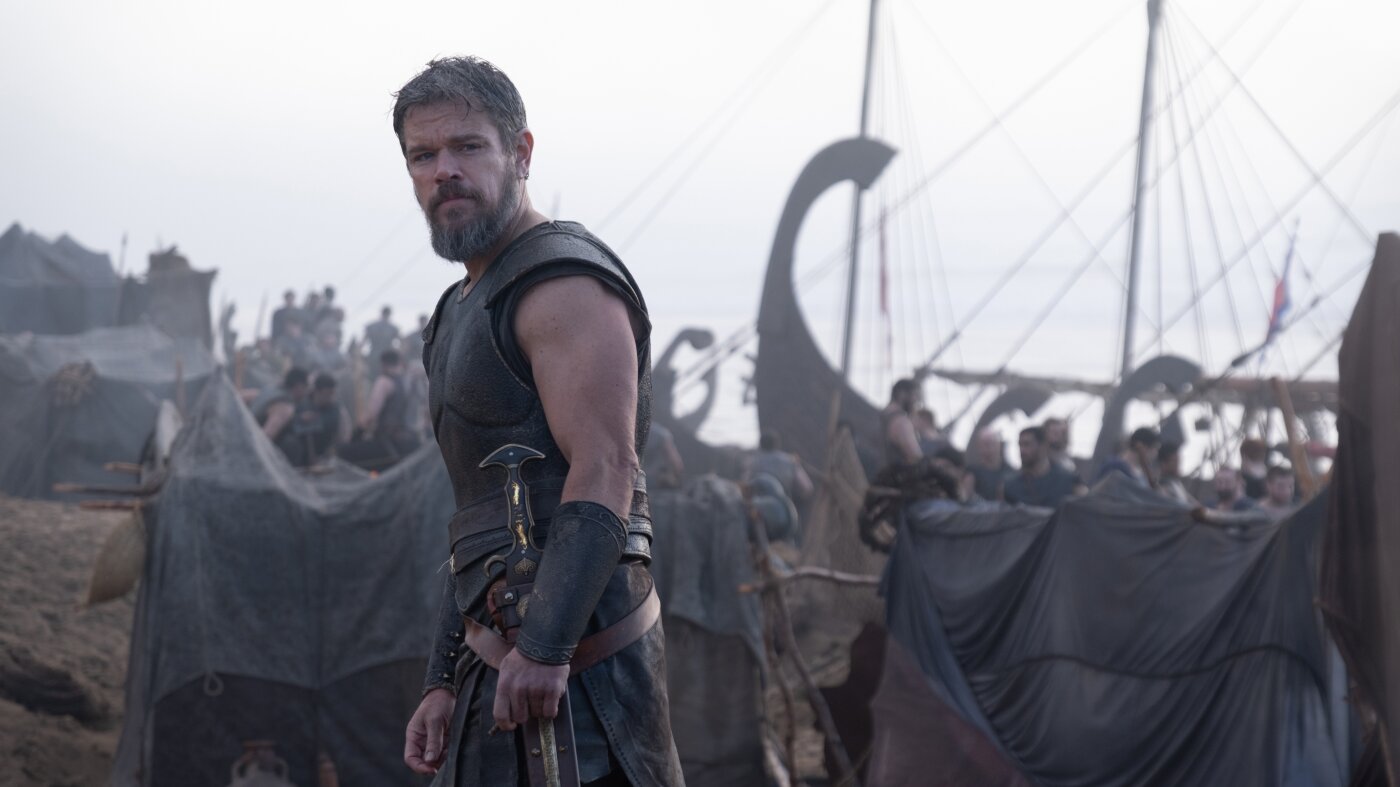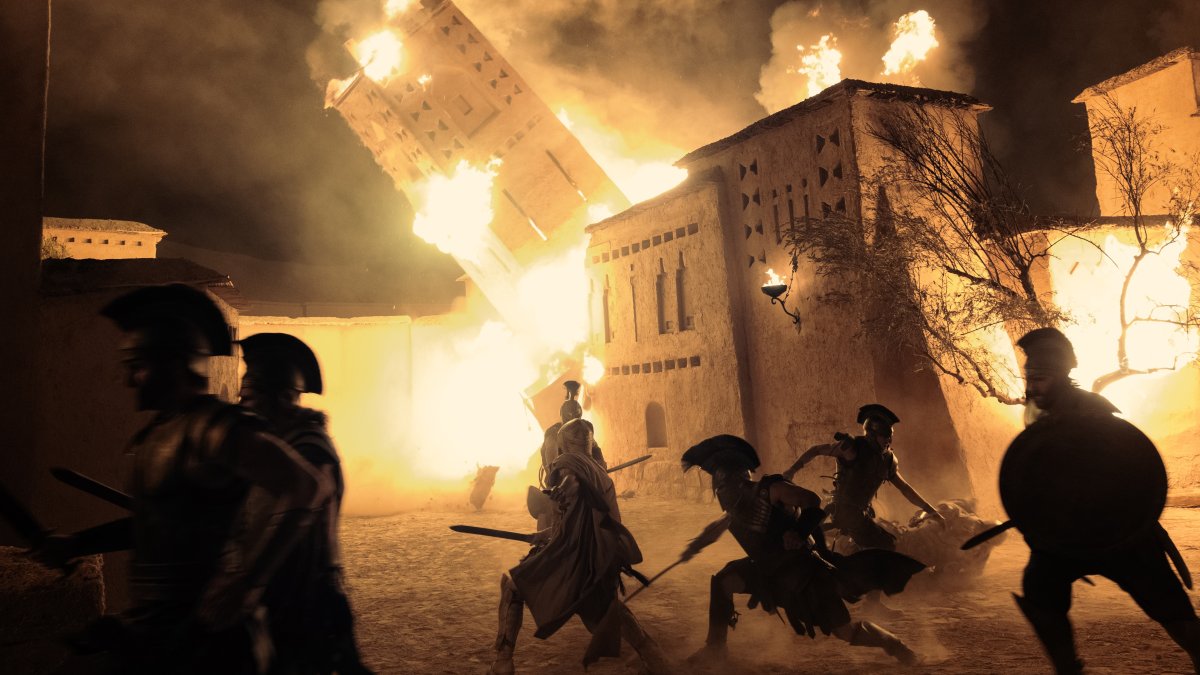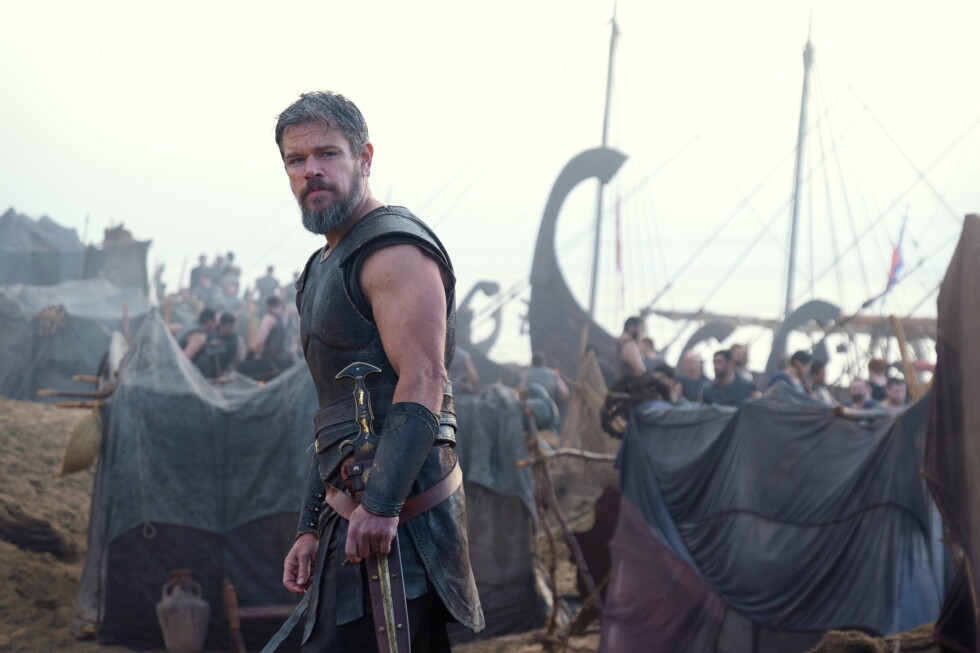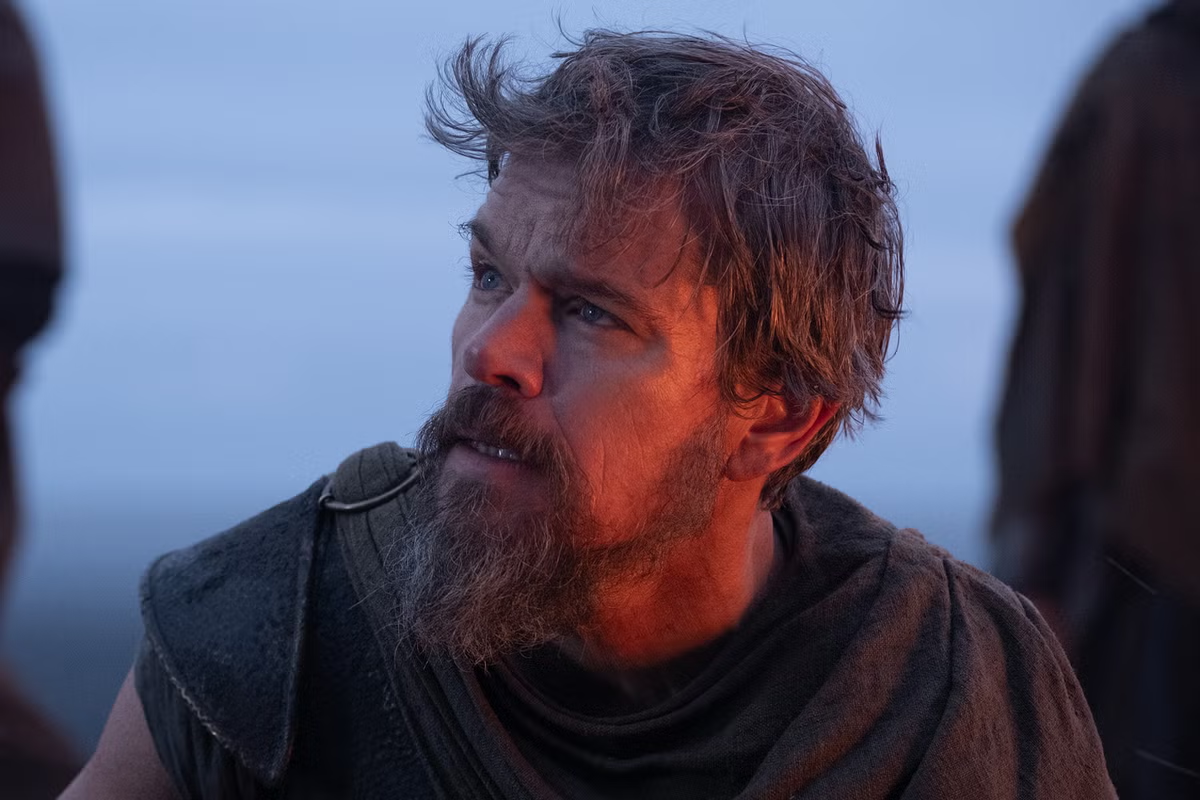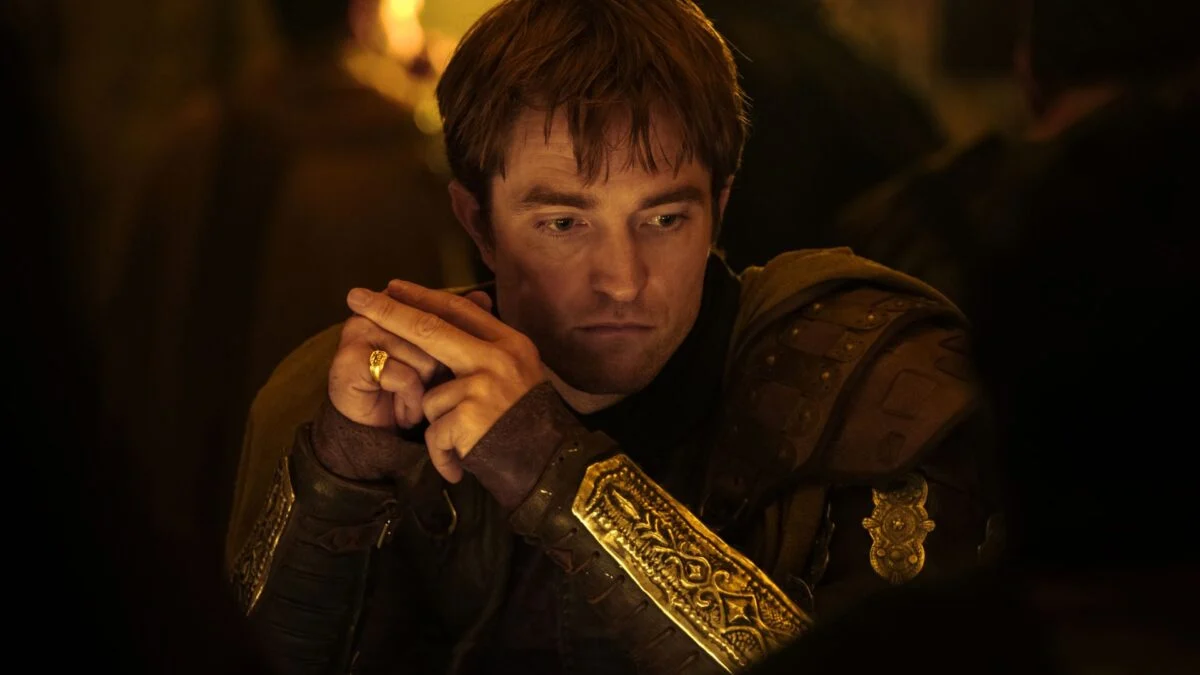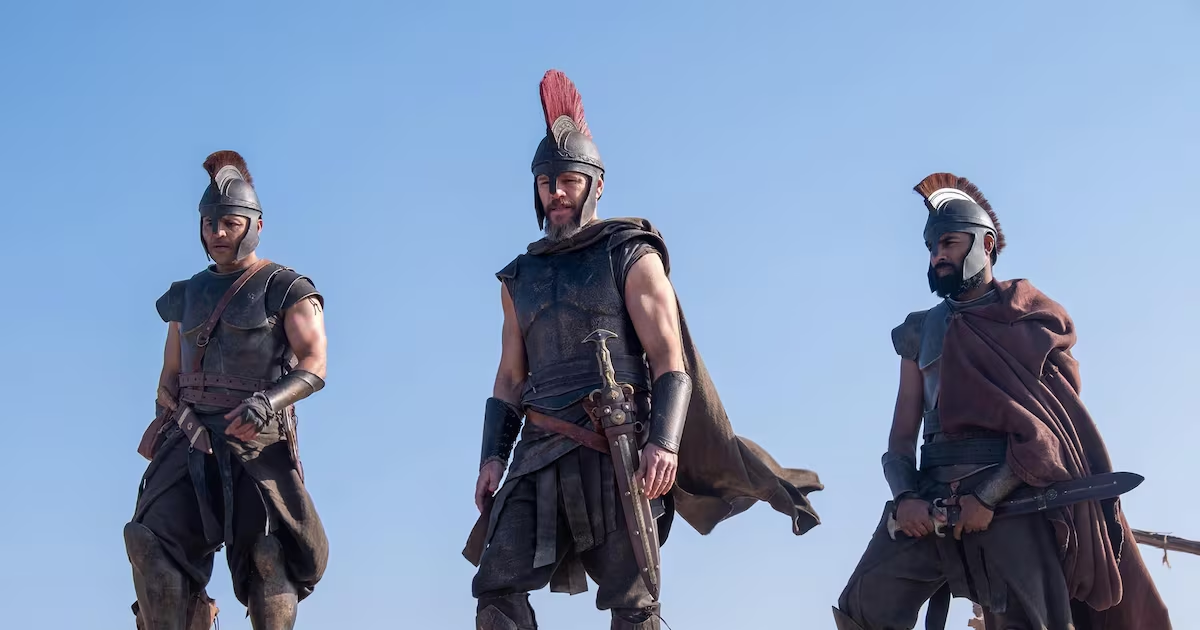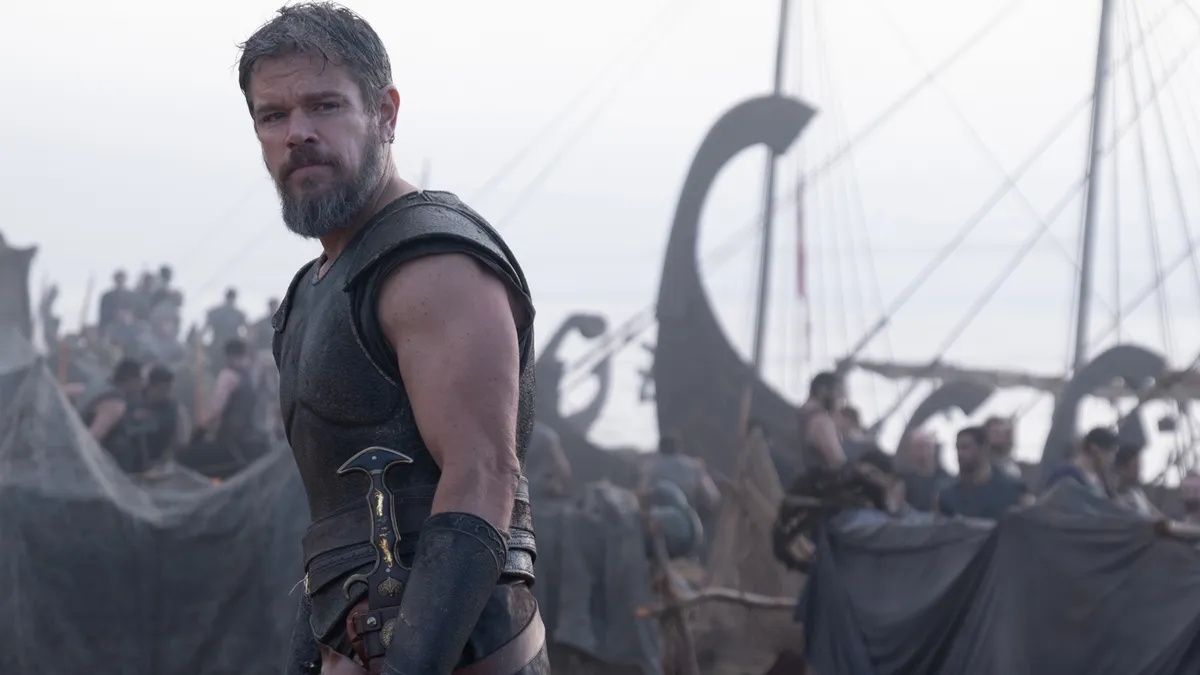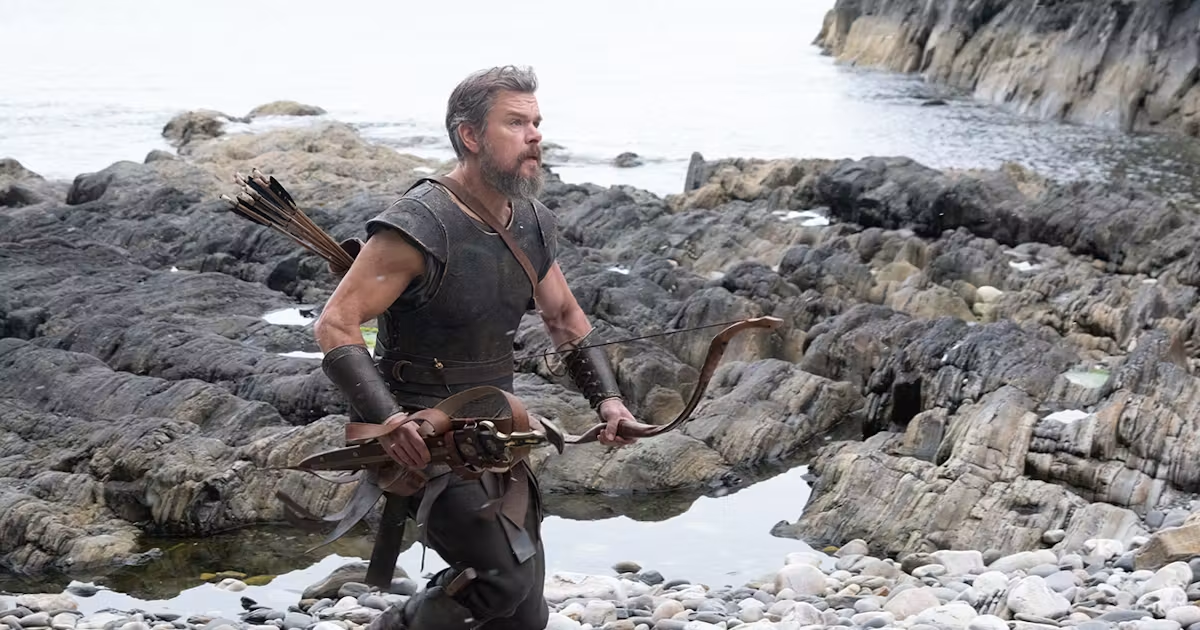
A man floats half-dead for days in the middle of the Mediterranean. Eventually he is rescued by a kind stranger and nursed back to health. His body recovers, but not his mind: he can’t remember who he is or how he ended up stranded in the sea. When his memories return, he’s wracked with guilt over his role in a destructive project orchestrated by distant invisible forces. Thus begins the story of Jason Bourne (Matt Damon) in The Bourne Identity and of Odysseus (Matt Damon) in Christopher Nolan’s new film, The Odyssey. Though one is adapted from a nearly 3000-year-old Greek epic and the other from a 1980s spy thriller, it’s no coincidence that Damon is Bourne again as an amnesiac veteran fighter. “Matt plays an Everyman very well in a lot of films,” Nolan has said, explaining the casting of his relatable superhero. “But he’s also Jason Bourne.” When we first encounter Odysseus in the narrative’s present day, his well-meaning caregiver Calypso (Charlize Theron) has been keeping him in a lotus-induced stupor for seven years, sensing that he isn’t ready to confront his trauma and check out of her idyllic clinic. Slowly, he begins to remember the endless war in Troy, the ill-fated attempt to bring his men home to Ithaca, and the wife and son who have been waiting for him for nearly 20 years.In The Odyssey, as in The Bourne Identity and Nolan’s breakout hit Memento, memory loss is a screen for guilt. But Nolan’s Odysseus is too simple a man to have a guilt complex. He straightforwardly regrets the consequences of his well-intentioned choices and wants to forget them. The Homeric characterizations of Odysseus—“wily,” “crafty,” “lying”—don’t easily stick to the open-faced Damon, and in Nolan’s version, they don’t have to. More than the much-discussed racially diverse casting of the film, what makes The Odyssey feel most like a product of the twenty-first century is its simplification of a character famously described as polytropos—“of twists and turns” in Robert Fagles’s translation; “complicated” in Emily Wilson’s—into a basically good guy who feels bad. He’s closer to the protagonists of Nolan’s previous films, or to someone you might meet in group therapy, than to the conniving storyteller, arrogant bully, and cheating husband of the ancient epic.This isn’t to say that Homer’s hero isn’t haunted by war, or that he’s not at all sorry about the men who died under his leadership. Part of what makes Odysseus so relatable to modern readers is that he feels figuratively as well as literally at sea in a world that no longer seems governed by meaningful laws, divine or human. Daniel Mendelsohn, who recently translated the poem, said in an interview that the Odyssey is not just a post-war poem; “it’s also sort of a post-everything poem.” As Nolan’s grieving Penelope (Anne Hathaway, perfectly balancing regality and humanity) tells her son Telemachus (Tom Holland), there’s no easy way to restore Ithaca to the prosperous peace of her husband Odysseus’s rule: “That world is gone.”The gods, whose active participation in the Trojan War made them major characters in Homer’s Iliad, are relatively absent in the poem often read as its sequel. A couple come down to earth to help Odysseus and Telemachus out at crucial moments—including Athena, played by Zendaya in the film—and we’re sometimes privy to their strategy sessions up on Olympus. But their existence is often simply inferred, usually as the source of bad weather. After multiple shipwrecks, murderous monsters, and harrowing near-death experiences, it would be understandable if Odysseus, like George Costanza, began only to believe in the gods for the bad things.Homer’s Odysseus deals with the alienation and fragmentation of this post-war reality not through drugs but through narrative manipulation, with a sophistication notably absent from Nolan’s film. In the poem, right before reaching Ithaca, Odysseus washes up on the shore of Phaeacia, where he finds refuge at the king’s court. In the guise of an anonymous traveler, he flatters the bard-in-residence into singing of the Trojan horse, masterminded by the cunning Odysseus. Moved to tears by hearing his own story, he reveals himself and picks up where the bard left off. His narration takes up four action-packed books at the center of the poem, telling the tales of the man-eating Cyclops, the giant and also man-eating Lestrygonians, the sorceress Circe, the shades of Hades, the Sirens’ song, Scylla and Charybdis, the sun god’s forbidden cattle, and finally Calypso. The stories that Odysseus expertly (and perhaps not altogether truthfully) weaves for his audience appear in Nolan’s film as facile flashbacks; the plot is non-linear, but we get none of the disorienting temporal tricks we might expect from the director of Inception and Tenet. Much of what, in Homer’s version, prolongs Odysseus’s journey and thus his story—his horniness, his hubris—Nolan’s script strips away, leaving only a guilty conscience buffeted about by some very cool-looking waves. Nolan recently said that he realized, while embarking on The Odyssey, “I’ve been telling this story in all my films for years.” In Dunkirk, his best film about how hard it is to get home from a war in a boat while hostile unseen forces attack you from above, Nolan tackles some of Homer’s thorniest themes: cowardice, temporal confusion, fatally stupid decisions, the complications that compromise even the most sentimental homecomings. But with The Odyssey, he’s taken his own pet themes—self-deception; “the noble lie”; superheroes whose moral virtue makes them lonely and sad—and willfully projected them onto the poem. Reverse-engineering the epic to produce the same moral lesson as his last film, Oppenheimer, Nolan asks us to believe that Odysseus views his creation of the famous gift horse as a god-defying abomination, a violation of “Zeus’ law” of hospitality, that ended the war but doomed an entire civilization to a post-literate dark age.It takes quite a few twists and turns of the basic plot to arrive at this framing. Something has indeed gone wrong with xenia, the Greek term for the custom of hospitality often translated as “guest-friendship,” in the world of the Odyssey. During her husband’s long absence, suitors have descended on Penelope and are overstaying their welcome, and the godless monsters Odysseus’s men encounter are not gracious hosts. But if there’s an original sin of xenia-violation in this story, it’s not the Trojan horse. Ten years earlier, the Trojan prince Paris started the war by absconding from the house of the Greek king Menelaus, where he was a guest, with his wife Helen, who may or may not have gone willingly. In Nolan’s version, it’s made clear that Helen’s abduction was used as a cynical pretext for Menelaus’s brother, Agamemnon, to gain control of the region’s trading routes, a plot Odysseus regrets abetting. A similar imperialist motive with obvious contemporary relevance is attributed to Agamemnon in Troy, the loose Bush-era adaptation of the Iliad; some stories really are timeless.All this spinning of Odysseus’s self-interested guile into world-historical guilt awkwardly stretches the fabric of the poem. But Nolan has no scruples about turning a story to his own ends. Brute physicality and equally brute didacticism are what interest him, not winged words and moral ambiguity. The emphasis on immediacy over the layered narration that structures the poem is most obvious in the many spectacular scenes of natural and supernatural violence during Odysseus’s adventures, where flames, waves, and monstrous appendages hit like a reel of IMAX film to the head. But in quieter domestic moments, Nolan’s commitment to literalism becomes almost poetic. When Circe (Samantha Morton), a goddess in the poem but earthily human in the film, pauses dinnertime conversation to turn Odysseus’s men into pigs, she transforms them not through subtle potions or spells but by molding their faces and bodies like clay. Back in Ithaca, as the suitors feast in Penelope’s hall, she mostly remains in her adjacent bedroom behind sliding latticed doors: she’s literally screening her callers. When the boldest of the suitors, Antinous (Robert Pattinson, having a great time), proposes marriage, we see them through a similar scrim: From behind Penelope’s loom, through the threads of the burial shroud she’s weaving and upon completion of which, she had promised, she will finally remarry. It’s a ruse—she’d been unweaving her work every night, before she got caught—but Nolan dwells more on the beautiful distortion of light through fabric than on the distortion of the truth through fabrication.Even Odysseus, when he returns in disguise as a beggar, must initially speak to his wife not only through the emotional wall she’s put up in her half-believing grief, but also through the literal one outside her room. In the poem, Penelope finally accepts the ragged stranger as her husband only after he passes a mental test, demonstrating intimate knowledge only Odysseus could know. Nolan focuses on the physical test to which Penelope puts Odysseus, when she announces she’ll marry whoever in the palace can string Odysseus’s massive bow and fire an arrow straight through a row of axe heads—a feat only Odysseus could ever achieve. One by one, the suitors fail; they complain it can’t be done. Finally the undercover Odysseus steps up. He, too, seems to struggle. Penelope turns to walk away, heartbroken; it’s not him after all. When, after a few tense moments, he succeeds, he playfully plucks the bowstring. She freezes. It’s the most affecting moment in the film, perhaps because the suspension of the string marks the last moment of calm before Odysseus—Bourne again—breaks back into action hero mode. Or perhaps it’s because the sound effect, according to the film’s composer, Ludwig Göransson, was created with a lyre. The ancient instrument, featured prominently in the film’s score, was used to accompany performances of epic, and Homer compares Odysseus in this moment to a musician stringing his lyre; the plucked string “sang like swallow-song.” A prosaic tool, ubiquitous in hunting and war, becomes literally lyrical. To twist a line from Tenet, it’s an expression of faith that the mechanics of the world, too, can be poetry.
Christopher Nolan’s Odyssey Strips Away the Epic’s Complexity
The new adaptation focuses on Nolan’s pet themes of self-deception, “the noble lie,” and superheroes whose moral virtue makes them lonely and sad.
1,663 words~8 min read