Story audio is generated using AI
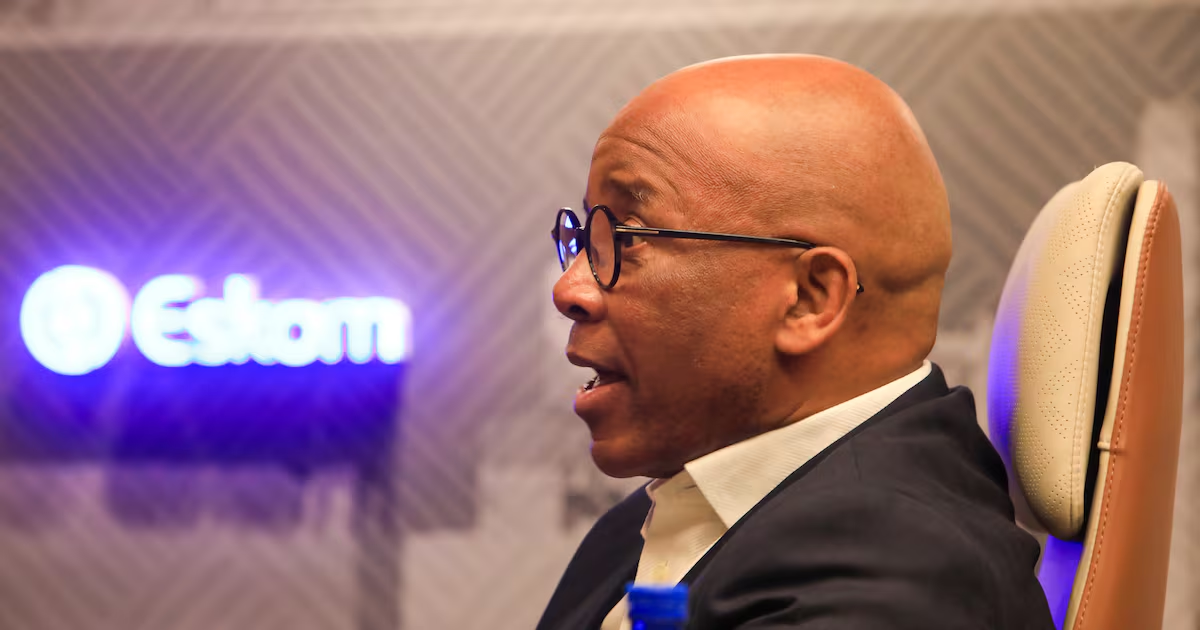
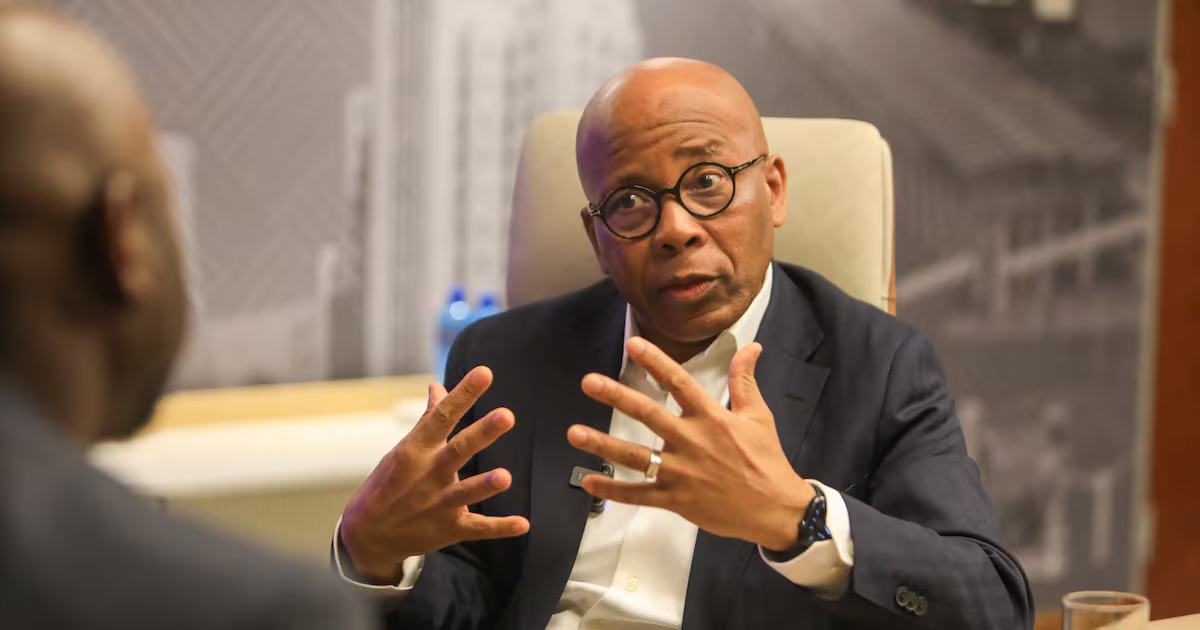
Mteto Nyati has done the country a service. As chair of Eskom, he wrote candidly about a pattern he has observed from close quarters, and it is a pattern worth sitting with. He described being approached, again and again, by business leaders asking him to intervene in operational and procurement matters that fall well outside the mandate of a board. He explained each time that his role is governance and oversight rather than management. The requests continued regardless. From this he drew a conclusion that ought to trouble all of us, which is that too many among our elite believe rules were written for other people.His sharpest observation concerned the organised business lobby. (We are not surprised, as these are the same characters who insisted on using Bain and McKinsey during the B20, being aware of the two consulting companies’ colourful roles during state capture.) Business Leadership South Africa and Business Unity South Africa have spent years positioning themselves as the guardians of clean governance and as the fiercest opponents of state capture and political meddling in state-owned enterprises. Nyati pointed out that these same bodies pressed for political intervention to strip Eskom of its transmission assets and hand them to an operator outside the group. He asked a question that deserves a proper answer rather than a defensive one. Where, in all of this, is the role of the board they claim to respect, and what exactly do these organisations believe in?The Black Business Council shares Nyati’s discomfort, and we want to widen the lens. What he has identified at Eskom is one instance of a broader arrangement that now goes by the reassuring name of a partnership between business and the government. Under this banner, established business is invited to sit on committees and task teams that shape the restructuring of the very entities in which it holds a commercial interest. In some cases private interests have even funded the salaries of advisers placed inside government processes, people who then sit in the rooms where decisions are weighed. Eskom and Transnet are the clearest examples of this at work, and both are being reshaped in ways that will determine who profits from the country’s energy and logistics networks for a generation.Capital may be a partner in building the productive economy. Capital may not appoint itself the referee of the contest it is playing inThere is a term for a situation in which a party helps design the rules of a restructuring from which it then stands to benefit. That term is conflict of interest. It is the same charge that organised business levels, quite correctly, at Eskom, when it warns that a single entity should not be both generator and gatekeeper of the grid. The principle is sound. Our objection is that it is being applied selectively. When the state holds both roles, we are told the arrangement is intolerable. When private capital positions itself as adviser, beneficiary and referee all at once, the same voices fall silent. Corporate governance, it seems, is a discipline reserved for others.There is a further dimension that the current debate has ignored entirely. These partnerships are not open to everyone. Black business is largely absent from the committees and advisory structures where the terms of restructuring are being set. We are asked to accept outcomes we had no hand in shaping and to compete afterwards on terms designed without us in the room. This places black enterprise at a direct commercial disadvantage. It also does something more corrosive. It reproduces the very pattern that the country committed itself to dismantling in 1994, where a narrow group decides the shape of the economy and everyone else is handed the result. An arrangement that concentrates influence in the hands of those who already hold capital is not a modern reform. It is apartheid economic thinking wearing the language of efficiency and reforms.We are not opposed to private participation in the recovery of our state-owned enterprises. The scale of investment that Transnet and Eskom require is real, and public balance sheets alone will not meet it. The question has never been whether the private sector has a role. The question is the character of that role. Capital may be a partner in building the productive economy. Capital may not appoint itself the referee of the contest it is playing in. When the same hands that stand to gain are also the hands that draw the boundary lines, the outcome is settled before the whistle blows, and it is settled in favour of those who already own the most.This is where our concern reaches beyond any single utility. The willingness of capital to insert itself into the machinery of the state and government and blindly and sheepishly allowing this reflects a deeper shift in the character of our economy.The financialisation of our economy is therefore not a neutral or technical development. It is a direct measure of the undue influence that capital now exerts, not only over the productive economy but over the policy choices the country makes about its own futureOver three decades our financial sector has grown at roughly double the pace of the economy as a whole, and the interests of financial markets have steadily assumed a central place in social, economic, and political life. We have arrived at a point where governments are expected to appease the markets, where long-term productive investment is crowded out by shorter-term financial returns, and where the pervasive power of finance makes policymakers beholden to those markets whether they wish to be or not. Scholars of the South African economy have warned that this both undermines democratic decision-making and entrenches an economic model that has failed the majority.The financialisation of our economy is therefore not a neutral or technical development. It is a direct measure of the undue influence that capital now exerts, not only over the productive economy but over the policy choices the country makes about its own future. When private interests help to decide how Eskom is unbundled and how Transnet is concessioned, they are not merely offering expertise. They are shaping the terms on which national assets pass into private hands and doing so from inside the process rather than across the table from it.Nyati closed his reflection with a call for courage, and we echo it. We must insist that the rules bind the powerful as firmly as they bind the ordinary citizen. We must ask, of every partnership presented to us as a reform, a simple set of questions. Who sits in the room? Who drew up the terms? Who benefits when the restructuring is complete, and who was never invited to shape it? These questions are not hostile to business. They are the minimum requirement of a market that wishes to be trusted.South Africa needs a capable state that delivers on the promise of our democracy. The push by some high-profile business leaders to remake the rules in their favour or those of their allies is a new kind of state capture that should be resisted. History will judge harshly the current government for allowing and facilitating this. What we should push for is an environment in which no participant appoints itself both player and referee. That is what we should be collectively fighting for. It begins the moment we are honest that the game, as currently arranged, is not being played on level ground. Matabane is CEO of the Black Business Council