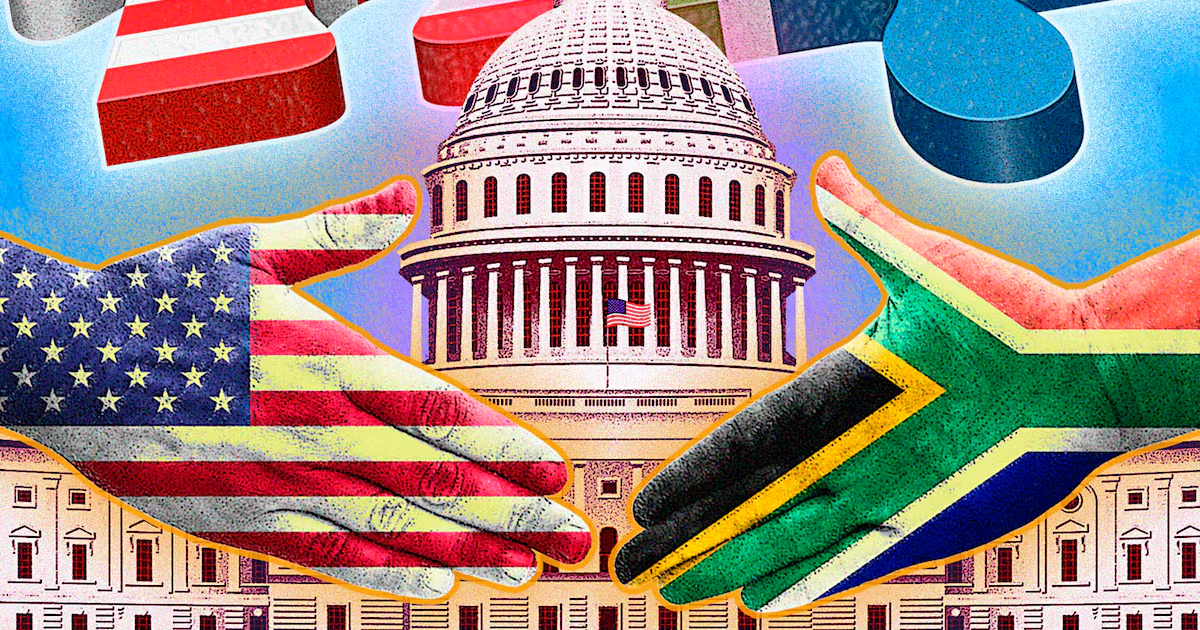
South Africa has historically had a fragmented business community, with formations grouping themselves along racial and ideological lines.This has seen the formations of widely diverse entities such as Nafcoc, Black Business Council and Sakeliga, among others. Each with its own constituency.There is a need for such organisations, as they have constituencies that they serve. At the end of the day, the business community, like the society it operates in, is not hegemonic.It would be unfair to have one lobby group speak on behalf of every business and business person in a country with many polarising policy positions like ours. Be that as it may, a growing economy that absorbs her young people in the place of work is in the interest of every business.This should be one matter that must force business to enter the same room and plot a way forward to grow the economy and a future where everyone has something to eat and a job to express their talents and acquired academic skills.South Africa’s dual bid to extend the African Growth and Opportunity Act (Agoa) and secure South Africa’s seat in it is one such opportunity where the business community should make a deliberate attempt to find common ground.Unfortunately, Business Unity South Africa (Busa) and Sakeliga proposed two opposite remedies to modernise Agoa — with the latter, in essence, asking US authorities to overlook government and focus on businesses in determining South Africa’s participation in Agoa.Busa, for its part, more or less aligned with the position of the government. It is not for this publication to pass judgment on the submissions made by the two entities to US authorities. However, it is disheartening that rather than having a unified business case to woo the US to consider extending Agoa and making the case for South Africa’s continued inclusion in the duty-free trade pact, the business groupings decided to air the country’s dirty laundry on the international stage.This is a temptation that should have been avoided in the national interest, particularly when there are no winners if the Agoa door is closed on South Africa.The odds of a favourable outcome to South Africa increase when its business community speaks from the same page. The grandstanding and attempt to settle contentious national debates such as transformation and black economic empowerment using Agoa is akin to cutting one’s nose off to spite one’s face.This is more so when all business lobby groups agree on the benefits that South Africa has derived from its participation in Agoa since the early 2000s.The business groupings must learn the art of negotiations and reaching across the aisle for meaningful engagement on matters of national interest. This democracy was built on the back of genuine, albeit robust, discussions where former enemies sat around the table to save the country from falling down the precipice.The business community must make a genuine attempt to find each other on matters such as the renewal of Agoa and South Africa’s place in it. This is one matter that should have seen sober heads prevail and focus on the global picture rather than narrow interests.The business community can do better and must do better. It is not for any South African business lobby group to speak on behalf of the more than 600 US companies that do business in the country on how the government’s transformation policies have affected them.The prerogative must be left to these businesses and their representative business body to opine on this matter.
EDITORIAL | Business should unite behind SA’s Agoa case
South African business groups should speak with one voice over African growth act
577 words~3 min read