Story audio is generated using AI
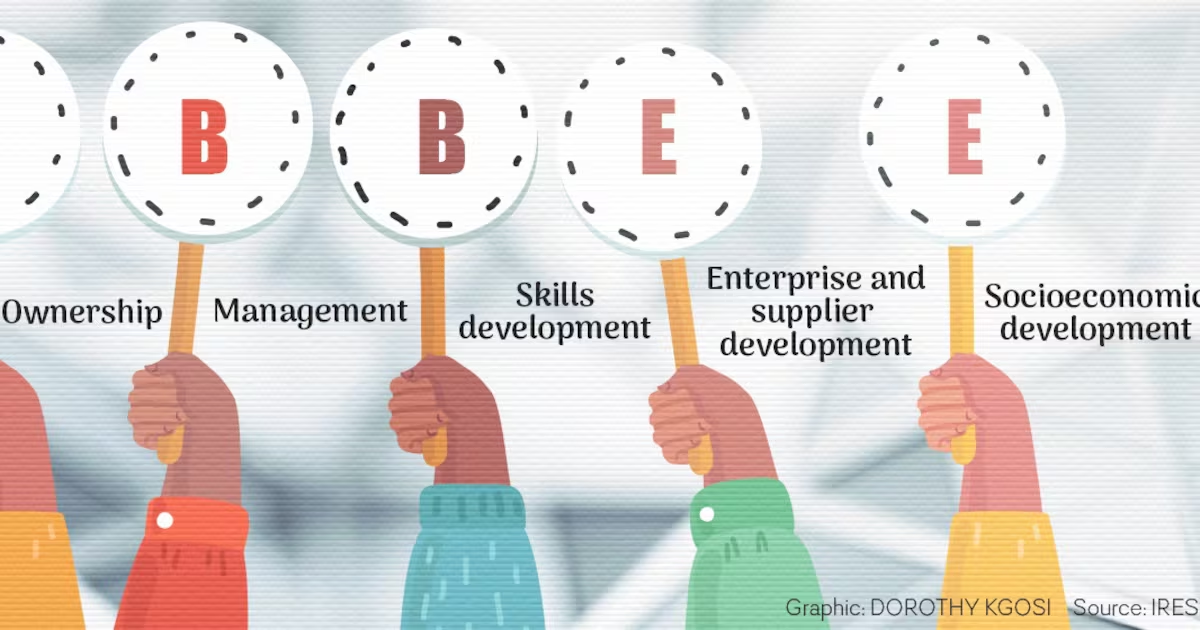
This month South Africans were told that one company spent 307% of its profit in a single year to comply with BEE. The figure travelled quickly. It has been carried in headlines, amplified on social media, and offered as proof that transformation is strangling the economy. It deserves a closer look, because the closer one looks, the less there is to see.The number comes from a survey conducted by Codera Analytics and XA Global Trade Advisors, reported under dramatic headlines by Daily Investor and others. The authors themselves are careful people. They concede, as Rob Rose has noted in the Financial Mail, that of about 700 firms approached, only 126 responded, and that the sample is not statistically representative of South African business. A self-selected group of 126 respondents, canvassed through business associations that were never neutral on the question, is not a measure of an economy. It is an opinion poll dressed as economics.Consider what the 307% claim actually says. It is a ratio of reported compliance spend to profit in a single year. Profit, as any director knows, is a residual. In a weak trading year it can be small, or close to nothing, and a modest cost set against a thin profit can produce an alarming percentage that means very little. No code of good practice, no scorecard, and no law requires any company to spend multiples of its profit on compliance. Empowerment is pursued through choices a board makes about ownership, skills development, enterprise and supplier development, and procurement. If a company genuinely directed three times its annual profit toward those activities, that would not be the harmful effect of a policy. It would be reckless stewardship by its directors, and shareholders would be entitled to ask hard questions.There is a simpler test. Company expenses are recorded in audited annual financial statements. There is no line in those statements called “BEE compliance”. The costs that critics bundle together are dispersed across training budgets, supplier payments, verification fees and ordinary commercial decisions that most well-run companies would make in any event. A number that cannot be traced to an audited account is a number assembled to make a point, not to measure a cost.A number that cannot be traced to an audited account is a number assembled to make a point, not to measure a cost.The same caution applies to the larger figures now in circulation, including the estimate from Solidarity and the Free Market Foundation that BEE costs the economy between R145bn and R290bn a year, or about 4% of GDP. A range in which the upper figure is double the lower is not a finding. It is a guess with a generous margin. The government, to its discredit, publishes too little compliance data of its own, and that vacuum is now being filled with estimates calibrated to alarm rather than to inform.We have been here before with the motor industry. When Nissan confirmed it would end assembly at Rosslyn, some commentators were quick to file it under the costs of transformation. The record says otherwise. Nissan announced a global recovery plan after a loss of roughly R82bn, a collapsed merger with Honda and Mitsubishi, and a decision to cut its worldwide plants from 17 to 10. Rosslyn had been running far below capacity for years, building a single ageing model. And the plant was not abandoned to the veld. It was bought by Chery, a Chinese manufacturer, in the very wave of competition that is reshaping the motor industry on every continent. To blame an empowerment scorecard for a global restructuring, while ignoring the Chinese carmakers now redrawing the map, is to choose a comfortable villain over an inconvenient truth.It is worth remembering why this policy exists at all. Apartheid was not only a system of political exclusion. It was an economic design, built deliberately to concentrate ownership, skills and opportunity in the hands of a minority and to reduce the majority to cheap labour. That design did not dissolve in 1994. To blame an empowerment scorecard for a global restructuring, while ignoring the Chinese carmakers now redrawing the map, is to choose a comfortable villain over an inconvenient truth.More than 30 years into our democracy, a small minority still holds the overwhelming majority of the economy, while the black majority, more than nine in 10 of us, owns a fraction of it. StatsSA has reported white median earnings at several times those of black Africans, and the ownership of land tells the same story. Left to itself, a market that begins from such a starting point does not correct the imbalance. It compounds it, generation after generation. Without deliberate redress, the majority of South Africans remain spectators in their own economy.This is not reverse discrimination, as is so often claimed. It is what our constitution contemplates. Critics like to quote section 217, which requires the state to procure goods and services in a manner that is fair, equitable, transparent, competitive and cost-effective. They tend to stop reading there. The very next subsections, 217(2) and 217(3), expressly permit the state to give preference to protect and advance those disadvantaged by unfair discrimination and require legislation to give that policy a framework. The Constitutional Court has held that to read the first subsection so as to defeat the others would subvert the constitution itself. Fairness, in our constitutional order, includes redress. It is neither fair nor wise to preserve the advantages handed down by an illegitimate system and then to call their preservation fairness.None of this means BEE is beyond criticism. It is not, and the Black Business Council has never pretended otherwise. We have warned for years that too many companies tick boxes rather than transform, that fronting too often goes unpunished because the B-BBEE Commission lacks the capacity to pursue it, and that the benefits have been far short of their potential. These are arguments for stronger implementation and sharper enforcement. They are not arguments for repeal. Even the authors of the survey now being used against us accept that transformation is essential. The question they raise is one of method, not of principle.That distinction is where the real debate should live, and we welcome it. What we cannot accept is the quieter project running beneath the headlines: a sustained effort to move public sentiment far enough that redress legislation might be rolled back altogether, whether through the courts, through bills that would dilute the policy, or simply through repetition until a thumb-suck becomes received wisdom.Those who believe in this country’s founding promise should understand that the promise is now under pressure. The answer is engagement, not hostility and the use of substantive evidence as much as possible. For as long as the economy remains in the hands of a minority, we will continue to engage in policy forums, in boardrooms, and in the public square; not to defend a slogan but to advance the substance of redress and broad-based participation. • Matabane is CEO of the Black Business Council and a member of the Presidential B-BBEE Advisory Council.