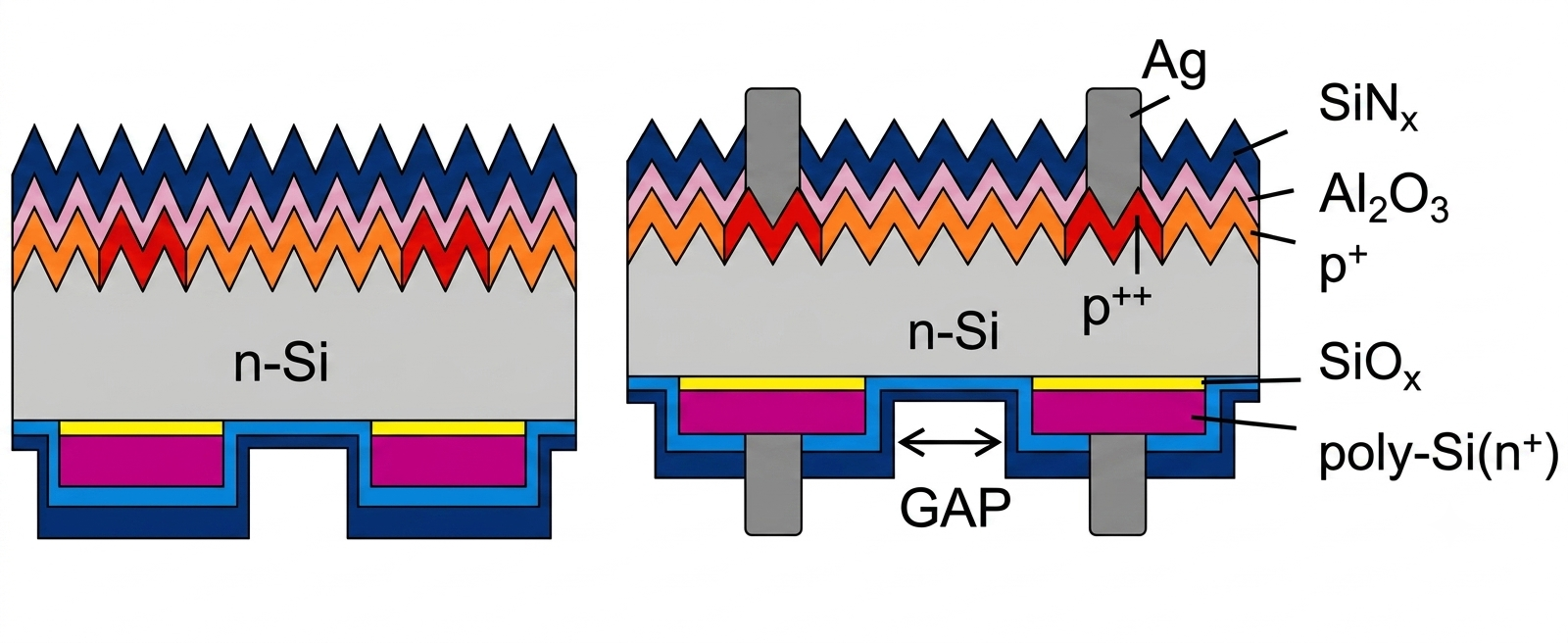
Researchers in China developed a laser-assisted poly-Si finger contact fabrication method combining picosecond laser modification and potassium hydroxide wet etching to reduce parasitic absorption in industrial TOPCon solar cells. The optimized process achieved a certified efficiency of 26.08% by improving optical performance while maintaining effective passivation and carrier transport.
Researchers from China’s Yangzhou University have developed a laser-modification–assisted wet-etching process to fabricate rear poly-finger contacts for industrial TOPCon solar cells.
“Our work proposes a manufacturable poly-finger rear patterning strategy combining picosecond laser modification and precision potassium hydroxide (KOH) wet etching to boost the efficiency of industrial n-type TOPCon solar cells,” corresponding author Qinqin Wang told pv magazine.
The scientists explained that double-sided passivating contact solar cells suffer from parasitic absorption in front poly-Si layers and grid-line shadow losses, limiting efficiency improvements. Back-contact (BC) solar cells overcome these issues by placing passivating contacts on the rear side, eliminating front shading and approaching the theoretical efficiency limit of silicon cells. However, BC fabrication remains challenging due to complex rear-side patterning and precise metallization alignment, they emphasized.