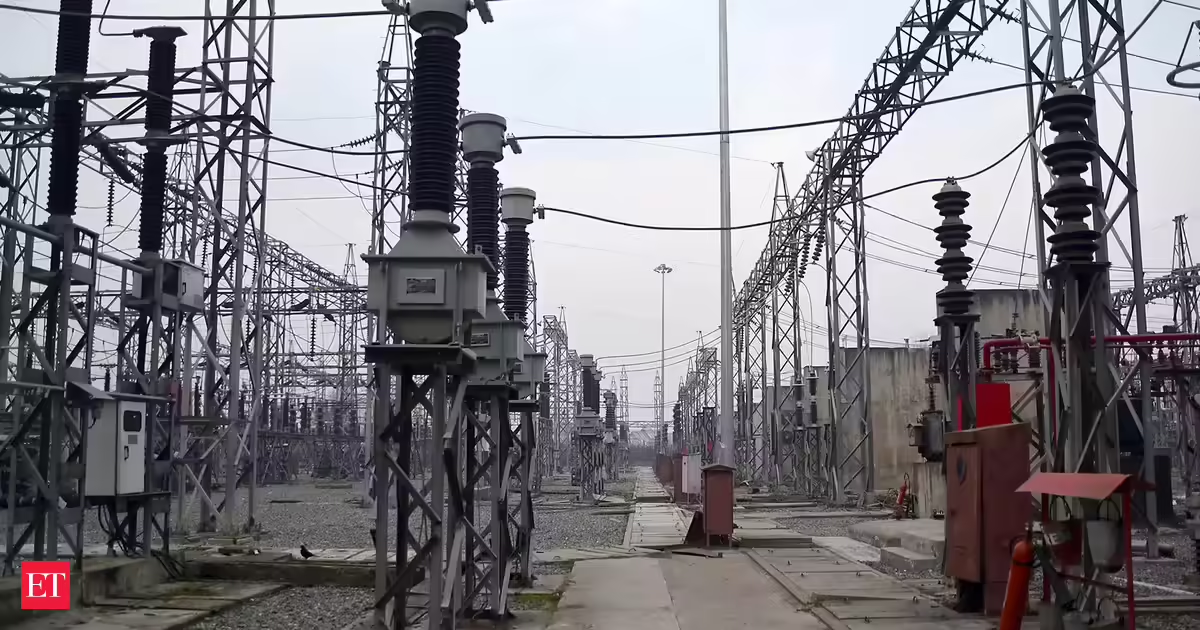
A decade ago, India’s electricity debate was about whether there was enough power to go around. That is not where the sector stands today. Installed generation capacity has crossed 530 GW, and the national supply-demand gap has narrowed to almost negligible levels. For a country where growth, cooling demand and industrial activity are rising together, the next question is different: can this progress make electricity dependable at the point of use?Electricity (HT File)Power shortage is often used as one phrase, but it has different meanings. An energy shortage measures the gap between electricity required and supplied over a period. A peak deficit measures whether the system can meet maximum demand. Supply hours show how long consumers receive electricity in a day. Reliability is wider. It includes outages, voltage fluctuation, feeder failures, evening peak pressure, transmission constraints and the ability of distribution companies to deliver power consistently.The latest official supply data captures India’s progress. At the all-India level, energy shortage stood at only 0.1% in FY25 and 0% in FY26 up to February. Bihar’s energy not supplied declined from 176 million units in FY25 to 14 million units in FY26 up to February. Jharkhand’s declined from 77 million units to five million units over the same period.Yet an annual energy balance is not the same as consumer experience. Average supply-hour data gives a more grounded picture. In 2023-24, rural Bihar received 22 hours of daily supply and rural Jharkhand also received around 22 hours. The national rural average was around 21.9 hours, while Uttar Pradesh, Haryana, Jammu & Kashmir and Nagaland remained below 20 hours of rural supply. These numbers show why the next phase of progress must be measured by quality and reliability, not aggregate availability.The summer of 2026 made this shift visible. On May 21, India’s peak power demand touched a record 270.82 GW during solar hours at 3:45 pm, and the system successfully met it. Yet on May 24, India’s peak demand of around 250 GW came during non-solar hours at 10:36 pm. Daytime shortage remained zero, while night-time shortage stood at 0.45 GW. The number was small, but its significance was large. It showed that India’s next power challenge is building firm, flexible supply for the hours when solar output falls and demand remains high.The geography of this challenge needs care. It cannot be reduced to north versus south, or east versus west. Power cuts can occur in cities as well as rural areas. Renewable-rich states can still face reliability issues because generation alone does not guarantee delivery. Solar capacity needs storage, grid balancing, transmission capacity and stable distribution companies. Similarly, a resource-rich state does not automatically enjoy dependable power merely because fuel or generation assets are nearby.Bihar and Jharkhand show two sides of this transition. Bihar’s development ambitions depend on reliable electricity for manufacturing, logistics, cold chains, hospitals, education, services and small enterprises. Jharkhand is resource-rich and industrially significant, with coal, mining, metals and steel-linked activity. Yet reliable supply still depends on feeders, transformers, distribution losses, procurement planning and distribution companies’ finances. The link between generation and consumer experience is built through institutions and infrastructure.India’s power debate has to move from capacity alone to quality of supply. The country will need stronger transmission planning, healthier distribution companies, faster storage deployment, better coal logistics, flexible generation, deeper renewable integration and upgraded local networks. No single technology or reform can solve a challenge that is technical, financial and institutional at the same time.Nuclear power already has a place in India’s clean baseload story. India’s long-running cooperation with Russia at Kudankulam, where NPCIL has worked with Rosatom on VVER reactors, shows how international partnerships have supported large-scale capacity creation. But the reliability challenge now requires thinking beyond only large centralised projects.Small Modular Reactors, or SMRs, belong in that debate. They should not be presented as a quick fix or as a substitute for distribution reform. International experience shows why modular nuclear is being discussed as an option for firm, low-carbon power. If we were to take Rosatom as an example, its extensive work with floating nuclear power units and the RITM-200 reactor family outlines the relevance of such technologies in this conversation. For India, the relevance lies in whether such technologies can support industrial clusters, retiring thermal sites and future growth corridors.The Department of Atomic Energy has indicated a similar direction through Bharat Small Modular Reactor-200 and SMR-55. Their proposed use cases include captive power for energy-intensive industries, repurposing retiring fossil-fuel sites and deployment in remote locations without grid connectivity. Lead units of BSMR-200 and SMR-55 are proposed at Tarapur Atomic Power Station.For Bihar and Jharkhand, the relevance is long term. SMRs cannot repair weak feeders, reduce billing losses or fix financially stressed discoms. Those remain governance and distribution priorities. But modular nuclear can become part of a broader reliability architecture if India wants cleaner firm power near future industrial corridors.India’s next electricity milestone will not be measured only by how many megawatts are added. It will be measured by how consistently electricity reaches the point of use. India has shown that it can move from shortage to sufficiency. The next step is to move from sufficiency to reliability. That is the geography of power that matters now.(The views expressed are personal)This article is authored by Rudra Prasad Pradhan, professor, department of humanities and social sciences, BITS Pilani-KK Birla Goa Campus, Goa and Political Economy Distinguished Fellow, Centre for Public Policy Research.
India’s next power milestone is reliability
This article is authored by Rudra Prasad Pradhan.
903 words~4 min read