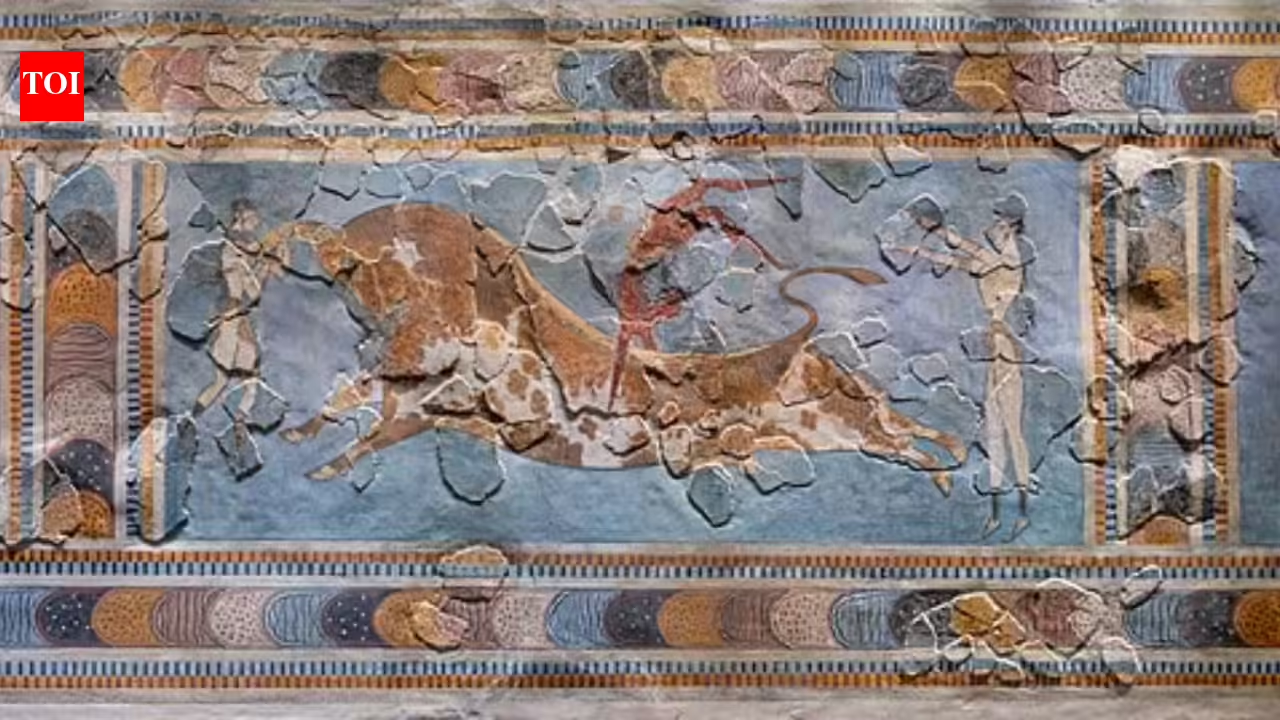
The Bull-Leaping Fresco is the most completely restored of several stucco panels originally sited on the upper-story portion of the east wall of the Minoan palace at Knossos in Crete. Image Credit: WikipediaThe Bronze Age Cretan Minoans were widely praised for being among the first and most impressive civilizations in Europe because of their splendid palaces, rich frescoes, and extensive trading routes at sea. However, for more than a hundred years, archaeologists had a puzzle that remained unresolved: who were these famous people?Traditionally, artefacts were the main evidence of contact between Crete and other regions, but they could not show whether new influences arrived through trade or through migration. To answer this question, scientists turned to genetics. Thanks to genome-wide analysis of ancient DNA, a new perspective on Minoan origins emerged, suggesting that the civilization developed gradually through interaction between local populations and neighboring regions.Aegean landscape connection runs deepThe first step forward was taken through a groundbreaking study in 2017. As it is stated in Genetic origins of the Minoans and Mycenaeans, the Minoans did not turn out to be strangers with an exotic origin who appeared on the shores of Crete as a ready-made civilization. Instead, the researchers found that the Minoans and their continental counterparts, the Mycenaeans, traced most of their ancestry to Neolithic farmers in western Anatolia and the Aegean.At the same time, the Minoan genetic profile was not completely isolated. The Minoans also had ancestry that may have come from populations in the Caucasus and Iran. This additional ancestry suggests that, despite living on an island, the Minoans continued to receive genetic input from the east.Minoan Marine Style Octopus Flask with Ancient Sea Motifs. Image Credit: WikipediaA common genetic junctionLater studies broadened the picture to the wider region. In one follow-up study, Early Bronze Age people from Crete, mainland Greece, and nearby islands showed striking genetic similarity. They had the overwhelming majority of their DNA coming from the same Neolithic Aegean gene pool.Crete appears to fit a broader regional pattern in which local populations retained much of their genetic identity while receiving limited outside input. In other words, the ancient Aegean already showed substantial genetic convergence before the first palaces were built.Gradual changes and family preferencesThis story received more detailed clarification thanks to a 2023 study published in PubMed that studied the genomes of 102 prehistoric individuals from the area. The study suggests that eastern ancestry did not arrive in Crete in a single migratory wave.Beyond tracing large-scale migration, the paper also identified a very high rate of consanguineous endogamy, or marriage within close kin groups. The findings suggest that Minoan society was open to outside contact by sea while maintaining strong kin-based continuity at home. Using modern high-throughput sequencing to recover ancient nuclear genomes, scientists were able to move beyond limited maternal evidence and build a clearer picture of human population history.
In 2020, ancient DNA studies uncovered Minoan roots across the Aegean and reshaped Crete's past
The Bronze Age Cretan Minoans were widely praised for being among the first and most impressive civilizations in Europe because of their splendid palaces, rich frescoes, and extensive trading routes at sea. However, for more than a hundred years, archaeologists had a puzzle that remained unresolved: who were these famous people?
477 words~2 min read