Reading someone’s mind has been a sci-fi staple for decades. Meta’s AI research lab just took a measurable step toward making it real, though the current version is less Professor X and more like a very ambitious autocorrect for your neurons.
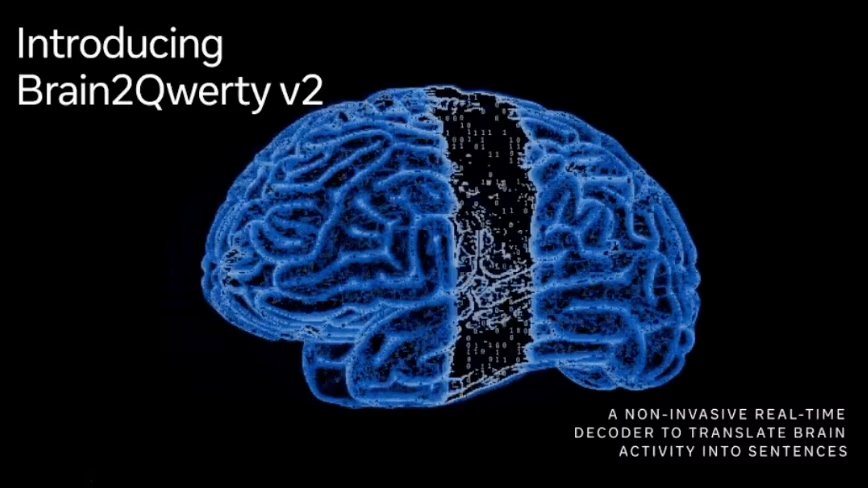
Meta’s Fundamental AI Research (FAIR) lab developed Brain2Qwerty, a non-invasive AI system that decodes typed sentences directly from brain activity. Built in collaboration with Spain’s Basque Center on Cognition, Brain and Language (BCBL), the system achieved 70-80% character-level accuracy using magnetoencephalography (MEG) recordings from 35 healthy volunteers who typed memorized sentences.
How Brain2Qwerty actually works
The system uses a hybrid deep-learning architecture that stitches together three distinct AI components: convolutional neural networks (CNN), transformers, and traditional language models. In English: it layers pattern recognition, context understanding, and linguistic prediction on top of each other to make sense of the electrical noise your brain produces when you think about pressing keys.
There are two brain-scanning methods at play here, and the gap between them matters. MEG, which measures magnetic fields generated by neural activity, delivered the headline-grabbing 70-80% character accuracy. EEG, which uses electrodes placed on the scalp, landed at roughly 50% accuracy.