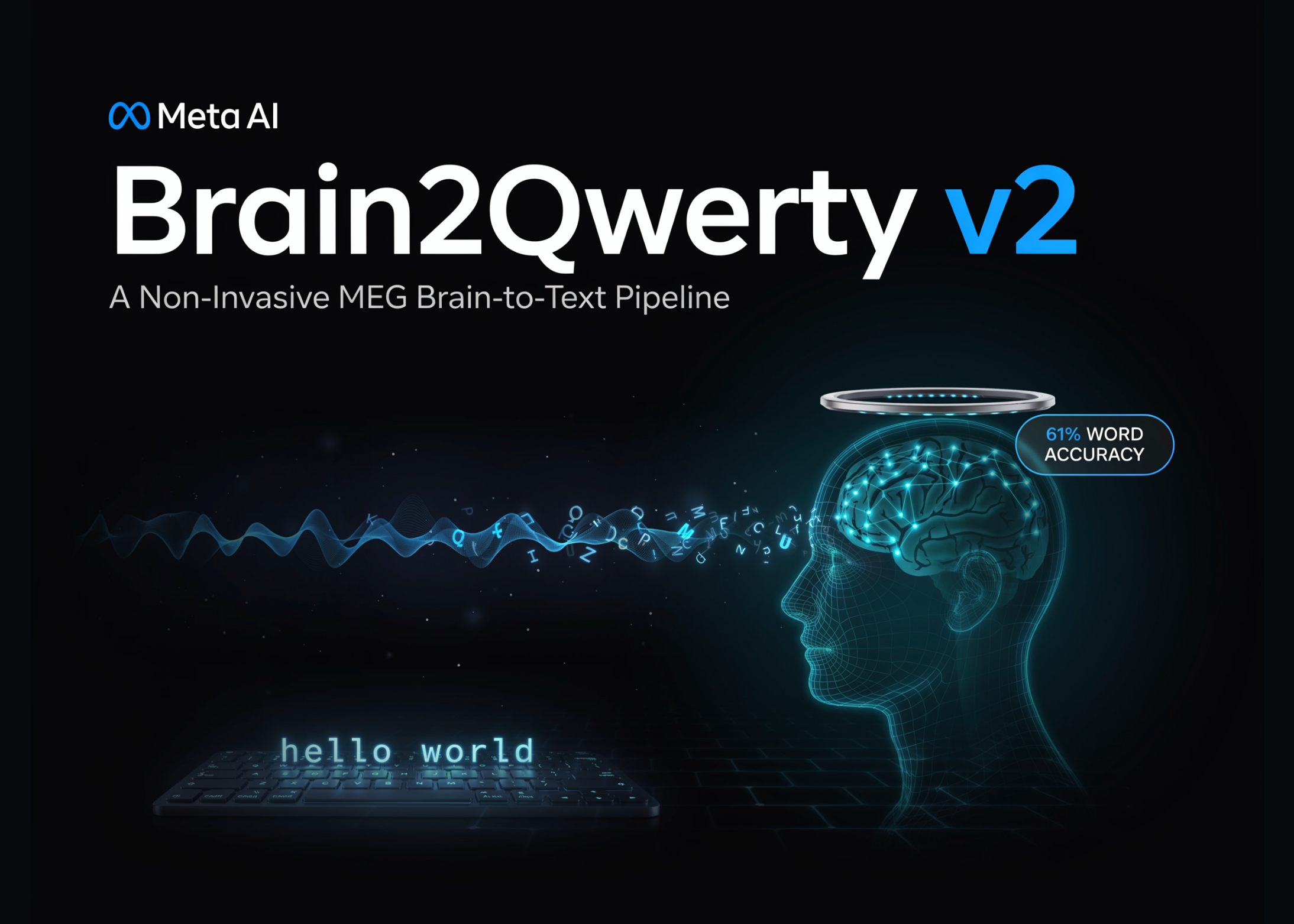
Meta AI has built a system that can read your brain activity while you type and reconstruct the words you intended to write. No implants, no surgery, just a helmet covered in sensors. It’s called Brain2Qwerty, and it represents one of the most ambitious attempts to decode human language from non-invasive brain recordings.
The system, detailed in a paper published on February 6, 2025, achieved an average character error rate of 32% when using magnetoencephalography (MEG) sensors. In English: roughly one in three characters came out wrong. That sounds rough until you consider the alternative, EEG-based readings, which produced a 67% error rate. The best MEG participants hit a 19% character error rate.
How it actually works
Think of Brain2Qwerty like a three-stage translation pipeline for your brain’s electrical chatter.
First, a convolutional module analyzes 500-millisecond windows of brain signals. It’s essentially looking at tiny snapshots of neural activity and trying to identify patterns that correspond to finger movements and letter intentions.