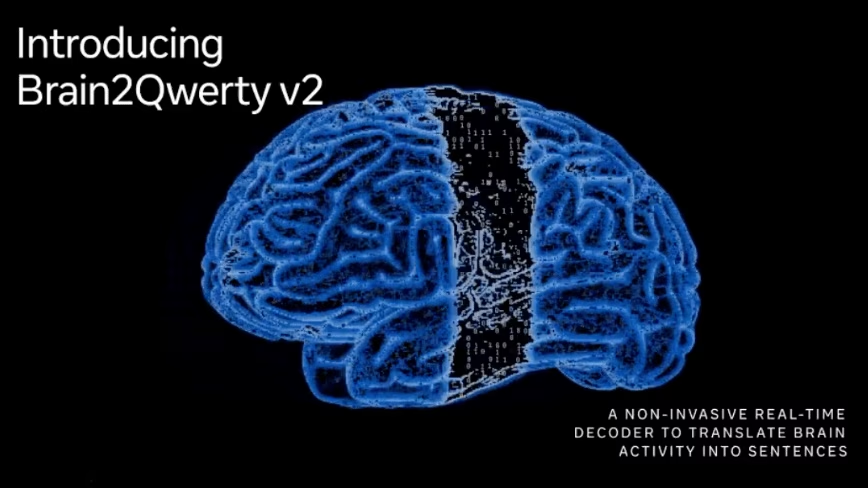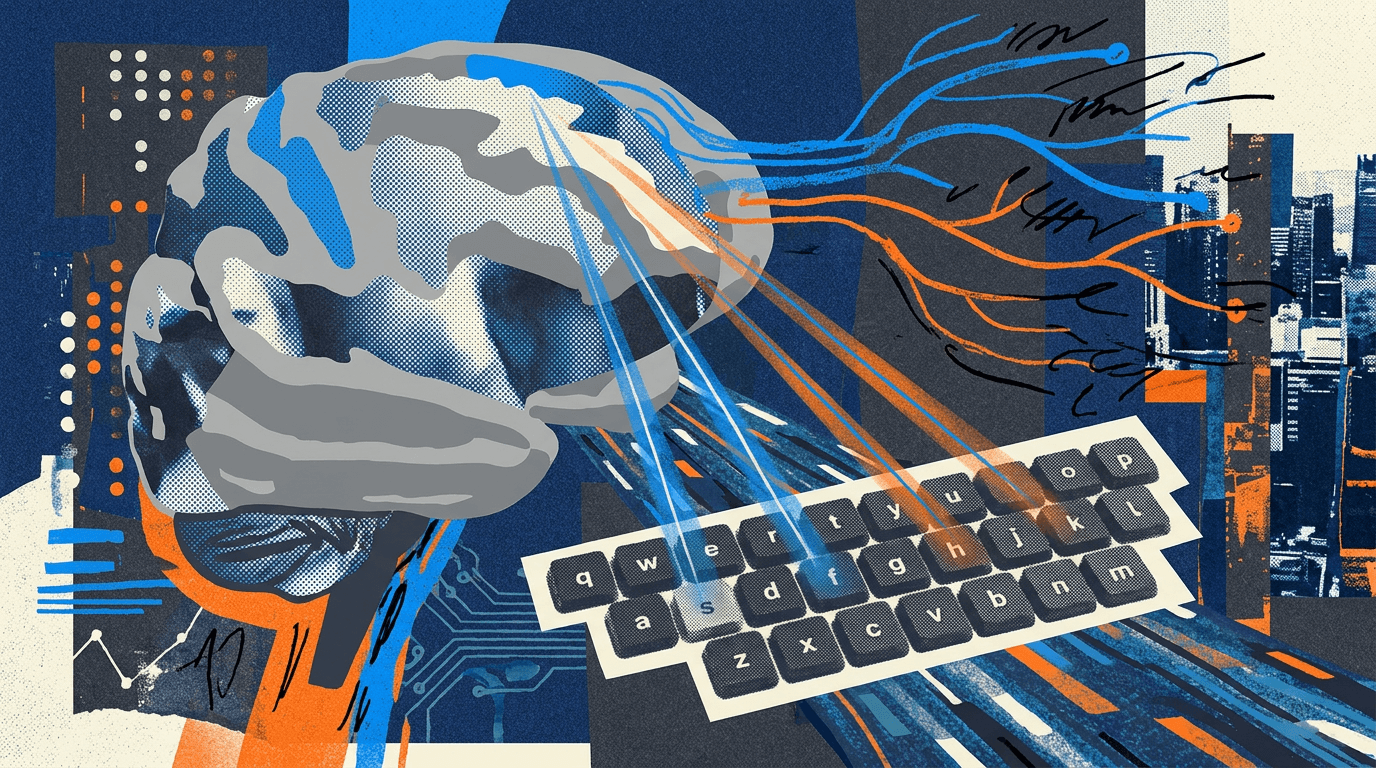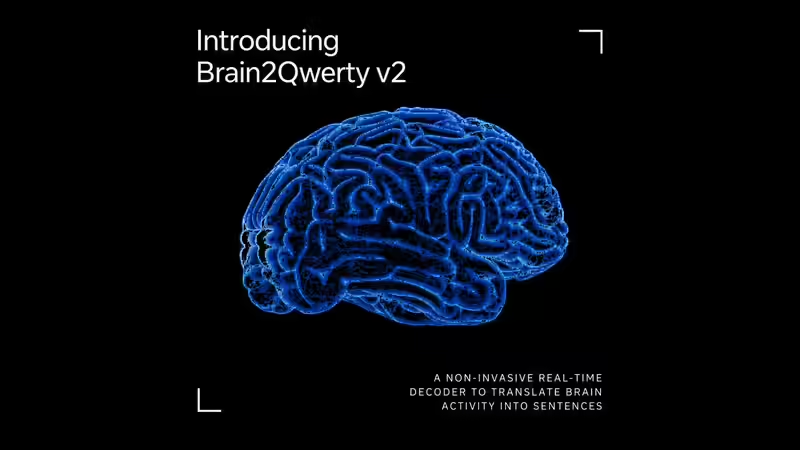
Meta has unveiled Brain2Qwerty v2, an AI system that turns brain activity into typed text using a head-worn scanner rather than any surgical implant, the company announced this week. The research points toward a day when people might type using thought alone, and it could matter most for those whom illness or injury has stripped of the ability to communicate.This is the second version of a research project from Meta's FAIR lab, following the original Brain2Qwerty that debuted in 2025. The technology could prove especially valuable for people with brain lesions, paralysis or other conditions that make communication hard, since it offers a path to typing with thought alone. The first version proved the idea worked; this one pushes it close to the accuracy once reserved for methods that open the skull.How the technology worksBrain2Qwerty v2 reads what a person intends to type from their brain signals alone, free of any implanted hardware. It relies on magnetoencephalography, or MEG, a non-invasive method that measures the tiny magnetic fields the brain produces, captured from outside the head. Where surgical approaches place electrodes against the brain itself, MEG works through a scanner the user wears, picking up neural activity from beyond the skull.The scanner looks the part, resembling a giant hairdryer that the wearer sits inside, registering the faint magnetic flickers that accompany every thought. Meta points out that the higher-accuracy alternatives, stereotactic electroencephalography (sEEG) and electrocorticography (ECoG), buy their precision at the price of brain surgery, with all the risk, cost and limited reach that surgery carries.That trade-off marks the real divide in this field. Elon Musk's Neuralink chases accuracy by implanting electrodes directly, accepting the surgery to get the cleanest possible signal. Meta is taking the opposite bet, reading a noisier signal from outside the head and leaning on AI to make sense of it.MEG earns its place by capturing a cleaner signal than the cheaper, more familiar EEG cap, whose readings stay too noisy to pull whole sentences from. It trades that for sensitivity and timing sharp enough to track the rapid flicker of typing, which is why Meta built the system around the scanner rather than the electrodes most people associate with sleep clinics.Accuracy and trainingMeta trained Brain2Qwerty v2 on roughly 22,000 sentences from nine volunteers, each of whom spent about 10 hours typing inside an MEG scanner. The headline change sits in the architecture. The first version leaned on a hand-built pipeline that matched specific neural patterns to individual key presses, and it needed to know the exact timing of each keystroke in advance, which ruled out real-time use. Version 2 replaces that with end-to-end deep learning that decodes language straight from the raw brain signal, reading the activity on its own, free of any external reference set to lean on.Under the surface, the pipeline runs in stages. One model reads a continuous window of magnetic activity and predicts a stream of characters; a fine-tuned language model then weighs those guesses against grammar and meaning, working much like a spellchecker for the brain. The build leans on the same family of tools behind modern chatbots, Transformers and convolutional networks, retrained on neural data. The original Brain2Qwerty, by contrast, managed a 32 per cent character error rate, and only when handed the precise timing of every keystroke in advance, a constraint that kept it off the table for real-world use.The numbers tell the story of the leap. Brain2Qwerty v2 reached an average word accuracy of 61 per cent, against the roughly 8 per cent typical of other non-invasive methods. Meta's best participant hit 78 per cent, with more than half of their sentences decoded carrying one word error or fewer.To sharpen the output further, Meta fine-tuned large language models on the neural data, letting the system weigh grammar and meaning when a signal turns ambiguous, much as predictive text guesses the word you reached for. Crucially, accuracy climbed as the training data grew, a hint that gathering more recordings could narrow the gap with surgical alternatives over time.The open-source pushRather than locking the work away, Meta is releasing the full training code for both Brain2Qwerty v1 and v2, and its research partner, the Basque Center on Cognition, Brain, and Language (BCBL), is publishing the v1 dataset. Meta frames the move as part of a broader effort to build open foundational brain models and speed up the work of diagnosing and treating neurological disorders, arguing that progress comes faster in the open than behind closed doors.A crowded fieldMeta has plenty of company in the race to read the brain. Neuralink and Synchron are pursuing implanted interfaces that demand surgery, while Merge Labs, backed by OpenAI chief executive Sam Altman, is among the newer entrants. The dividing line runs between the implant camp, which accepts surgery for a cleaner signal, and the growing group betting that AI can lift the performance of external, surgery-free systems to something comparable. Brain2Qwerty v2 plants Meta firmly in the second.Why the accuracy mattersSet the 61 per cent against the stakes, and the figure starts to land. Implanted interfaces, with electrodes resting on the motor cortex, already let people with ALS or locked-in syndrome type at close to natural speed, a genuine restoration of voice for those who had lost it. The price is brain surgery, and with it the risk of infection, inflammation and a signal that fades over months. Brain2Qwerty v2 matters because it marks the first time a surgery-free system has read full sentences anywhere near the range that once belonged to implants alone. The gap with surgical methods stays real, yet it has shrunk from a chasm to a stride.How close is this to everyday life?Temper the excitement with one practical fact. MEG scanners are massive, costly machines that belong in research labs rather than living rooms, so typing an email by thought remains years away from any consumer. This is a research milestone rather than a product launch, and Meta says as much.Even so, the direction matters. By pairing advances in neuroscience with modern AI, Meta is showing that surgery-free brain-to-text may sit closer than the field once assumed. For someone who has lost the ability to speak, that prospect could end up meaning far more than any chatbot or image generator.Frequently asked questionsWhat is Brain2Qwerty v2?Brain2Qwerty v2 is a research system from Meta that uses AI to translate brain activity into text, letting a person type by thinking. It works through a worn scanner rather than a surgical implant or a chip placed inside the head.Does it require brain surgery or implants?It avoids both. The system uses magnetoencephalography, or MEG, a non-invasive scanner worn like a helmet that reads magnetic signals from outside the head, in contrast to implant-based approaches such as Neuralink.How accurate is it?Brain2Qwerty v2 reaches an average word accuracy of 61 per cent, well above the roughly 8 per cent of other non-invasive techniques. The best participant reached 78 per cent.How is this different from the first version?The original matched specific neural patterns to individual keystrokes and needed the exact timing of each key press, which prevented real-time use. Version 2 uses end-to-end deep learning to decode language directly from raw brain signals, in real time.Who could benefit from this technology?Meta says it could help people with paralysis, brain injuries or other conditions that take away speech, giving them a way to type their thoughts.When could people actually use it? A consumer version remains years off. The MEG scanners involved are large, expensive laboratory machines, so for now this is a research advance rather than a device anyone can buy.end of article
Meta's Brain2Qwerty v2 Types Your Thoughts From a Helmet, Skipping Brain Surgery
Meta has unveiled its Brain2Qwerty v2 system, a groundbreaking non-invasive technology that translates thoughts into typed text using a head-worn scanner, achieving an impressive 61% word accuracy. This innovative AI solution shines a light on the possibilities for individuals suffering from communication challenges due to illness or injury. Although consumer applications are still years ahead, it represents a significant step forward in brain-computer interface technology.
1,266 words~6 min read