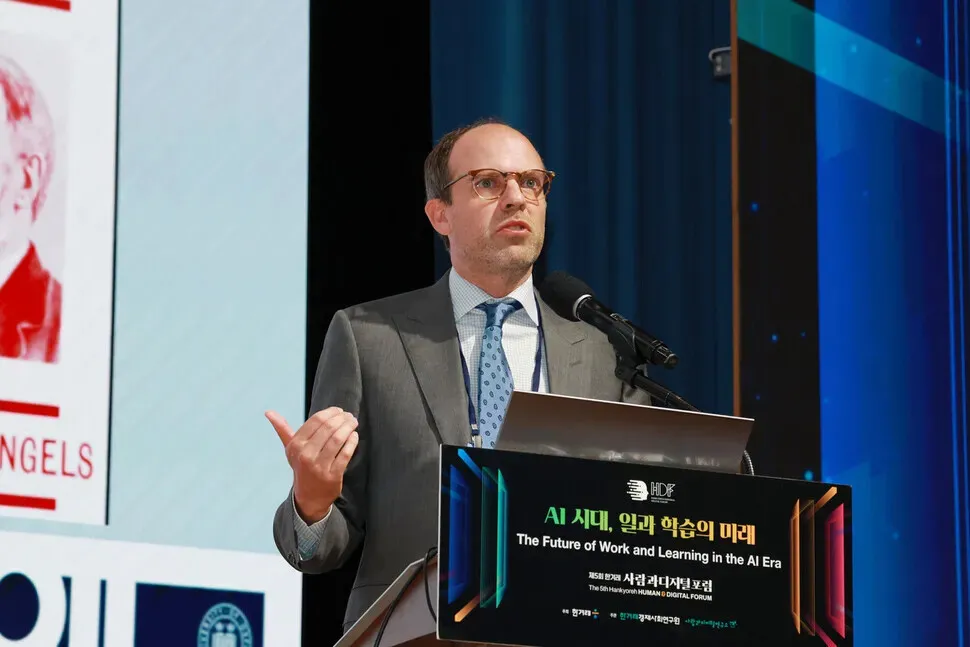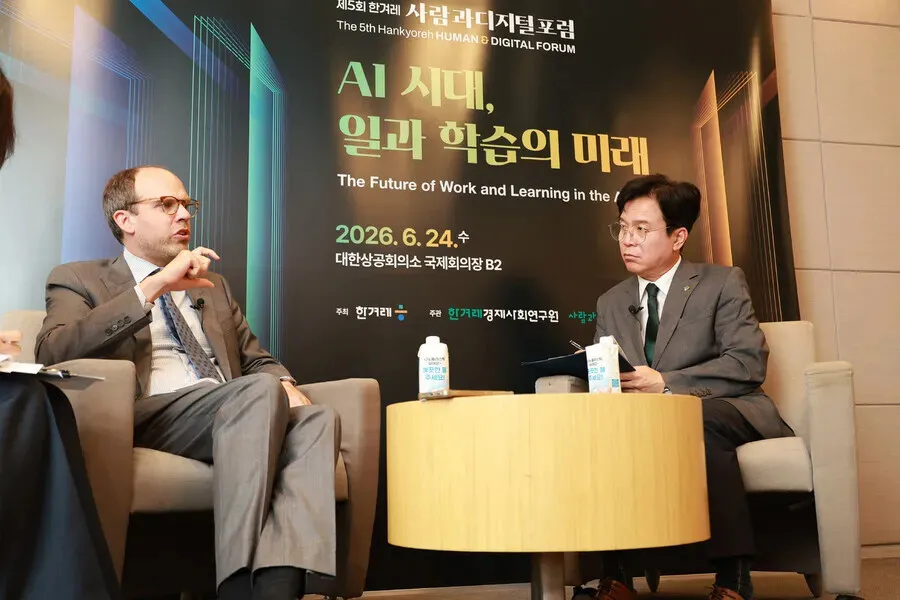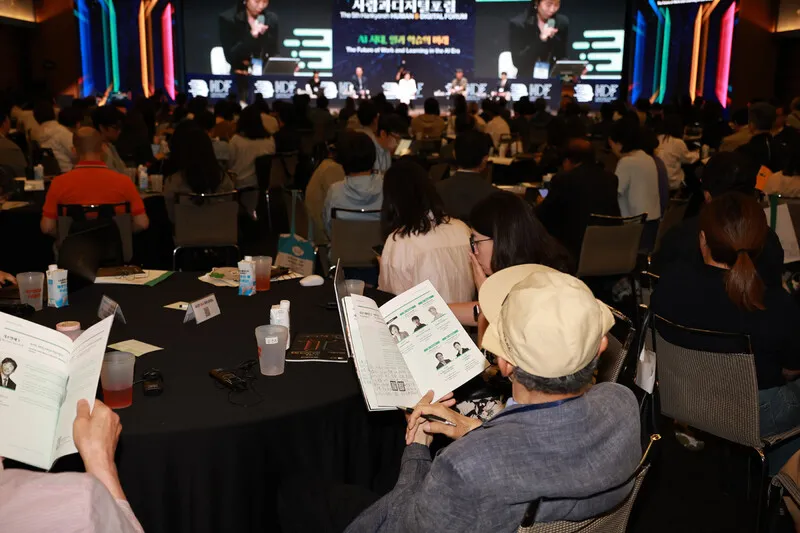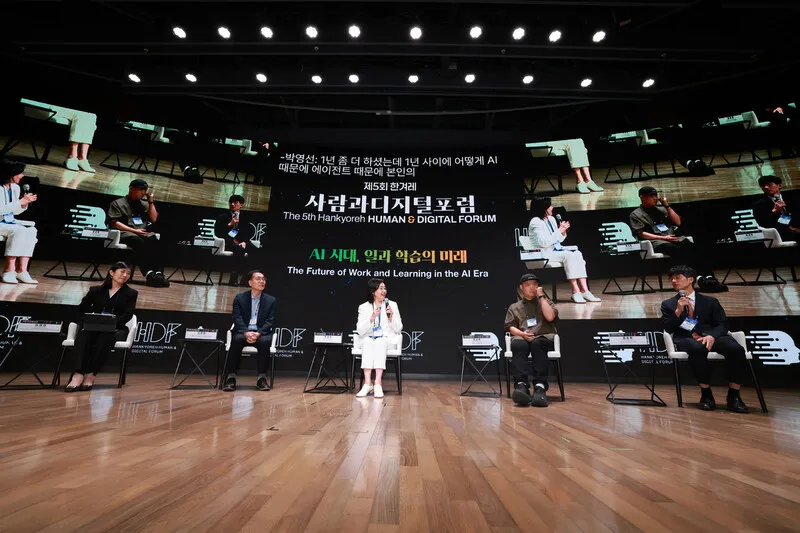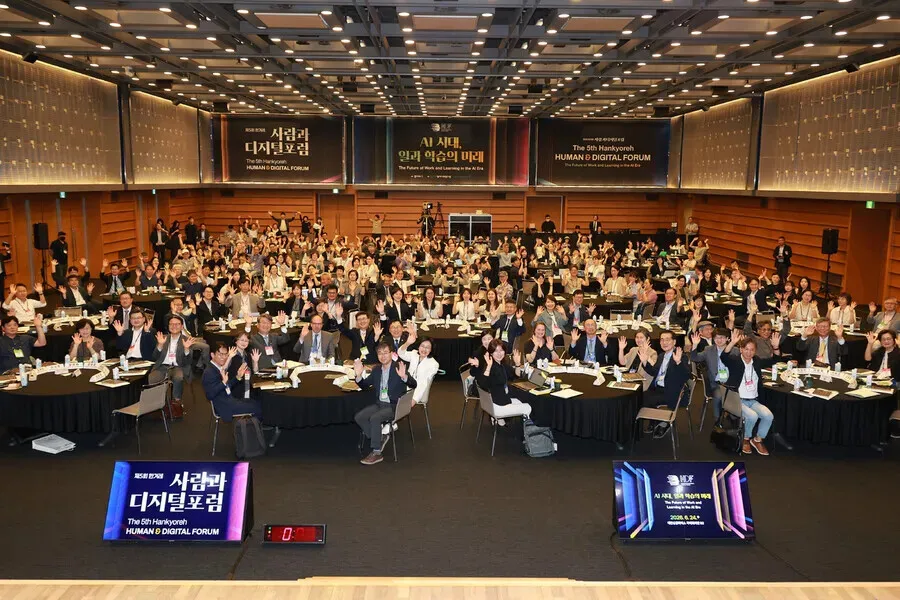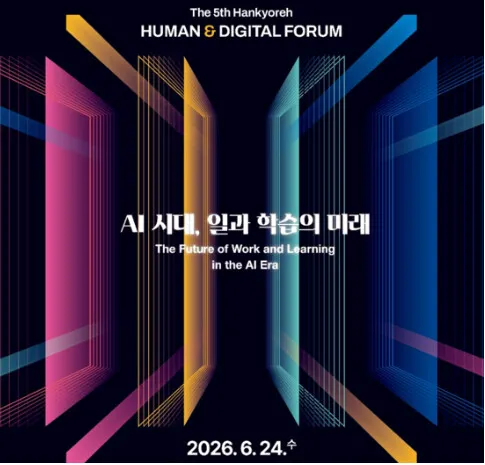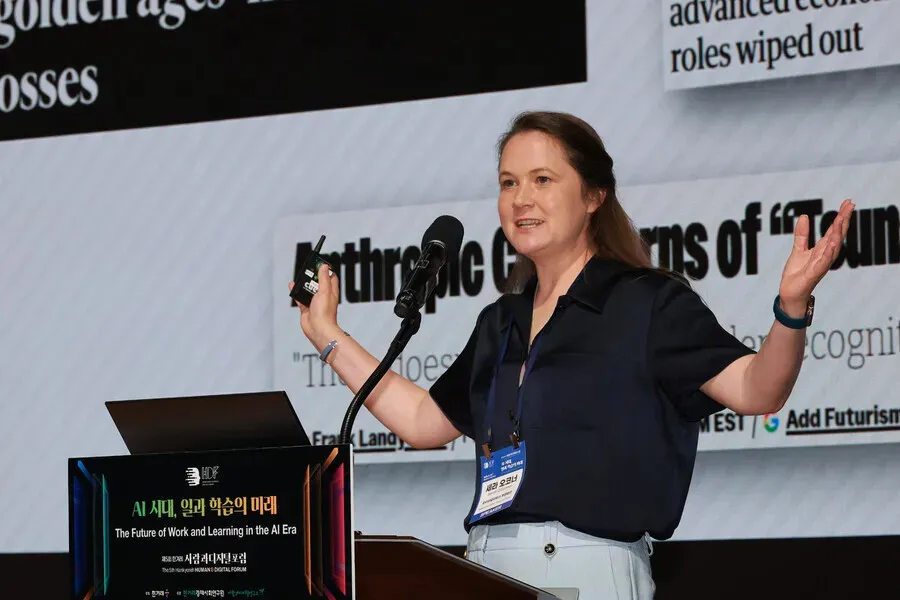
Sarah O'Connor, a columnist and associate editor at the Financial Times, speaks at the fifth annual Hankyoreh Human and Digital Forum, held at the Korea Chamber of Commerce and Industry in Seoul’s Jung District on June 24, 2026. (Jung Yong-il/Hankyoreh)
AI is often portrayed as an unstoppable tsunami sweeping away everything in its path. But this kind of metaphor does little more than frame change as something inevitable. In the process, it casts people as passive bystanders — individuals who can only react once the wave has already hit.During her keynote speech titled “AI Transition and Deepening Inequality: Who Bears the Cost and How Should It Be Shared?” at the fifth annual Hankyoreh Human and Digital Forum, Sarah O’Connor, a columnist and associate editor at the Financial Times, emphasized that humans, rather than technology, should be at the center of discussions about AI and the future of work. She argued that a better future of work is possible, but that it will not emerge automatically.O’Connor posits that in this era of AI determinism, the focus should not be on predictive questions about what can or will happen. Instead, she argues that the key questions are normative and moral ones concerning what ought to be done.She also highlighted that attention should not be limited to quantitative claims about the number of jobs at risk of automation, but should instead focus on the qualitative changes in labor.O’Connor began her presentation with a photo of a scruffy pair of boots that she wore while reporting in the field, using them to underscore the importance of firsthand observation and engagement with workers’ experiences.When sharing her experience interviewing translators, she explained that AI has shifted translators’ roles toward reviewing machine-generated outputs. She also showed that this issue extends beyond translators by introducing research demonstrating how declines in translation quality affect the broader public that consumes translated content.There were also instances in which AI played a more positive role. At a Swedish mine O’Connor visited for reporting, miners strongly opposed management’s attempt to introduce a system that would track the location of all workers in real time.A compromise was ultimately reached through the development of an anonymization feature, and miners subsequently became more receptive to new initiatives, including the adoption of automation technology.O’Connor argued that this example demonstrates how the outcomes of technology depend not only on the technology itself but also on the active role people play in shaping its implementation.She identified three key factors: the voice of the people, concerning who participates in negotiations when digital tools are designed and implemented; the agency of the people, concerning who decides how these tools are used in everyday operations; and the pacemaker, concerning whether the speed of technological adoption is determined by workers, managers or customers.Throughout her speech, O’Connor emphasized that the future of work could become more considerate of human mental and physical well-being and more fulfilling overall, but that achieving such a future would require active effort and struggle.By Han Gui-young, director of the Hankyoreh Human and Digital Research InstitutePlease direct questions or comments to [english@hani.co.kr]