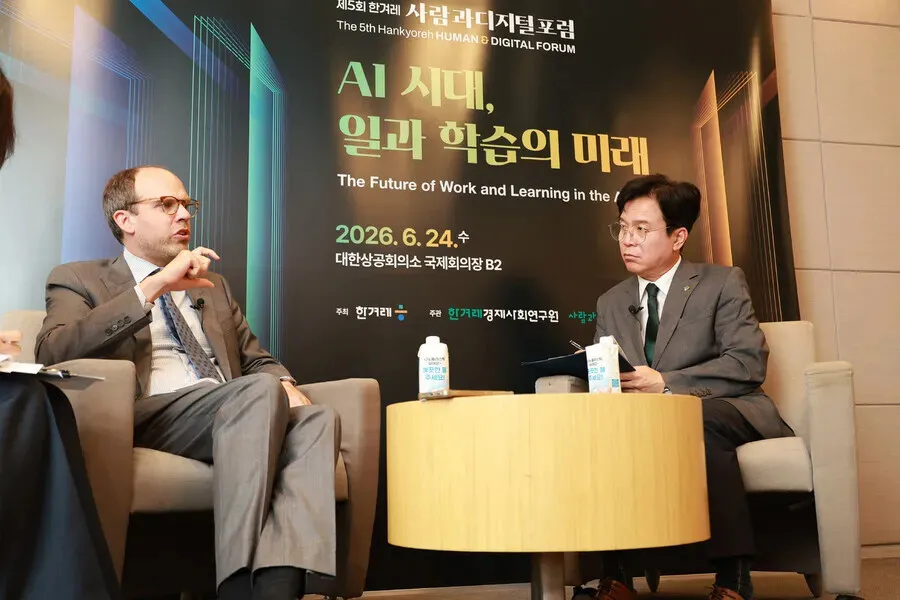
Carl Benedikt Frey speaks to Labor Minister Kim Young-hoon of South Korea on the sidelines of the Hankyoreh Human and Digital Forum held at the Korean Chamber of Commerce and Industry in Seoul’s Jung District on June 24, 2026. (Jung Yong-il/Hankyoreh)
Before he became South Korea's labor minister, Kim Young-hoon drove trains. The steam engine that powered the First Industrial Revolution also sparked a global railroad boom, giving rise to a new profession: the railroad engineer. Will railroad engineers be able to survive in this era of artificial intelligence? It was this question that prompted a conversation between Kim and Carl Benedikt Frey, a professor of AI and work at Oxford University. Frey, an economist who has researched how advancements in technology have affected the labor market since the Industrial Revolution in the 18th century, offered a glimpse of the history of policies that were implemented to reduce the shocks to the labor market during industrial transitions, and Kim asked about the possibility of sustainable reform and societal redistribution. The one-hour conversation between the two took place at the Korea Chamber of Commerce and Industry building in Seoul’s Jung District on the sidelines of the fifth annual Hankyoreh Human and Digital Forum on Wednesday.The following conversation has been edited for length and clarity. Kim Young-hoon: I was, until recently, a train engineer. When wagon drivers’ jobs were jeopardized by the railroads, they resisted fiercely. And now the very job of train engineer may be on the verge of disappearing. If the AI impact we’re witnessing today is similar to the “Engels’ pause” at the beginning of the Industrial Revolution, how do you think governments should act?Carl Benedikt Frey: During the First Industrial Revolution — during Engels’ pause, as you mentioned — workers rioted. And often these workers are portrayed as irrational enemies of progress, but they were not the ones who stood to benefit from technological progress. And so, in that way, their opposition made sense. Obviously, the gains from technological progress need to be more widely shared, or people are rightfully going to resist it.So I think there are three strands of policy that are really important. And the first line of policy response has to do with building a safety net. So during the First Industrial Revolution, Britain had something called the Poor Laws. In regions where the Poor Laws were more generous, you had less resistance to mechanization. And so providing that safety net was critical to the industrialization process itself and helps explain, also in part, why Britain was first industrialized.When Germany industrialized, for example, it did so with more developed educational institutions. Germany had already invested more heavily in elementary schooling. It was building technical schools, engineering schools and business schools. And so, it educated the talent for the new modern economy that was emerging, and that made the transition easier. In Germany, the state took a much more active role in creating the industries of the future, from railroads to the chemical industry to new emerging electrical industries.[We also need to] support the creation of new work more broadly. And so large firms, for example, that already have scale can focus more on increasing productivity in tasks that they are already doing, and that tends to push them towards automation and process improvements. And startups, on the other hand, don’t have scale and so are more likely to invest in creating new products that in turn can lead to new industries that create new types of work.Kim: In the AI era, social innovation should follow AI-driven innovation, and I think the government has an important role to play in that.Frey: So if you look at social spending across the globe, you see that most welfare systems began to emerge in the aftermath of the Great Depression. And so what the Great Depression did is show that misfortune can happen to anybody, and as a result of that, people across the income distribution banded together and demanded social innovation in terms of a welfare state. And if AI has a very broad-based impact on the labor market, I think we will see similar demands for better safety nets and new social innovations building on the welfare systems we developed in the aftermath of the Great Depression.Some places have more peaceful labor relations, and those places benefit from that still today. So in Sweden, for example, the confederation of industry and the unions have now created something called “transition agreements,” which are, in essence, made to help people transition into new types of work, because at the end of the day, that’s helpful for labor, and that’s helpful for businesses as well that need to adjust to new technological realities.Kim: If the Great Depression turned out to be an opportunity for social innovation, could the AI revolution be an opportunity for overcoming crises currently facing Korea, including low-skilled labor and the low birth rate?Frey: Something that we do see quite clearly in the data is that countries that are facing labor shortages because of aging populations are more likely to introduce automation technologies like robots and artificial intelligence to make up for that. So I think that in a way those demographic challenges can become an opportunity for productivity. At the same time, though, AI is not just an automation technology; it’s not just a productivity tool — it’s a technology that is also going to have, most likely, an impact on the social fabric too.And so there’s a big debate around what has been driving the decline in fertility. Part of it, I think, clearly has to do with fewer stable relationships, and part of that may have to do with things like social media, which has meant that more people are replacing social activities with screen time. There’s a risk that AI companionship, which is now becoming more common, is going to exacerbate that tendency. And so while AI as a productivity tool has the potential to help boost productivity to deal with labor shortages, there is a possibility that if we don’t deal with those potential downsides that we’ve seen with social media, AI could actually make that situation worse and lead to more screen time, fewer social relationships, and fewer stable relationships.Kim: I totally agree with you. I’m reminded of how members of the COVID-19 generation who have entered the workforce struggle more with interpersonal relationships than with the work itself.Frey: Another reason that matters is that in the labor market, AI will, if anything, make those social skills more important. So if AI writes your letters, how do you distinguish yourself in such a world? Well, the distinguishing feature is going to be in-person communication. So as AI improves in the virtual space, our ability to communicate with each other will become more important in the labor market. And if people lose those skills at the time when they matter the most, that will be a very significant loss.Kim: Bonus negotiations at Samsung Electronics have recently been a hot-button issue in Korea. When I attended a conference of the International Labour Organization earlier this month, government officials and labor representatives from different countries were all asking me about the bonus negotiations at Samsung Electronics. How can we redistribute the profits generated by AI-driven innovation, especially by the “Big Tech” companies? Is there a way to achieve sustainable innovation while also implementing that redistribution?Frey: I think that often the tension between equity, equality and innovation has been overstated. So if you look in the United States, the most innovative state by far is California. It’s also the state that does the most redistribution in the United States. If you look at innovation in Europe, the country with the most unicorns per capita is Sweden, where labor unions are strong, and where there’s a high degree of redistribution as well.The question of what happens to Samsung and the workers at Samsung is obviously an important question for Korea and the world. Variable compensation has some virtues in the sense that it aligns incentives. It means that workers can benefit on the upside; they have a stake in the company, but it also has downsides in that you share in the losses too. But the bigger question is how we can make sure that the gains from technology benefit the broader population and not just the management or the workers at Samsung.I think, though, that in order to make the productivity gains from AI more widely shared, it is important to look beyond individual companies, because no employee or no country wants to be too dependent on one or a few firms. So rather than thinking about workers and the population taking a stake in individual companies, I think a more broad-based equity stake through the pension system, for example — as has been done in Sweden — provides fewer perverse incentives and provides less dependence on one or a few firms and their performance.And I think going forward if AI ends up driving down the labor share of income and more and more of income takes the form of profits across many different industries, then I think that is the direction that many societies will need to take. And so finding ways of making the gains of AI broadly shared, but not in an anti-competitive manner, is the key task facing governments.How does the tax code, particularly in Korea, need to change in response to that? And then how can we make sure that some of those tax dollars actually find the workers that lose out in technological progress? Kim: In order to avoid an “Engels’ pause,” there needs to be social innovation, and central to that is the tax code. Workers are producers and taxpayers as well as being consumers, and the tax codes and social security systems of modern nations have been devised based on that. But AI is overturning this very premise. We absolutely must rework tax and social security systems that had been created on the premise of traditional employment relations, and that social discussion needs to start now. The first step in that direction is addressing the question of how we are going to socially redistribute the surplus tax revenues generated by chipmakers like Samsung and SK Hynix. That’s a discussion that’s currently underway between the Ministry of Labor and Employment, the Ministry of Economy and Finance, and the Blue House’s policy office. From my perspective as labor minister, the people that society needs to be reinvesting in are those who are bearing the brunt of the impact of AI: young people, those engaged in a variety of new forms of work, and the people who are not protected by our existing unionization laws. When young people who struggle to even get their foot in the door to work start to feel like technological innovation will do nothing for them, that’s when they may become the strongest force of resistance against it. Policies that support young people aren’t handouts; they are the most tried and true reinvestment for the future of our country, and an investment in sustainable innovation. It’s the government’s job to respond to young Koreans who say that their lives haven’t gotten any better despite the stock market reaching historic new highs. What is an “Engels’ pause”?Engels’ pause refers to a phenomenon witnessed during the early decades of the Industrial Revolution in Britain in which working-class wages stagnated or even fell despite rapid advancements in technology. The term was coined by the American economic historian Robert Allen, who was inspired by Friedrich Engels’ work on the miserable living conditions of workers in the 19th century. Experts including Frey say that care needs to be taken in this era of AI transition so as to avoid a 21st-century redo of Engels’ pause, and that core to that will be social redistribution of profits generated by increases in productivity. By Lee Ju-hyun, By Lee Ju-hyun, Hankyoreh Human and Digital Research Institute staff writerPlease direct questions or comments to [english@hani.co.kr]