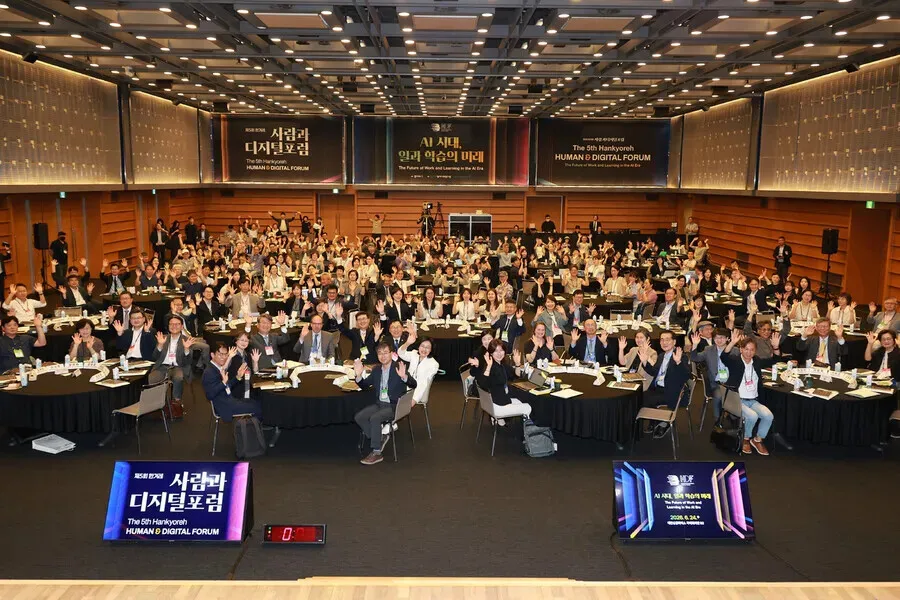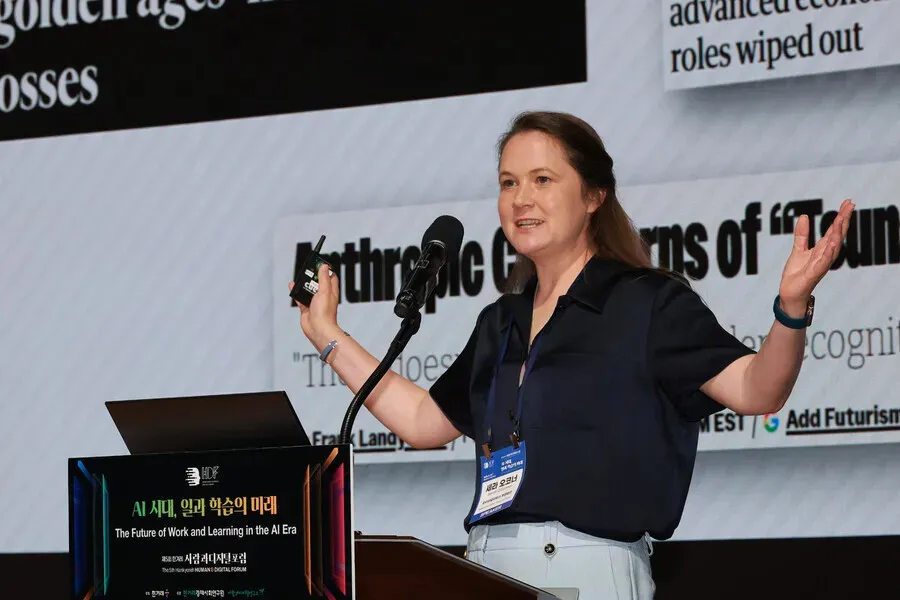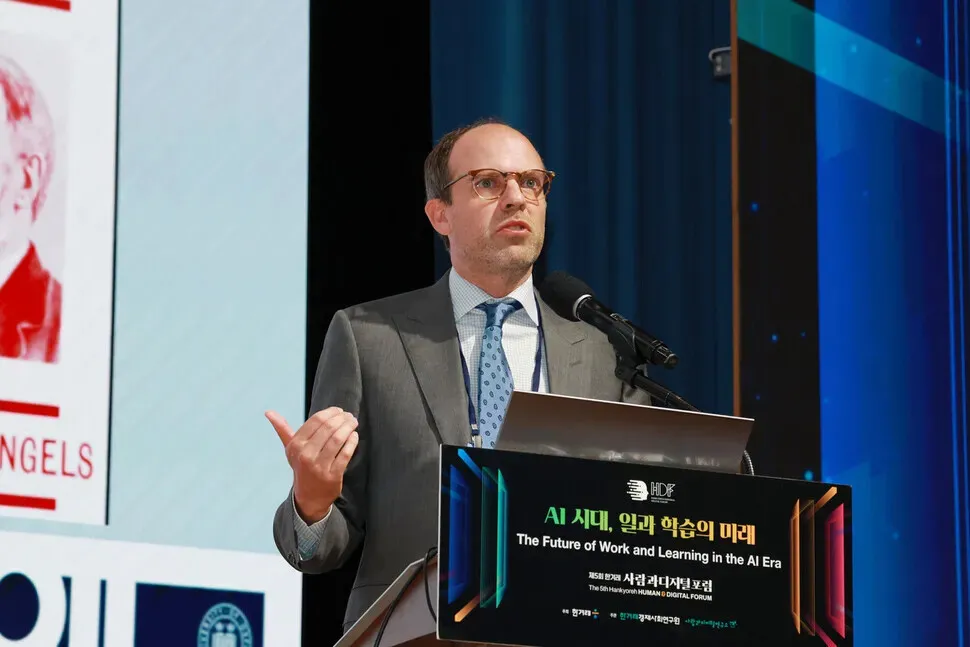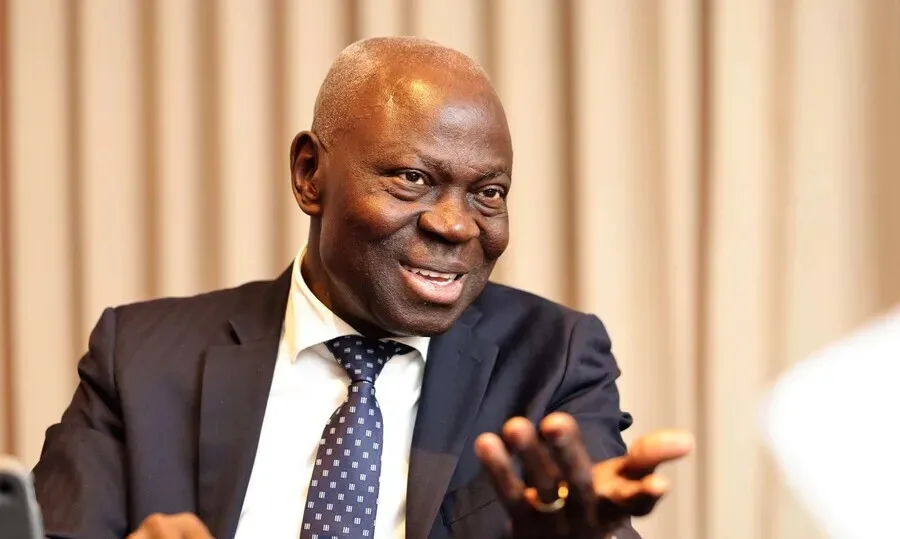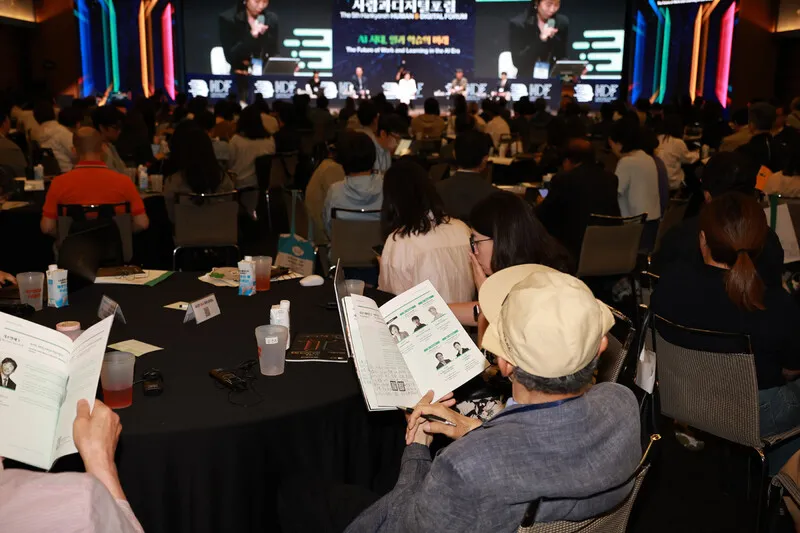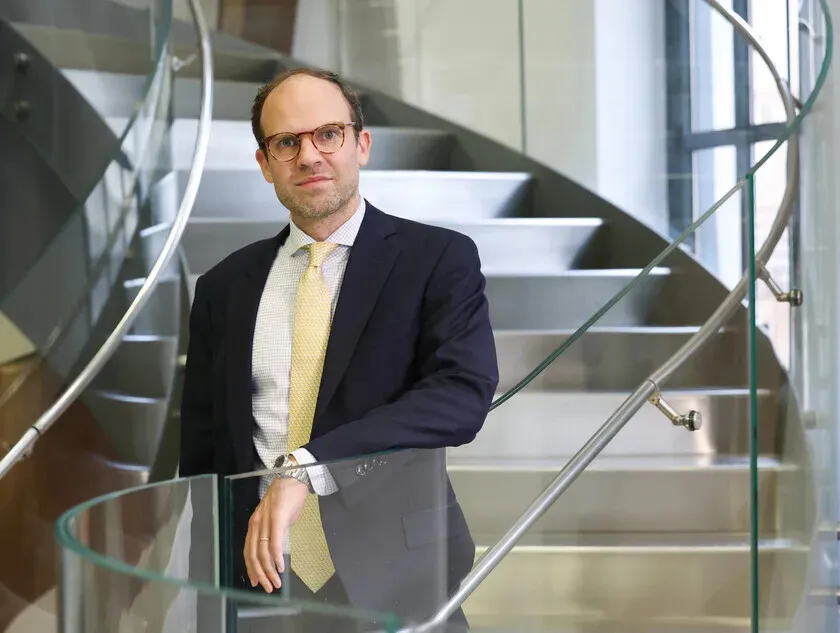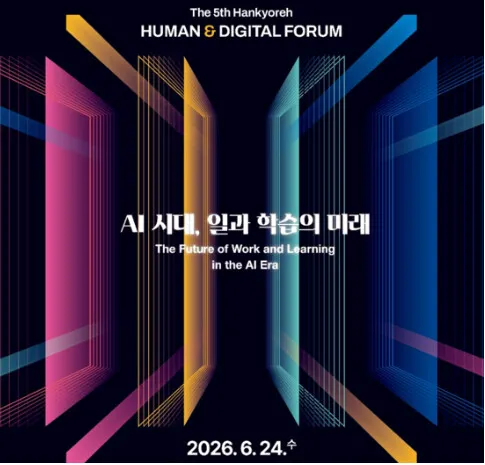
The fifth annual Hankyoreh Human and Digital Forum, a gathering for exploring how technology can put people first, will be held on June 24 under the theme “The Future of Work and Learning in the AI Era.”The forum will gather experts from Korea and around the world to consider new approaches and solutions in an era when generative AI is reshaping the job market and disrupting traditional education.The automated teller machine has been a major driver of automation in bank work. When large numbers of ATMs were adopted by Citibank in the US in the 1970s, many predicted the new technology would eliminate the job of bank teller.The basic logic behind the prediction was that an ATM could do a teller’s job for 27 cents on the dollar, and four times as fast.But that prediction didn’t come true. The number of bank tellers in the US actually increased between the 1980s and the early 2000s.Since ATMs lowered the cost of doing business, banks were able to open more branches. And instead of handling cash, tellers pivoted to relational finance: building trust with customers, handling credit card loans and brokering investment products.So in this case, automation served to complement human labor, enabling jobs to be maintained and even expanded.In the end, the decline in bank teller jobs was driven not by the ATM, but by the iPhone. As mobile banking was widely adopted in the 2010s, the number of tellers fell by nearly 30%.What this case study shows is that the relationship between automation and employment is not linear. In addition, the outcome of a given technology depends both on its context and on the institutions in place at the time of its adoption.The forum’s first keynote speaker is Carl Benedikt Frey, a professor at Oxford University and world-renowned economist who argues that whether AI will create or eliminate jobs depends less on the technology itself than on the institutions and political decisions that shape its use. An article he published in 2013 sparked widespread debate about the future of jobs when he claimed that 47% of US jobs could be susceptible to automation. In his lecture at this year’s forum, titled “Designing the Future of Work in the AI Transition: Conditions for Good Jobs and Sustainable Progress,” he will discuss how, in an era when technological change is threatening people’s livelihoods, we can draw lessons from history to overcome fear and anxiety and better navigate the transformation of human labor. For example, the Industrial Revolution of the 18th and 19th centuries led to the industrialization of the entire manufacturing sector in the UK, but did not have the same effect in France. This difference was caused by political and social contexts and institutions such as parliamentary democracy and the political power of the capitalist class. The UK experienced fierce backlash in the form of the Luddite movement, which inevitably failed because of the workers’ lack of political power. As a result, workers in Britain experienced seven decades of grueling hardships and job displacement before eventually reaping the benefits of the Industrial Revolution. In contrast, French workers managed to protect their jobs through resistance, though this also slowed the country’s process of industrialization. Frey argues that the impact of generative AI on jobs is determined not by the technology itself, but by human decisions — including political choices, institutions, regulations and the balance of power between those who benefit from AI and those who bear its costs. He also argues that true progress is possible only when the benefits generated by technology are distributed fairly, ensuring that the pain of transition is not concentrated among specific groups. The second speaker at the forum will be Sarah O’Connor, associate editor at the Financial Times, who will give a talk titled “AI Transition and Deepening Inequality: Who Bears the Cost and How Should It Be Shared?” Drawing on her experience covering the frontlines of technological change — where translators now do nothing more than edit AI translations, retail workers work alongside robots, and recent graduates are being interviewed by AI software as they enter the workforce — O’Connor will examine the shift in job quality in recent years. She poses the following questions: Could we say that machines are not so much taking jobs away, but that workers are being fitted into systems for machines? And if so, does this mean that basic questions of fairness, talent, and humanitas are being redefined within the logic of those systems and their algorithms? By examining efforts by workers who have sought to secure humane working conditions while combating the rise of machines, from British cotton workers in the 19th century all the way to Swedish miners in the 21st, O’Connor explores ways to resist algorithms. After their keynotes, Frey and O’Connor will take part in a roundtable discussion on “Rewriting the Rules of the AI Transition: Designing Institutions and Solidarity” moderated by Lee Sang-heon, the chief economist at the International Labour Organization.The speakers will be joined by Chang Ji-yeun, a senior research fellow at the Korea Labor Institute, for a lively debate on how profits resulting from increased productivity in the AI transition should be divvied up, as well as sharing examples and experiences from their respective countries on how to ensure a fair transition that does not disproportionately burden vulnerable and marginalized groups.The forum will also feature a session dedicated to discussing the sorts of changes that professionals are seeing in their own workplaces and elsewhere. “The Changing Workplace: How Can We Work with AI?” moderated by Park Young-sun, the chairperson of the Strategic Economic Advisory Committee, will invite experts on the vanguard of change to share their personal experiences of working with AI. Participants in the roundtable include Eum Sung-won, the head of Korea communications for OpenAI; Hong Sung-joon, the chief design officer at BankSalad; Lee Deok-man, the head of the AI & Robotics Convergence Research Institute at POSCO Holdings; and You Jae-youn, who chairs the social division of the Presidential Council on National AI Strategy. Following lunch, the author Chang Kang-myoung, known for his novel “The Future that Arrived Early,” will deliver a special lecture sure to make you think about the future of work by examining the shifts that have taken place in the Go community since AlphaGo changed everything. For more details, see the forum’s English website: https://enhdf2024.imweb.me/ By Han Gui-young, director of the Hankyoreh Human and Digital Research InstitutePlease direct questions or comments to [english@hani.co.kr]
Hankyoreh Human and Digital Forum to explore future of work and learning in AI era
The 5th Hankyoreh Human and Digital Forum will bring experts from around the world to Korea to discuss and debate the implications of the AI transition for how we work and learn
1,076 words~5 min read