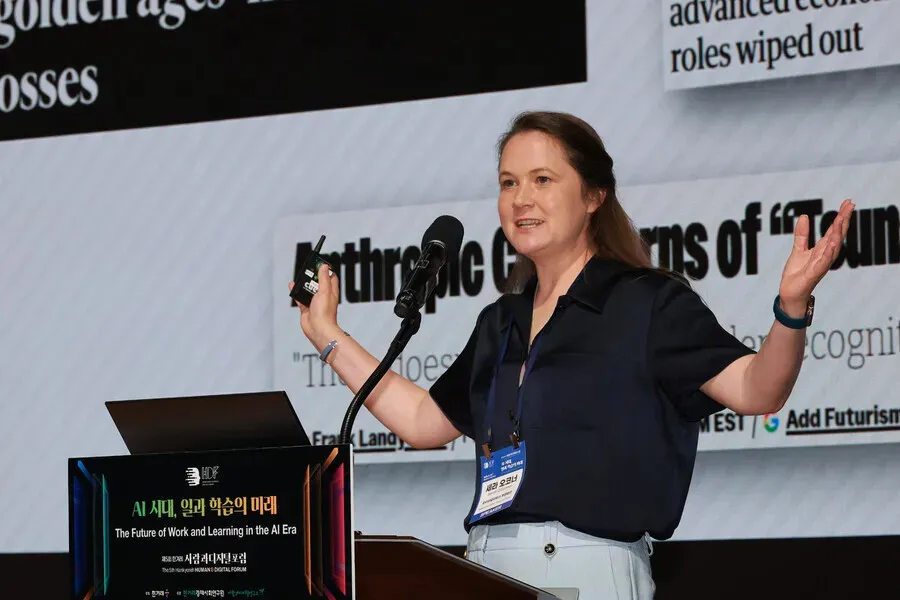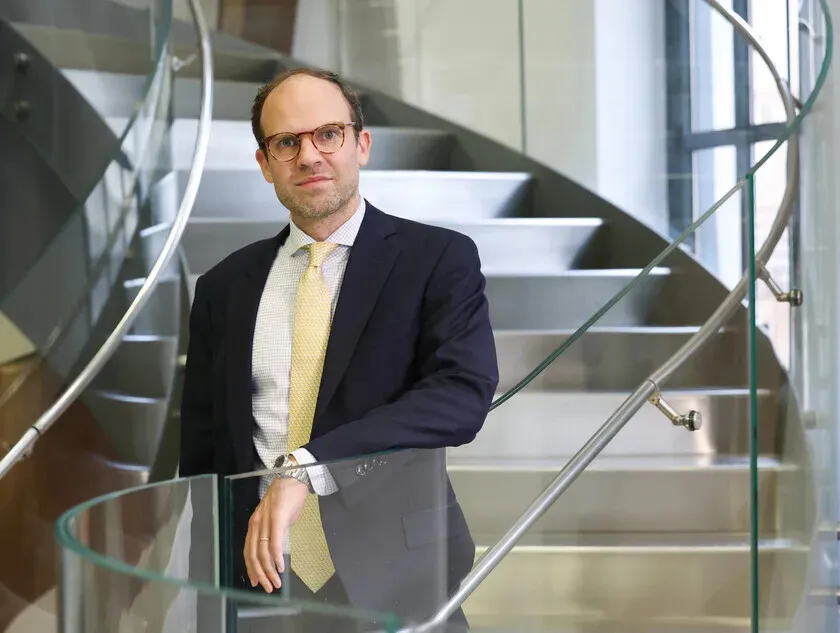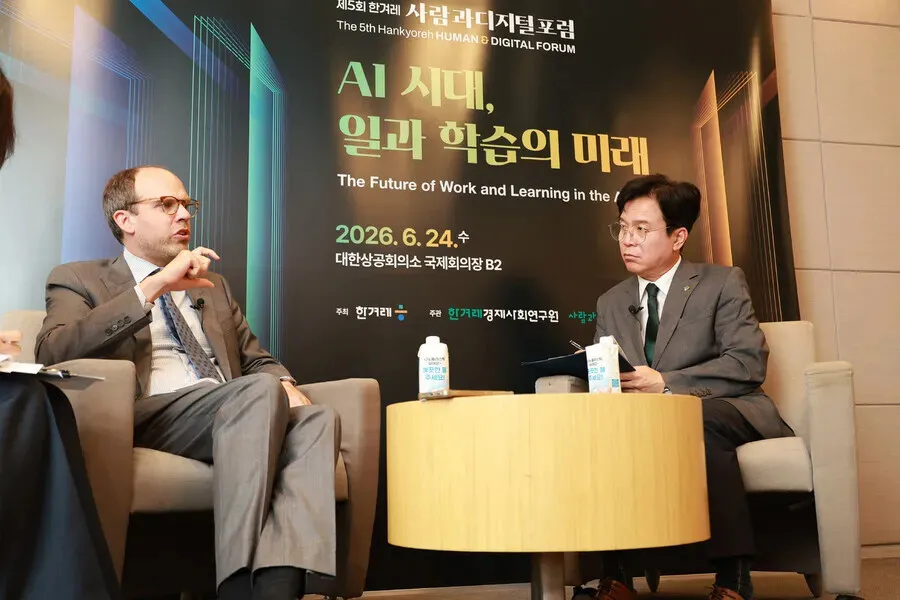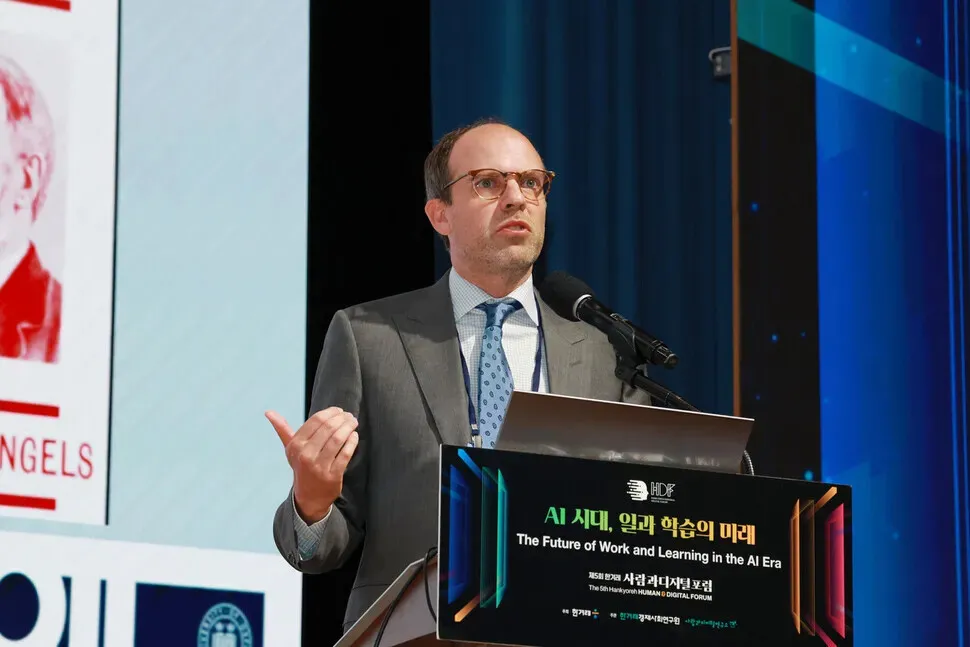
Carl Benedikt Frey speaks at the fifth annual Hankyoreh Human and Digital Forum held at the Korea Chamber of Commerce and Industry in Seoul on June 24, 2026. (Kim Hye-yun/Hankyoreh)
Carl Benedikt Frey is a world-renowned Oxford University professor who has been a leading voice in the debate over the future of employment. Over the past decade, he has analyzed the effects that automation has on the labor market.For the fifth annual Hankyoreh Human and Digital Forum — which took place at the international conference hall of the Korea Chamber of Commerce and Industry building in Seoul’s Jung District on Wednesday — Frey delivered a keynote speech titled “How Societies Can Avoid the Technology Trap.”In his presentation, he underscored the transitional nature of the current moment. Because of the time needed for the benefits of technological change to reach ordinary workers, he stressed, the future of work will hinge on how well the transitional period is managed through a robust social safety net.The “technology trap” that Frey warned of is a situation where technology ends up mostly benefiting a minority, which leads to widespread popular resistance that ultimately becomes an obstacle to innovation.The economist John Maynard Keynes shared the optimistic perspective that while technological advancements might cause unemployment in the short term, they resolve economic problems and liberate people from work in the longer term.But a look at post-Industrial Revolution history shows that it has often taken decades for the benefits of technology to reach ordinary workers. This creates a paradoxical phenomenon where wages for the lowest earners fall even as labor productivity greatly increases.Frey observed that when the benefits of new technology are not equally distributed and the transition is not properly managed from the outset, this can lead to resistance to technological change, as exemplified historically by the Luddites. In such a situation, long-term gains might not even come to pass, he suggested.A similar situation unfolded with the computer revolution in the late 20th century. In the US and other advanced economies, the adoption of new technology led to productivity improvements, but wages did not rise proportionately for workers. Instead, the gains from automation went primarily to investors and highly skilled workers.Frey also noted that the nature of workers’ lives varies with the kinds of technologies that humans adopt.Examining post-Industrial Revolution history, he observed that examples of “labor-replacing” technology — in other words, technology that works to substitute existing workers with machinery — have tended to increase hardship for workers, while quality of life has improved for workers in cases of “labor-enabling” or supplementary technology, where worker capabilities are enhanced in ways that increase both productivity and wages simultaneously.While Frey’s stance on technology was cautious, he shied away from outright pessimism.Many of today’s jobs did not exist in the 1940s. A large number have been newly created, including those of IT technicians, social media managers and data scientists.Frey consistently maintained that while AI can indeed create new industries and jobs, ensuring justice in that transitional process will require a robust social safety net to protect workers from suffering.Historically, resistance to mechanization has been weaker in countries that had laws in place to protect poor people. Anxieties toward AI are relatively lower in countries with strong social safety nets, such as the nations of northern Europe.At the same time, Frey stressed that social inclusiveness should not be allowed to become an obstacle to creative destruction. Observing that the lack of technological progress and automation can lead to societal stagnation and make conditions worse in the medium to long term, he emphasized the importance of taking advantage of economic growth potential while minimizing downward risks as much as possible.He also underscored the importance of human agency, noting that the effects of automation on human society are not dictated by technology alone but hinge on human political choices about what to automate and what kind of society is desired.By Han Gui-young, director of the Hankyoreh Human and Digital Research InstitutePlease direct questions or comments to [english@hani.co.kr]