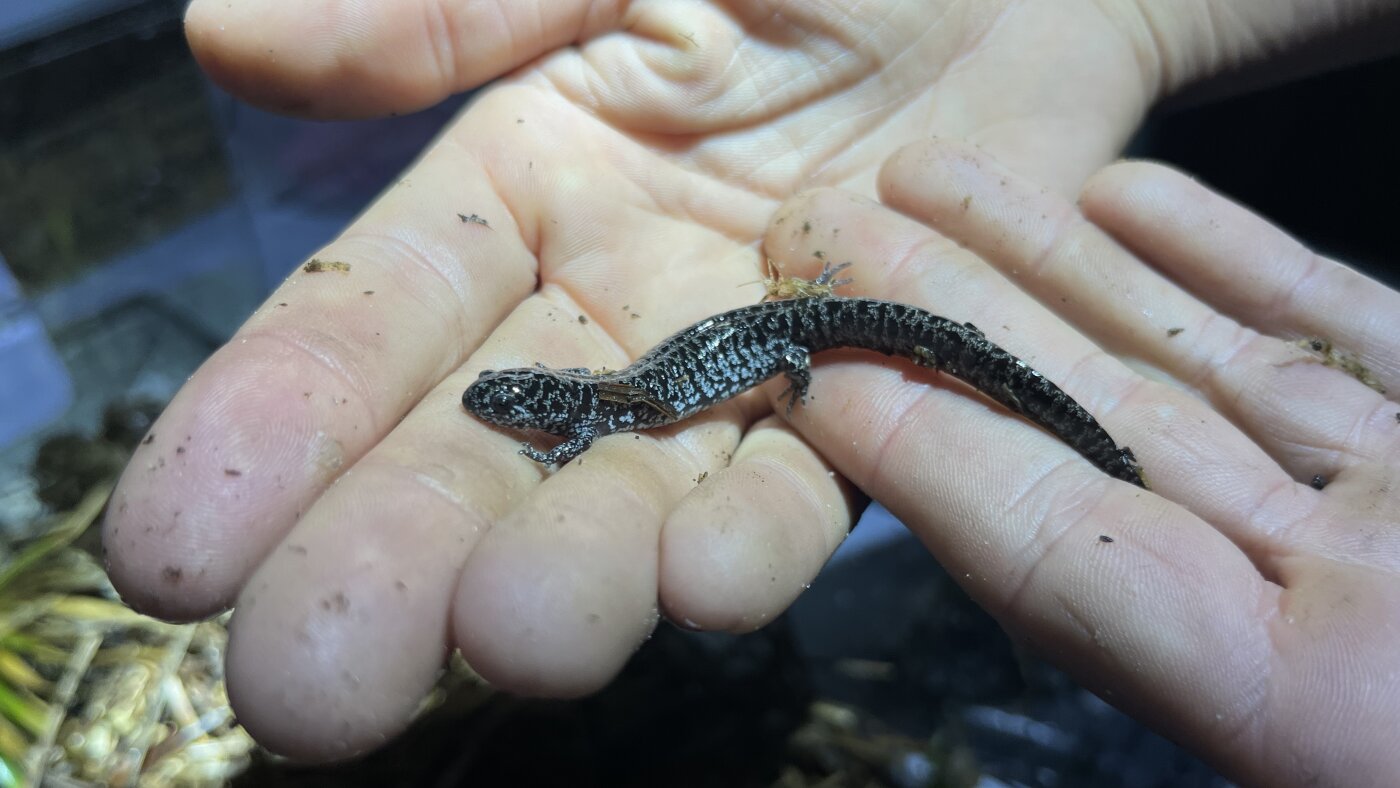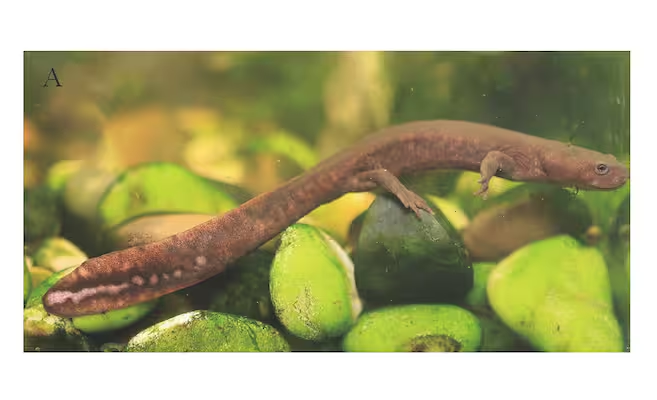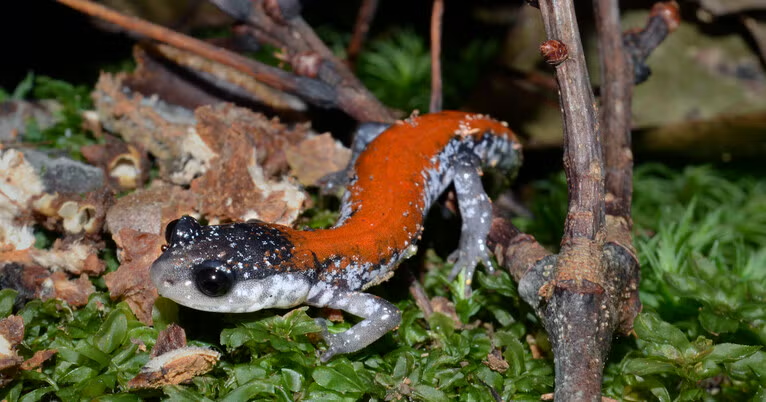
For her doctoral dissertation, Yale’s Nathalie Alomar decided to study a small amphibian that appeared to have eluded the forces of evolution.She found that there is more to its evolution than meets the eye. In a new study, Alomar and a team of scientists report that the story of the common woodland salamander — long considered a classic example of “evolutionary stasis,” meaning that it has evolved into many species without changing its overall structure much at all — is more complicated than previously believed. For the research, the team collected nearly 300 individual woodland salamanders — which are from the genus Plethodon, and ubiquitous in forests of the eastern United States — representing 30 distinct species. And while these animals looked quite similar, a subsequent laboratory analysis found that aspects of their physiology differed substantially.
From left: Raíssa Rainha, Laura Alencar, and Nathalie Alomar at Cloudland Canyon State Park, Georgia.
Photo by Nathalie Alomar
Specifically, traits such as resistance to water loss, metabolic rate, and cold tolerance varied widely among the species, who appear to have evolved rapidly and differently largely in response to the climate of their habitats, they found. The findings, published in The Proceedings of the National Academy of Sciences of the United States of America, challenge the widespread notion that evolutionary diversity can be judged primarily by an organism’s appearance.Critically, they found, important physiological adaptations can occur even when body shape remains relatively unchanged. The project was part of a wider research program led by Martha Muñoz, an associate professor of ecology and evolutionary biology in Yale’s Faculty of Arts and Sciences. “Many Plethodon species can look almost indistinguishable from one another, even when they come from very different regions,” said Alomar, a Ph.D. student in Yale’s Graduate School of Arts and Sciences. “But in the lab, I started noticing subtle differences, and it was exciting to see those qualitative impressions reflected in the quantitative patterns we found in the data.”