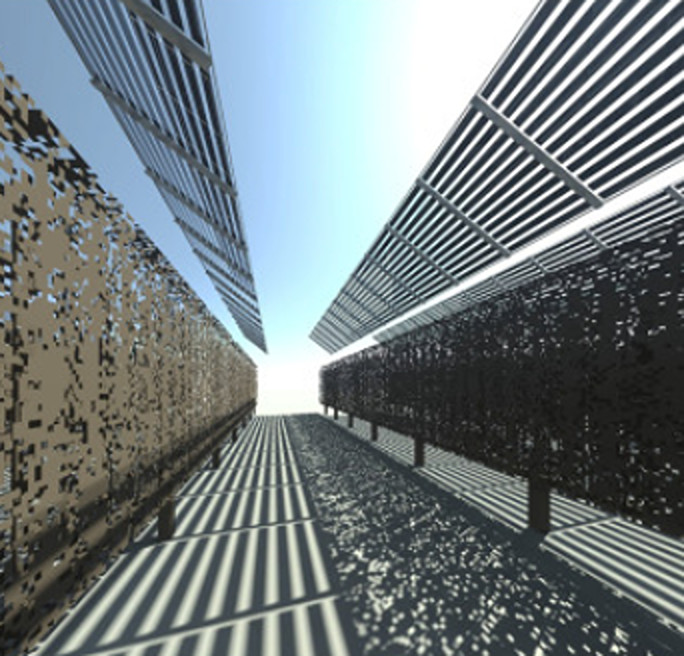
A Delft University of Technology team has improved agrivoltaic light-simulation methods by making atmospheric and canopy representations more realistic and computationally efficient. Their work enhances the accuracy of predictions for crop growth and solar energy yield in shared land-use systems, supporting better system design and optimization.
A research group at Delft University of Technology in the Netherlands has extended and improved light-simulation workflows for agrivoltaics (agri-PV) applications, with a focus on more realistic and computationally efficient representations of atmospheric conditions and crop geometry. This advancement is important because more accurate and scalable simulations improve the reliability of predictions for both crop yield and solar energy production in shared land-use systems, thereby reducing design uncertainty and supporting more effective optimization of sustainable food–energy integration.
“Our Python framework fills two gaps,” corresponding author Odysseas Alexandros Katsikogiannis told pv magazine. “First, Radiance’s spectral handling was primarily limited to the visible band, whereas we add site-specific sun and sky spectra across the entire solar spectrum—which matters for PV performance. Second, most simulations treat the sun as a single point, producing sharp-edged shadows; instead, we render soft shadows (penumbra) efficiently, which matters for crops below semi-transparent PV modules.”