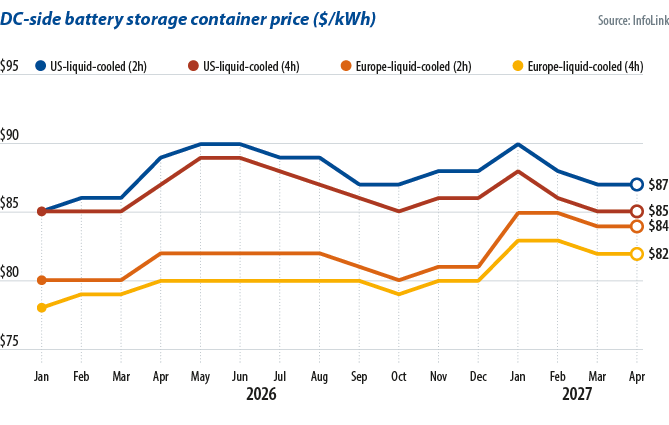
Battery storage has seen an incredible turnaround over the last decade, moving from a curiosity of the power grid to a potentially dominant tool in grid flexibility. Plummeting battery costs have bolstered the economic case for solar photovoltaics, when paired with batteries, as a baseload power supply source. Batteries' shifting role from mainly filling supply gaps at times of peak demand or absorbing excess renewable supply to one more fundamentally supportive of grid-scale power has potentially big implications for future gas demand — even in places where gas is cheap, like the US. Battery costs globally fell by over 90% between 2010 and 2025, mostly driven by economies of scale from electric vehicle manufacturing. That has enabled low-carbon power technologies like solar and wind — long derided for their inherent intermittency — to become much more reliable supply sources at scale. In California, batteries now supply more than 60% of hour-to-hour power-ramping needs, up from less than 1% just a few years ago. By end-2024, 47% of the almost 1,000 gigawatts of solar capacity waiting for grid connection in the US was paired with batteries, including 93% in California, according to Lawrence Berkeley National Laboratory data. Consultancy DNV projects that by the mid-2030s, roughly half of all new solar installations worldwide will be paired with storage, up from 7% today. By midcentury, DNV expects a similar proportion of total global solar capacity will be co-located with storage, up from 2% now. The Mideast, India, Southeast Asia and sub-Saharan Africa will have more solar with storage than standalone solar by then, DNV reckons.
Falling Battery Costs Push Solar Toward Baseload Viability
Battery storage now allows for greater grid flexibility from intermittent sources, with potentially large implications for gas demand.
262 words~1 min read