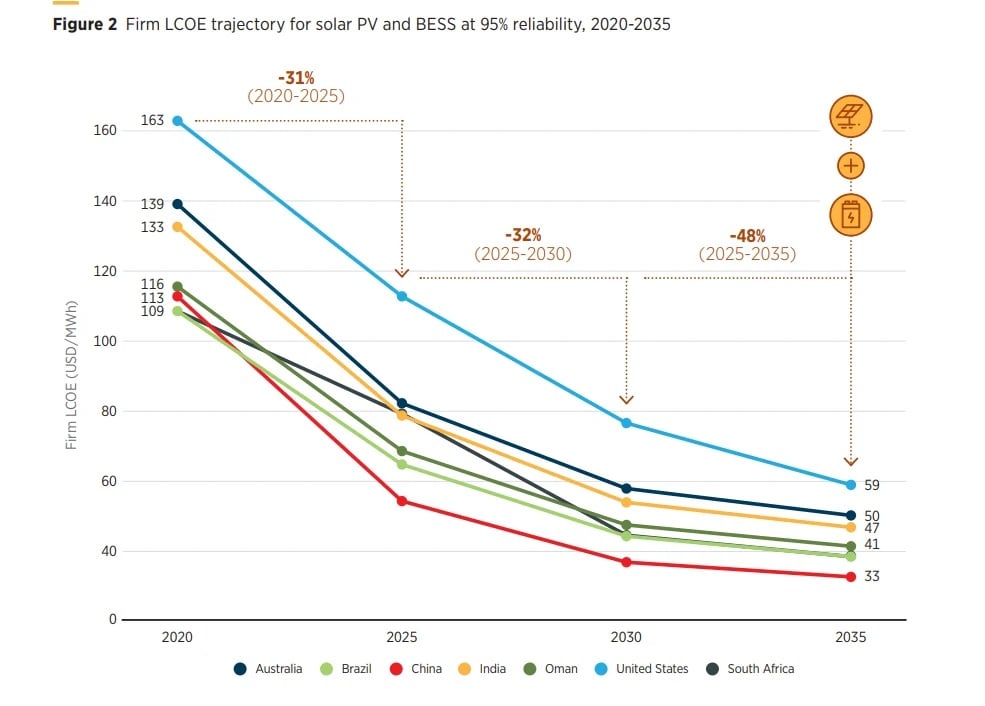
Wood Mackenzie presented modelling for Ukraine, Ghana, and the Netherlands showing that 300 MW solar-plus-storage systems can deliver competitive, baseload-like power across very different grid contexts. Across all three countries, hybrid PV-plus-storage consistently outperforms conventional coal and gas in LCOE terms, highlighting faster deployability, strong cost declines, and superior resilience versus long-lead-time fossil infrastructure.
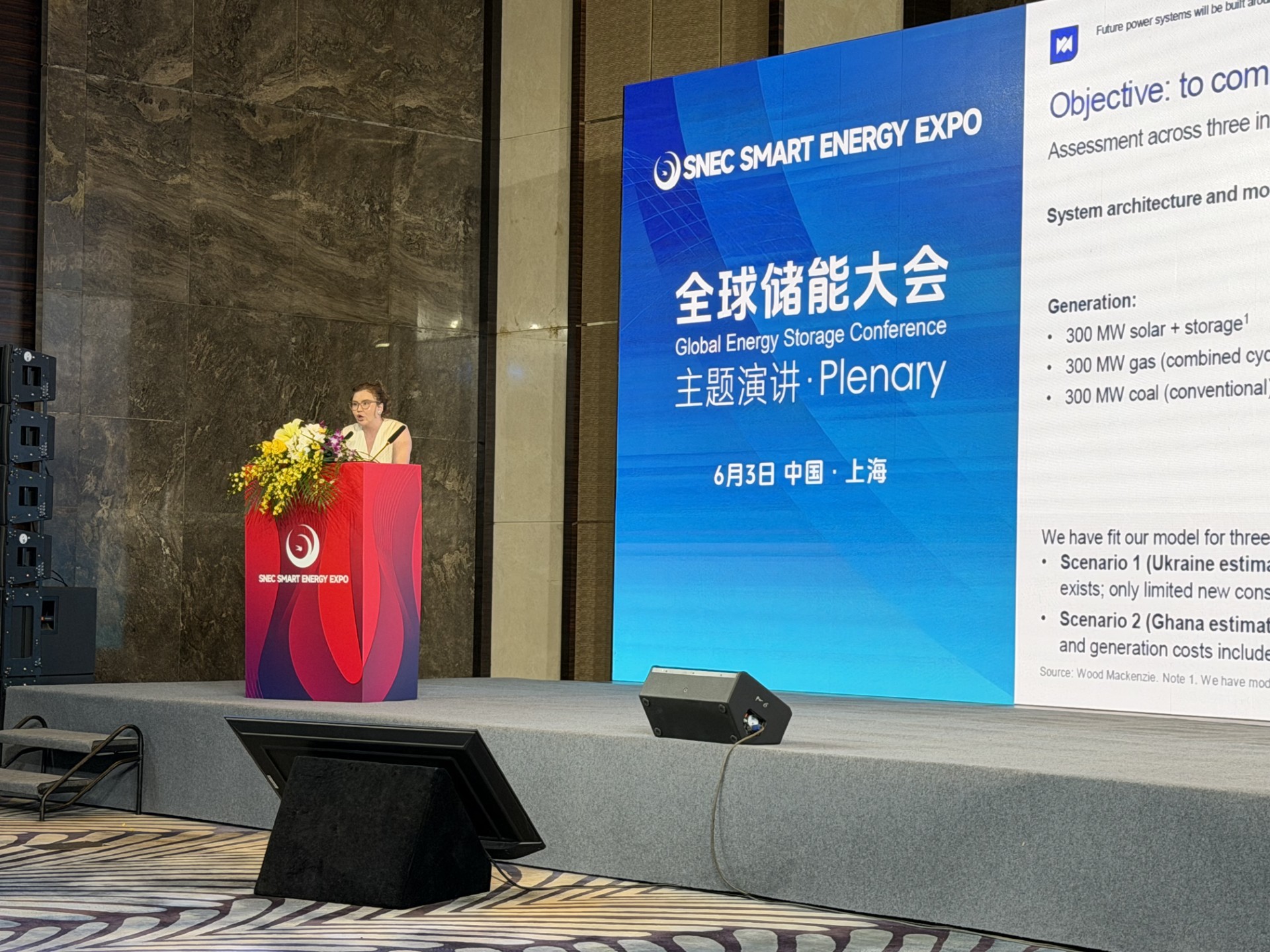
At last week’s Global Energy Storage Conference Plenary at the SNEC trade show in Shanghai, China, Yana Hryshko, Head of Global Solar Supply Chain at Wood Mackenzie, spoke about the very attractive potential of solar and battery storage to deliver baseload power in a wide range of markets around the world. Specifically, the team at Wood Mackenzie has modelled three scenarios for Ukraine, Ghana and the Netherlands. For each country two solar-plus-storage deployments were considered, one for 4-hour storage and the other for 12 hours, along with conventional energy deployments of combined cycle gas and coal.
Since Hryshko hails from Ukraine and Ukraine has shown remarkable resiliency in its energy infrastructure despite an almost ten-fold increase in Russian attacks this year compared to last year according to a recent report in the German daily Frankfurter Allgemeine Zeitung, the country has largely kept its lights on by relying on PV-plus-storage microgrids to provide power for extended periods. As Hryshko points out, these microgrids can tap into existing transmission grid infrastructure, thereby reducing the capex required to build these microgrids.